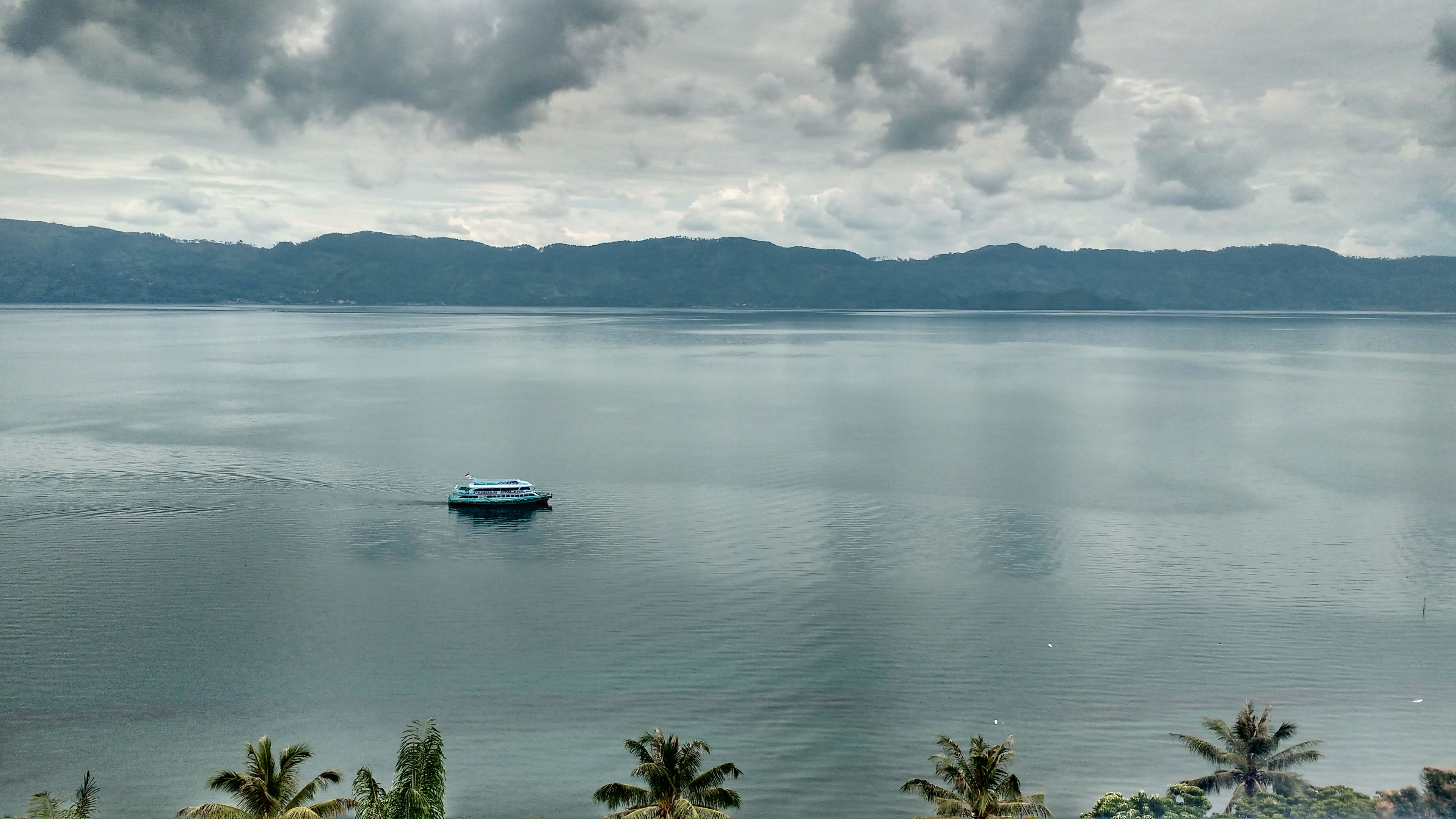
Lake Toba
When coffee steam is warmer than the wind off the caldera.
Lake Toba is a silence held inside a crater so large it changes your sense of distance.
It isn’t a lake you circle quickly; it’s a lake that keeps receding, like a thought you can’t finish.
People come for the scale, then stay—if they let themselves—for the small human pauses around it.
The Overlook Stalls Between One Photo and the Next
On the road above Lake Toba, the overlooks have their own small economy: a few plastic stools, a kettle that never seems to cool, a row of instant coffee sachets pinned like flags. Most visitors treat these stalls as a brief stop—camera out, lake behind, engine still running. What gets missed is the way the lake arrives through sound and smell first. Coffee steam thickens in the cool air, clove smoke drifts from a quiet cigarette, and the conversations are low, practical, unperformed. From here the water looks calm in a way that feels engineered, as if the caldera walls are holding it in place. If you wait, the scene changes without announcing itself: a motorbike stops, someone points not at the lake but at a cloud snagged on a ridge; a vendor rinses a glass and the faint clink becomes the loudest thing. The overlook becomes less like a viewpoint and more like a threshold—between the fast road and the slower, deeper time of Toba.
The Ten Minutes After the Wind Lets Go
Lake Toba transforms in a very specific window: when the afternoon wind drops before dusk and the surface stops scuffing itself into matte grey. It can happen suddenly—one minute the water is textured and restless, the next it begins to hold shapes. From the overlook stalls, you feel it first on your skin. The air stops pushing. The coffee steam rises straight up instead of sideways. In those ten minutes, the caldera becomes legible. The far rim sharpens; villages on Samosir appear as small pale marks; the shoreline stops trembling. Even the road noise seems to thin, as if it has more room to leave. If there’s haze, it lifts just enough to separate layers—near slopes dark, far slopes blue, then the faintest line of sky. People tend to hurry past because nothing “happens.” That’s the point. The lake doesn’t perform; it settles. If you’re still, your attention settles with it, and the overlook stops being a stop.
The Reflections
When the wind eases, Toba reflects in large, calm slabs rather than crisp mirror-lines. The caldera rim appears as a softened dark band, and the brightest reflection is often the pale sky, not the mountains.
The Water
The water shifts between deep slate-blue and a muted green-grey, depending on cloud cover and angle from the rim. In clearer dry-season light, it leans bluer; in humid afternoons it takes on a milkier tone as haze flattens contrast.
The Landscape
Everything is framed by the caldera: wide, protective walls with ridges that catch cloud and hold it. Samosir Island sits in the middle like a slow interruption, turning the lake into layered distances rather than one open bowl.
Best Angles
Tele Viewpoint (near Sidikalang road approach)
Stand slightly off the main pull-in, nearer the stall edge; face toward Samosir with the caldera rim layered behind it. Frame the lake with a strip of roadside railing or roofline to keep the human scale.
Simarjarunjung ridge pull-offs
Use the ridge height to show depth: foreground tea/coffee stall silhouettes, midground lake, far rim fading into haze. Best when clouds sit low and the far shore goes blue.
A stall doorway or tarp opening at an overlook
What creators usually miss: shoot from inside the dim stall toward the bright lake, letting cups, kettle, or a hanging sachet line become the frame. The lake feels farther, quieter, more real.
The bench facing away from the busiest photo spot
The intimate angle: sit where you can hear the kettle and the road at once, and watch the lake indirectly—through peripheral vision. It’s less about the image, more about letting the scale soften you.
Crowd pattern — busiest from late morning to mid-afternoon when tour vans stop for quick photos; quietest early morning and the last hour before dusk.
Effort level — minimal walking but frequent stepping in and out of vehicles; the main effort is patience and standing in cooler wind on exposed roadside edges.
Access note — no permits for typical roadside overlooks; some stalls expect you to buy a drink if you use seating, and parking may be a small informal fee.
What to bring — a light jacket for rim wind, small cash for coffee/snacks/parking, and a cloth to wipe lens haze if humidity is high.
Handpicked Stays & Tables
Places chosen for beauty and intention, not algorithms. Each one is worth your time.

Taman Simalem Resort
Merek, northern Lake Toba highlands

Niagara Hotel Lake Toba
Parapat

Maruba Restaurant
Parapat

Overlook coffee stall (Tele/Simarjarunjung pull-offs)
Rim roads above the lake
On Lake Toba’s rim, the clearest view often starts with a cup you didn’t plan to drink.