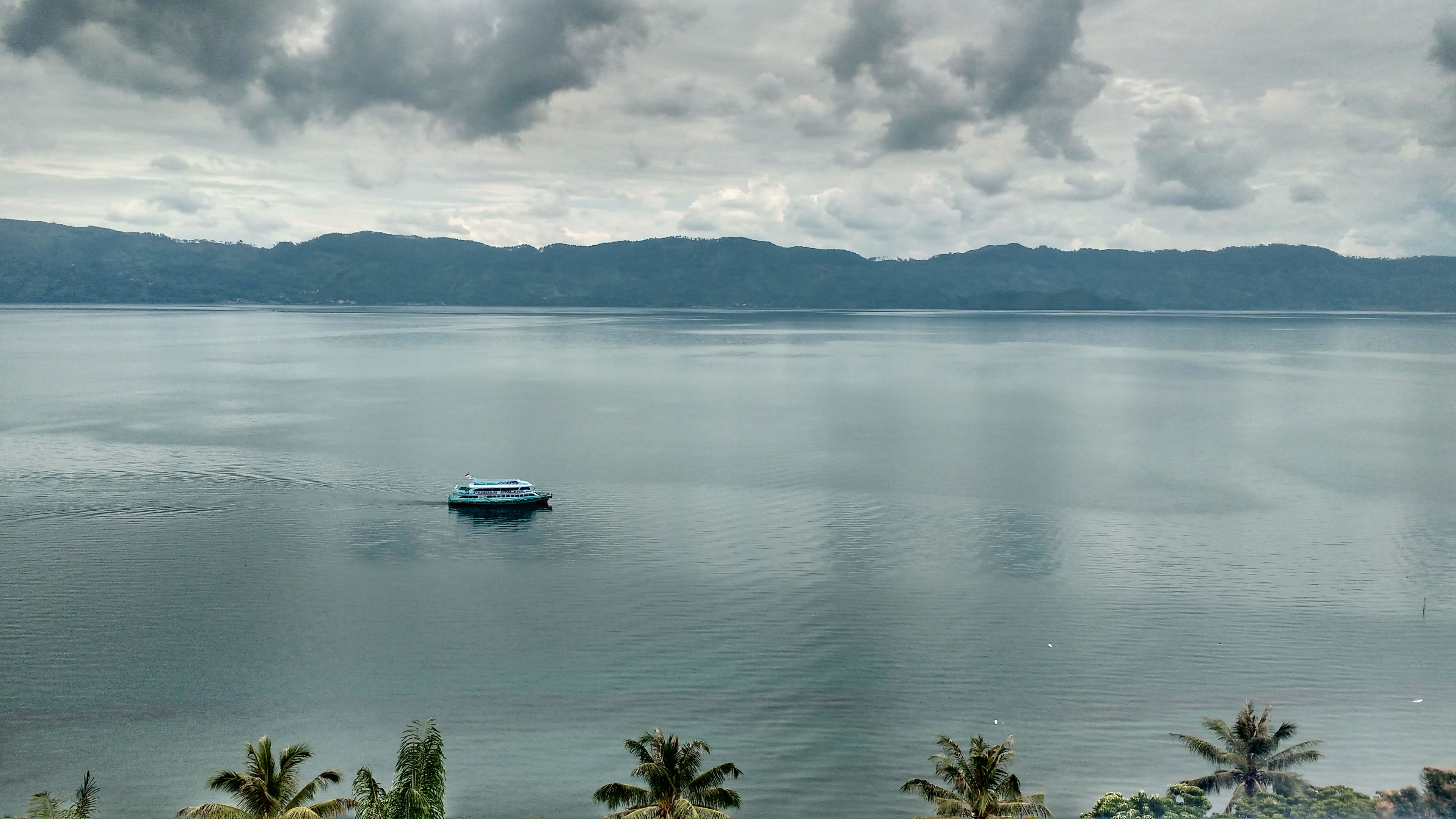
Lake Toba
When the ferry engine goes quiet and the caldera starts to sing.
Lake Toba holds its vastness with a soft, inland patience.
It is a lake with the proportions of a sea, shaped by an old volcanic memory and ringed by high, dark ridgelines.
It pulls you in not with spectacle, but with the feeling that time here moves on deeper tracks.
Beyond the Tuk Tuk Jetty, After the Last Wake
Most visits to Lake Toba happen in the orbit of Tuk Tuk: café stools facing the water, ferry arrivals, the easy loop of guesthouses along the shore. But if you keep walking past the jetty—ten minutes, then fifteen—the sound changes. Engines thin out. Cutlery fades. You begin to hear smaller things: sandals on stone, a dog settling, a radio murmuring behind a curtain. The lake surface looks different here, too. Close to the jetty it is always disturbed by wakes, always doing its job of receiving movement. Beyond it, the water starts to behave like a held breath. Smoke from cooking fires on Samosir drifts low and straight when the wind drops, and it gives the air a warm, slightly sweet edge. Across the caldera walls, scattered lights appear one by one, not in a rush. This is the side of Toba that doesn’t perform. It simply keeps its long, quiet attention on the shore.
The Ten Minutes When Blue Hour Finds the Water
Lake Toba transforms in a narrow window after sunset, when the sky has already let go of color but the lake has not yet turned black. It lasts about ten minutes, sometimes less in the wet season when cloud lowers early, sometimes longer in the dry season when the air clears and holds light like glass. In that moment the caldera stops reading as landscape and starts reading as silhouette—one continuous rim, almost abstract. The water becomes a darkened mirror with a faint cobalt cast, and every distant lamp on the far shore draws a thin, trembling line across it. If there is singing from a church inland, it arrives softened by distance, as if the lake is filtering it. Even the ferry horns sound more measured, less like traffic and more like ritual. Stand still. Don’t check the phone. You can feel the scale of the basin not as a fact, but as a mood settling into your chest.
The Reflections
When the wind drops, the lake takes reflections in long, unbroken bands—ridgeline, cloud base, then the first shore lights. Near shore, moored boats become doubled shapes, their hulls and shadows joining into a single, ink-dark form.
The Water
In late afternoon it shifts between slate-green and muted teal, colored by depth and the heavy sky of the caldera. During blue hour it turns cobalt-black, with occasional silver seams where a wake or a breeze rakes the surface.
The Landscape
Everything is framed by the caldera walls—steep, forested slopes that hold mist in their folds. Samosir sits inside the lake like a second, quieter world, and the far rim reads as a continuous edge where weather forms and dissolves.
Best Angles
Tuk Tuk shoreline walk, west of the main jetty
Follow the path until the cafés thin out; face northwest to layer boats in the foreground with the caldera rim beyond.
Ambarita waterfront stones (Samosir)
Stand low near the waterline; frame the gentle curve of shore and let the far lights run across the lake at dusk.
Tele Viewpoint (Menara Pandang Tele), overlooking the basin
Arrive late afternoon; shoot down into the caldera to show scale, then wait for clouds to cast moving shadows on the water.
A quiet step outside your guesthouse at night
Turn off room lights, listen first; watch the lake as a dark surface holding small points of shore light—an intimate view meant more for memory than the camera.
Crowd pattern — Midday around Tuk Tuk and Tomok is busiest; early morning and the hour after sunset are noticeably quieter, especially midweek.
Effort level — Mostly gentle walking on village roads and shore paths; viewpoints like Tele involve driving plus short walks and steps.
Access note — Ferries run on set schedules and can slow in rough weather; confirm last crossings if you plan to stay late on one side.
What to bring — A light layer for evenings (the air cools fast on the water), mosquito repellent, and something warm to drink for lingering through blue hour.
Handpicked Stays & Tables
Places chosen for beauty and intention, not algorithms. Each one is worth your time.

Toba Village Inn
Tuk Tuk, Samosir Island

Bagus Bay Homestay
Tuk Tuk, Samosir Island

Jenny's Restaurant
Tuk Tuk, Samosir Island

Tuktuk Pizzeria Restaurant
Tuk Tuk, Samosir Island
Stay until the singing thins and the water looks older than the day you arrived.