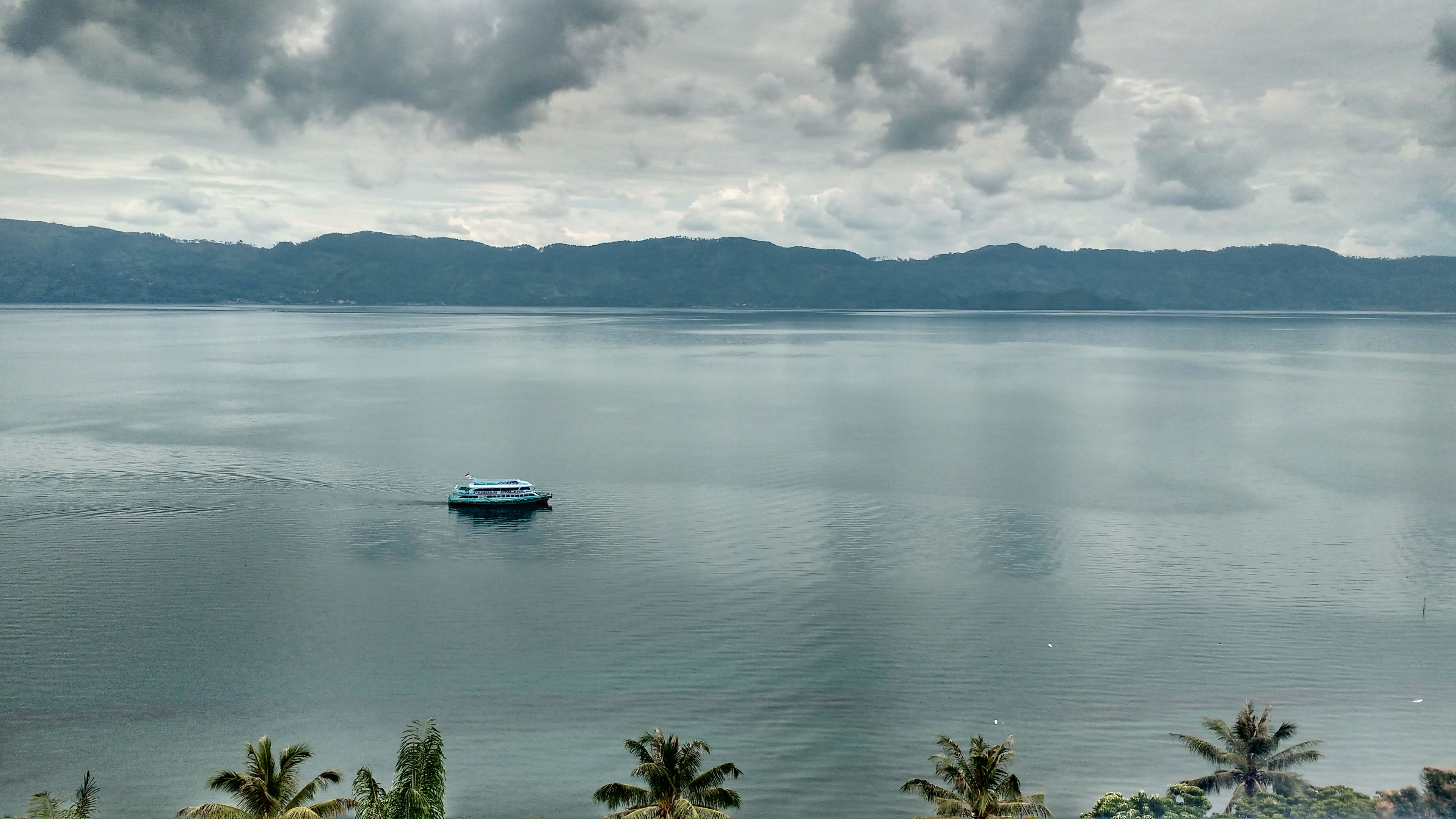
Lake Toba
The wake arrives first, and the island redraws itself behind it.
Lake Toba holds its scale quietly—water spread wide, edges far, time slowed down.
It is a lake that behaves like an inland sea, with weather, horizons, and crossings that feel earned.
Coming in by boat, you feel the place change you before you ever touch the shore.
The Shoreline After the Ferry Turns
Most visitors remember the view of Samosir and forget the water that delivers it. Watch the last minute of the crossing instead—the moment the ferry throttles down, pivots, and the wake fans out like a soft eraser. Along the village edge, the water lifts and loosens everything that looked fixed from a distance: a line of reeds, a tethered canoe, the floating edge of hyacinth, the reflection of a tin roof that suddenly breaks into pieces. The shoreline here isn’t a clean boundary. It’s a negotiation between volcanic rock, silt, and small daily movements: washing steps, mooring points, fish cages, a narrow strip where children step in and out without thinking of it as “the lake.” When the ferry turns, Lake Toba shows its working surface. For a few minutes, you can see how the lake edits the island’s edges, not with drama, but with repetition.
The Two Minutes Before the Ramp Drops in Tomok
There’s a precise hush right before arrival at Samosir—often at Tomok or Tuktuk—when the engine note lowers and the ferry stops being a moving room and becomes a listening platform. The lake changes texture in front of the bow: long chop collapses into small, organized ripples, then into a brief pane of calmer water as the boat slides into the lee of the pier. You feel the shift in your body first. Wind that has been steady on the deck suddenly falls away. Conversation thins. People stand, but they stop fidgeting, as if the lake has asked for stillness. This is when Lake Toba looks least like a destination and most like a presence. Reflections begin to hold again—a hillside, a cloud shelf, the dark line of trees—then fracture once more as the wake reaches the pilings. The transformation isn’t sunrise or sunset. It’s approach: the lake tightening its surface as land comes close.
The Reflections
When the wind eases near the pier, the hills duplicate faintly on the surface, as if drawn in graphite. The ferry wake then cuts through, turning that soft mirror into broken tiles that drift outward.
The Water
The water often reads as deep green-blue, darkened by depth and the shadow of surrounding slopes. Near shore it can turn tea-brown in patches where silt lifts and settles again after boats pass.
The Landscape
Samosir rises as a wide back of land inside the caldera, with layered ridgelines that make distances feel slower than they are. In the morning, mist can sit low along the inlets, separating villages from the higher farms for an hour.
Best Angles
Upper deck, starboard side on approach to Tomok
Stand near the front rail and face slightly right; frame the pier and the first houses with the wake widening behind you in peripheral view.
End of the pier at Tomok after disembarkation
Turn back toward the ferry as it pulls away; the shoreline becomes a layered scene of pilings, ripples, and the island rising beyond.
Tuktuk waterfront path at first calm
Walk to a quiet gap between cafés and aim low across the water; creators often shoot the hills, but the better story is the thin band where reflections start and fail.
A stone step down to the water near a small mooring
Sit close enough to hear the lap against rock; watch the wake arrive as a gentle lift rather than trying to capture the whole lake.
Crowd pattern — Midday ferries and weekend crossings can feel busy; early morning arrivals are quieter, with more space to stand and watch the water change.
Effort level — Mostly standing and short walks; boarding ramps can be steep and wet, and the deck can feel windy during the crossing.
Access note — Ferry schedules can shift with weather; carry small cash for tickets and minor pier fees if applicable.
What to bring — A light layer for wind on the deck, something to protect electronics from spray, and slip-resistant footwear for damp ramps.
Handpicked Stays & Tables
Places chosen for beauty and intention, not algorithms. Each one is worth your time.

Tuk Tuk Timbul Bungalows
Tuktuk, Samosir

Carolina Hotel
Tuktuk, Samosir

Jenny's Restaurant
Tuktuk, Samosir

Leo's Restaurant
Tuktuk, Samosir
On Lake Toba, you don’t enter Samosir—you watch the water decide where the island begins.