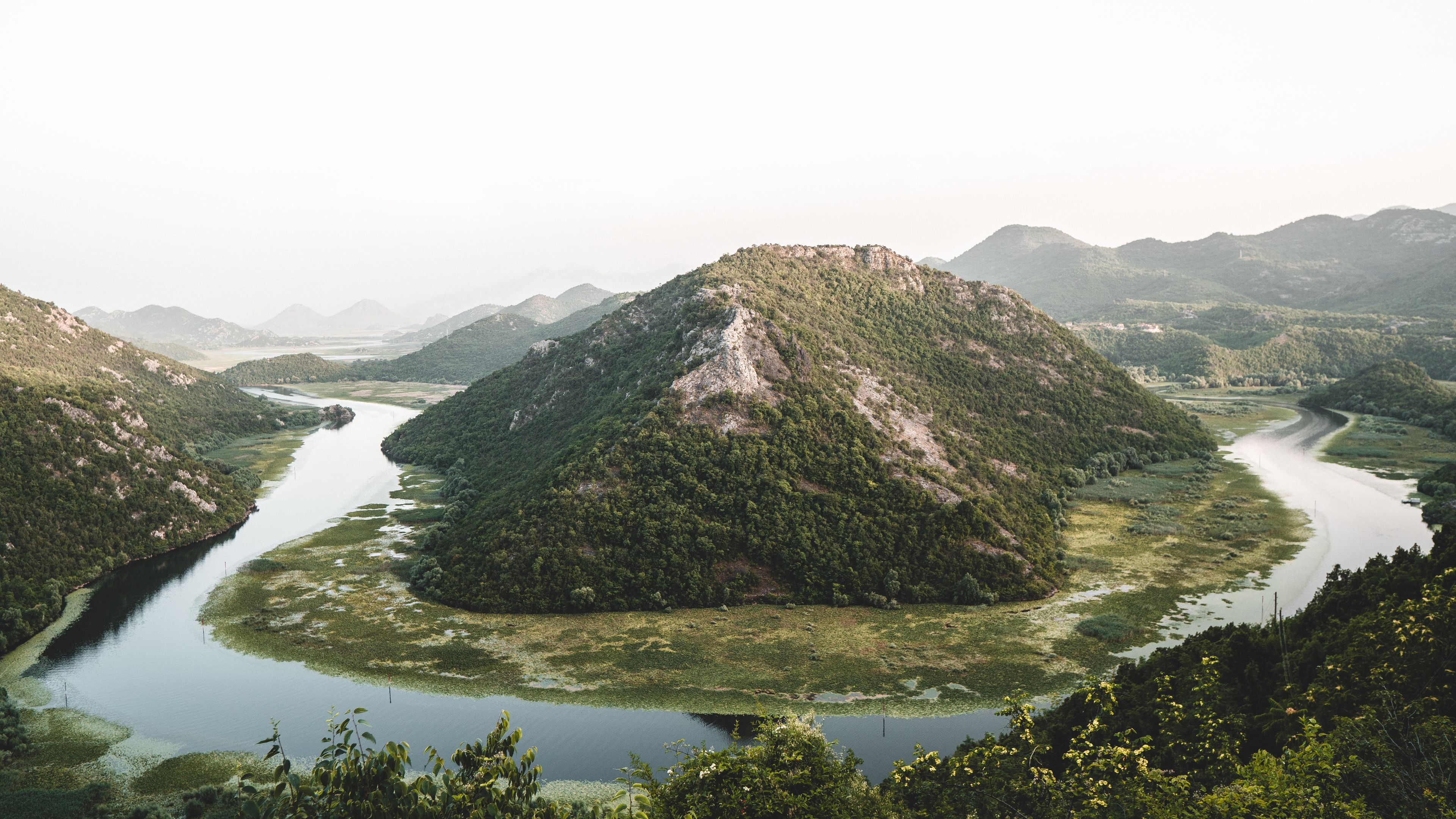
Lake Skadar
The lake arrives all at once, then keeps unfolding.
Lake Skadar is a wide, living basin where water and reeds negotiate the edge.
It feels less like a single lake and more like a shifting delta—open one minute, intimate the next.
Its pull is in the way it teaches patience: you don’t look at it, you wait for it to change.
The Silence Between the River and the Lake
Most visitors remember the famous bend of the Crnojevića River and treat the lake as what comes after. But the most revealing part is the in-between: the slow loosening of the river’s grip as it widens, the way the banks stop acting like borders. Right after the bend, sound changes first. The engine note thins out, then the air takes over—small wingbeats, the dry rasp of reeds, a distant dog on a shore you can’t see. Here, Lake Skadar doesn’t announce itself with a horizon. It arrives as texture: lily pads thickening into a floating field, darker channels stitched through green, the water turning from river-clear to lake-stained with silt and plant tannins. If you pause before the open expanse, you notice how boats begin to slow without being told. It’s not etiquette. It’s the lake’s pace setting yours.
The One Slow Turn After the Bend
There is a precise point—just after Rijeka Crnojevića’s river curve—when Lake Skadar reveals itself in a single, unhurried turn. You feel it more than you see it at first. The channel stops behaving like a corridor, and the sky suddenly has room to sit on the water. The first glimpse is never a grand panorama; it’s a widening of breath. Go in the early morning, when the river surface is still cool and the lake hasn’t started moving with the day. The light is low and lateral, sliding along the reeds instead of shining down. In those minutes, the water holds two worlds at once: the dark, contained river behind you and the pale openness ahead. It’s the transition that transforms everything—your sense of distance, the scale of the landscape, the way your eyes stop searching for landmarks and start reading subtle shifts in color.
The Reflections
In calm weather, the river’s reflections are sharp and close—trees and rock faces held like ink. As the channel opens into Skadar, reflections soften into wider bands: reed lines, cloud smears, and occasional mirrored islands that look briefly suspended.
The Water
Near the bend, the water can read as deep olive-brown, stained by vegetation and stirred sediment. Out on the lake, it turns into layered greens and silvers, changing with wind: a dull pewter under cloud, a lighter jade when sun grazes the surface.
The Landscape
Low mountains and ridges sit back from the water, letting the lake feel wide without feeling empty. Reeds and lily fields create a near-foreground that keeps the scale intimate, while distant slopes and small islands give the eye somewhere to rest.
Best Angles
Pavlova Strana viewpoint (above the Crnojevića bend)
Stand at the rail and frame the S-curve with the river leading left-to-right; morning light works best with the lake opening beyond the bend. Keep a little sky—Skadar needs air to feel like itself.
Rijeka Crnojevića waterfront (by the small bridge and terraces)
Shoot low across the water when the river is glassy; frame boats as small, quiet details rather than the subject. Early morning gives softer contrast and fewer distractions.
The first reed fields as the channel widens (boat route toward Virpazar)
Ask to idle the engine and frame the thin dark channels cutting through lily pads; most creators rush to open water and miss these graphic lines and the layered greens.
A brief stop in still water, mid-channel, facing back toward the bend
Turn around and let the river feel like a narrowing memory behind you; it’s the intimate angle that captures the transition, not the destination.
Crowd pattern — Pavlova Strana viewpoint gets busy mid-day; mornings and late evenings are often empty. Virpazar is most crowded 10:30–15:30 in peak season.
Effort level — minimal walking for viewpoints; boat time is the main effort. If you get motion-sensitive, choose a shorter river-to-lake route and ask for slower speed.
Access note — Lake Skadar is a National Park; entry fees and boat pricing can vary by operator and season. Confirm what’s included before boarding.
What to bring — a light layer for cool mornings on the water, polarized sunglasses for reading surface detail, and insect repellent near reeds in late spring and summer.
Handpicked Stays & Tables
Places chosen for beauty and intention, not algorithms. Each one is worth your time.

Hotel De’Andros
Virpazar

The Chedi Luštica Bay
Luštica Peninsula (coast, day-trip distance)

Konoba Badanj
Virpazar

Restaurant Mostina
Rijeka Crnojevića
Arrive expecting a view, and you leave remembering the turn that changed the air.