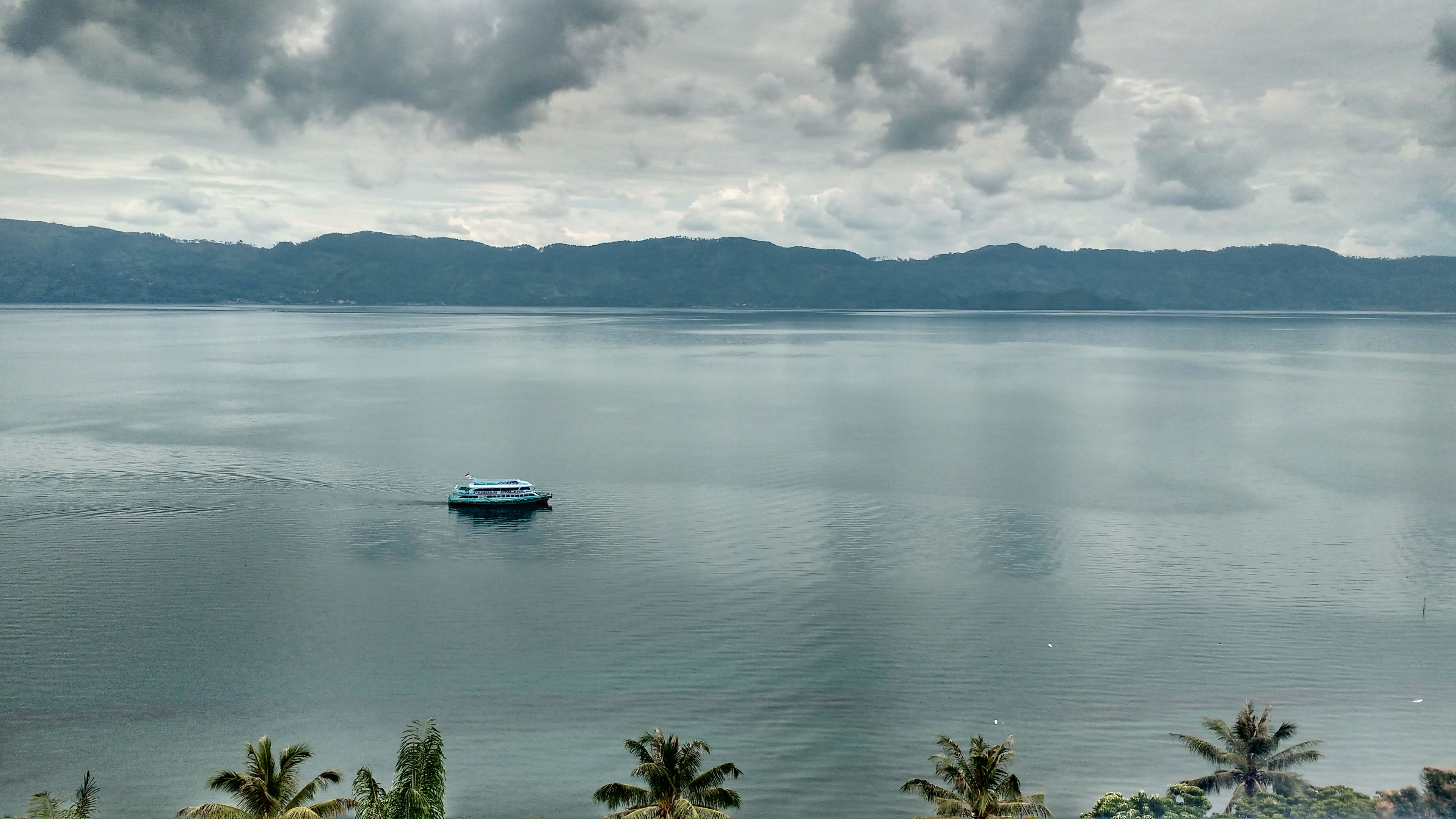
Lake Sentani
After the last canoe turns back, the lake begins to speak softly.
Lake Sentani holds its calm close, even with a city breathing nearby.
It is a lake of villages and small islands, where human sound and bird sound trade places by the hour.
What stays with you is the shift: from performed scenery to a lived, listening water.
The Sago-Edge Quiet After the Loop
Most visitors meet Sentani through the familiar canoe loop: a set of stops, a few photos, a return across open water. What’s missed is the lake’s softer boundary—where sago palms lean in and the shoreline stops being a “view” and becomes a working edge. When the last tourist canoe pulls away, the water near the sago stands changes texture. It darkens, not from depth alone, but from shade and tannin, and it holds small movements in place: a single paddle dip, a reed stem tapping the surface, the quick stitch of an insect. Listen here and you hear distance differently. Across the lake, an outboard becomes a low, steady line, while close-by sounds arrive with detail: a wooden hull settling against a post, a child’s voice from inside a house on stilts, birds shifting roost in the palms. The scene isn’t emptier; it’s simply no longer arranged for you. This is where Sentani feels most honest—quietly inhabited, quietly watching back.
The Twenty Minutes After the Boats Stop
On Lake Sentani, the transformation doesn’t begin at sunrise. It begins with absence. Late afternoon into early evening—often around 5:30 to 6:10—there’s a small, decisive thinning of noise as day-trippers finish their loop and engines point toward shore. The wake lines spread, soften, then disappear, and the lake stops constantly correcting itself. In that short window, the air cools just enough to settle. Smoke from cooking fires along the villages starts to drift in straighter bands. The surface becomes more readable: small rings where fish rise, long, quiet seams where the last wind slides off the hills. Birds step forward into the soundscape, not as a chorus but as separate presences—one call answered from another island, then a pause that feels deliberate. If you’re in a canoe at this hour, you begin to notice your own paddle as an intrusion and then, strangely, as a metronome. Each stroke makes a clean, private sound. Sentani shifts from a place you pass through to a place that asks you to match its pace.
The Reflections
When the wake fades, the stilt-house lines and palm trunks reappear in the water as thin, wavering ink. In the calmest minutes, islands and low hills sit doubled, with only the occasional fish ring gently breaking the symmetry.
The Water
Near the sago edges the water reads as tea-brown to deep olive, shaped by shade and tannin-rich runoff. In open sections it turns blue-green, the color thinning and brightening as sunlight lifts off the surface.
The Landscape
Low mountains and ridges encircle the basin, giving the lake a held feeling rather than an exposed one. Villages on stilts and scattered islands make the horizon irregular—more lived-in than geometric.
Best Angles
A stilt-village edge on the calmer leeward side
Stand (or sit low in a canoe) where houses meet water; frame the stilts and their mirrored lines, shooting parallel to the shoreline for repetition and quiet rhythm.
Between two small islands at slack water
Face toward the nearest ridge so the lake becomes a wide foreground; wait for the last wake to fade, then let the islands cut the reflection into calm panels.
Sago fringe at the end of the afternoon loop
Most creators aim for the open-lake panorama; instead, frame the shaded water, palm trunks, and small surface marks—ripples, rings, drifting leaves—where Sentani’s detail lives.
Inside the canoe, paused mid-stroke
Stop paddling and hold still; watch the surface re-settle around the blade’s last disturbance. This angle is for listening first, then looking.
Crowd pattern — busiest late morning through mid-afternoon when tour boats and visits cluster; noticeably quieter near sunset once the loop finishes.
Effort level — physically light if you choose roadside or jetty views; moderate only if you want slow canoe time and stillness (you’ll be sitting, balancing, and moving gently).
Access note — ask locally about where photography is welcome around villages; arrangements for boats are informal and depend on the landing point and weather.
What to bring — a light rain layer, water, and insect repellent for the sago edges; a small towel for spray; and a quiet, patient plan (the best moment is a wait, not an activity).
Handpicked Stays & Tables
Places chosen for beauty and intention, not algorithms. Each one is worth your time.

Hotels around Sentani Lake / Sentani town stays
Sentani (near the airport and lake access points)

Jayapura city hotels
Jayapura

Lakeside warung stalls (varies by village/jetty)
Along common access points near Sentani

Sentani town eateries (local restaurants/cafes)
Sentani
Stay until the paddles are no longer passing through, and Sentani settles into itself.