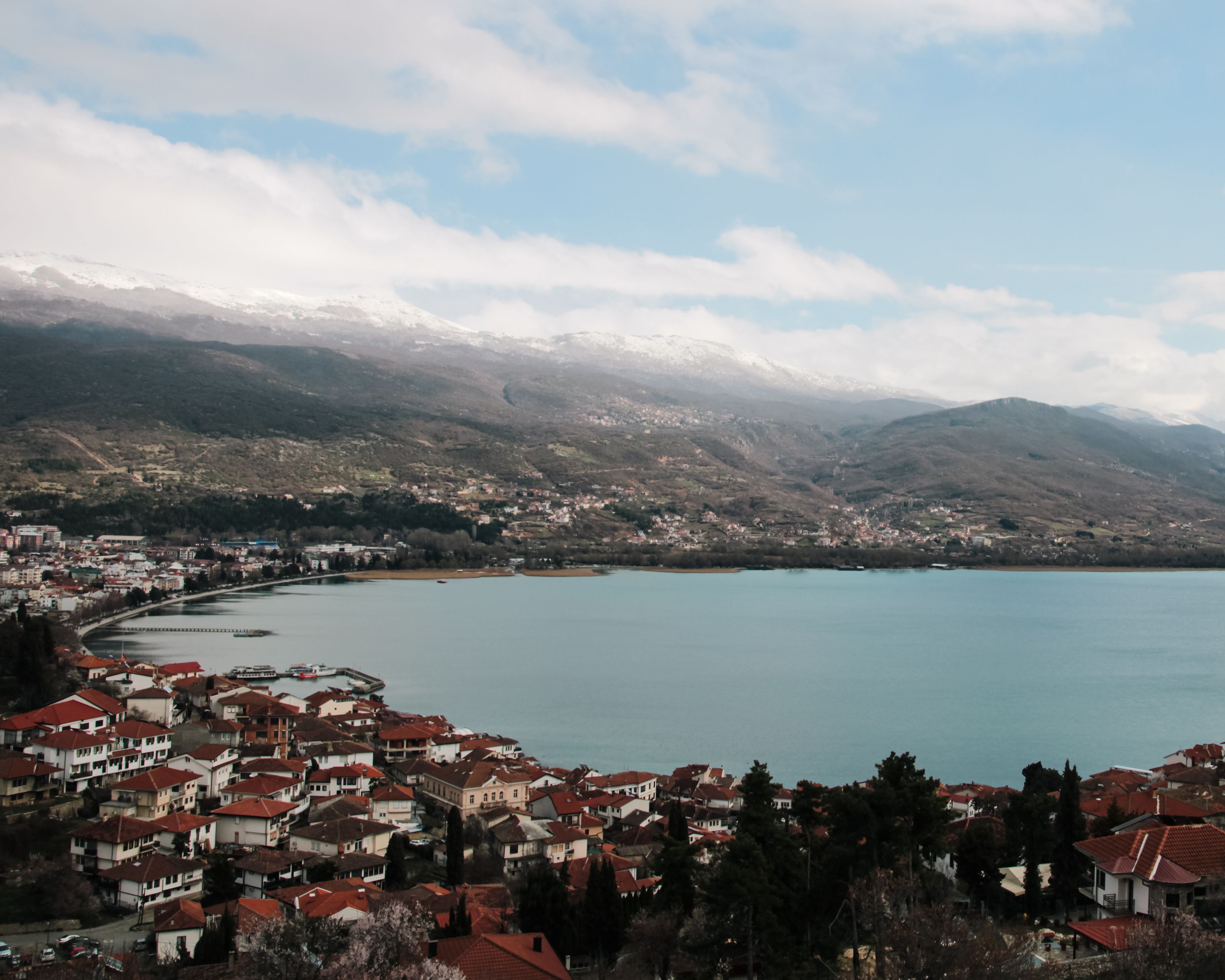
Lake Ohrid
Where stone, water, and centuries share the same silence.
Lake Ohrid sits with the patience of something that has watched people come and go for a very long time.
It isn’t defined by drama but by continuity: spring-fed clarity, deep time, and a shoreline built from layers of belief and daily life.
You come for the postcard, then stay for the feeling that the water is keeping records you can’t quite read.
The Old Town Steps When the Day Unhooks
Most visitors see Ohrid from the promenade—boats, menus, a clean line of water and stone. What they miss is how the lake changes along the old town’s lowest steps, where buildings meet the water without a buffer. In the late afternoon, when tour groups thin and the last swim towels disappear, the lake begins to press gently against the limestone, making small adjustments that feel deliberate: a soft lap, a pause, then a longer pull. The metal ladders and mooring rings become quiet instruments. Stand near Kaneo and watch the waterline work like an archivist. It darkens the stone a shade at a time, tracing yesterday’s level and erasing it slowly. Tiny fish gather in the shallow clarity, not in a hurry. Above, voices from the streets arrive muffled, as if the lake is absorbing them. This is Ohrid without performance—just the place settling back into itself.
Blue Hour Along Kaneo, When the Lake Turns to Glass-Blue
The shift happens after sunset but before the town lights fully take over—roughly 20 to 35 minutes after the sun drops behind Galičica. The sky stops being a color and becomes a surface. Lake Ohrid follows immediately. The water loses its daytime sparkle and takes on a heavier calm, as if it’s decided to stop reflecting the day and begin holding the night. From the path near the Church of St. John at Kaneo, the shoreline becomes a thin, dark contour and the boats turn into silhouettes with pale ropes. If there’s no wind, the lake flattens into a single sheet of blue-gray with occasional slow rings where a fish breaks the surface. The last warmth leaves the stone under your feet; you notice the temperature more than the view. It’s a precise kind of quiet—neither daytime leisure nor nighttime sleep. For a short window, Ohrid feels older than the people standing there.
The Reflections
In calm weather, the lake reflects like polished slate: churches, pines, and boat masts appear as softened doubles. At blue hour the reflections simplify—less detail, more shape—so the shoreline reads like ink on water.
The Water
By day it’s a clear, mineral turquoise near the shallows, shifting to deep cobalt farther out, fed by cold springs that keep the clarity steady. After sunset it turns steel-blue, not from depth alone but from the sky’s fading gradient laying itself flat across the surface.
The Landscape
Galičica and the surrounding ridges hold the lake in a quiet bowl, making the horizon feel close and contained. Stone terraces, cypress, and pale cliffs give the shoreline a restrained geometry, especially around the old town where architecture meets water directly.
Best Angles
Church of St. John at Kaneo viewpoint
Stand just off the main overlook on the path edge; frame the church against the lake with open water to the right. Best facing west-northwest at sunset into blue hour.
Ohrid boardwalk (promenade) near the small harbors
Walk until the cafés thin; shoot low across the water so the boats become a repeating line. Morning light works best facing east as the surface brightens and the town stays muted.
Plaošnik plateau above the old town
Creators often miss how quiet the lake looks from above; frame the curve of shoreline with roofs in the foreground. Late afternoon gives soft shadow on the town and stronger color on the water.
The lowest stone steps below the old town walls
Sit where the water reaches the steps and watch the waterline move; don’t compose, just stay still. The lake’s sound changes minute to minute when the wind dies.
Crowd pattern — busiest mid-day in July and August; noticeably quieter early mornings year-round and after 18:00 when day visitors drift away from the old town.
Effort level — mostly flat walking along the promenade; a few short climbs and stone steps in the old town and up toward Kaneo viewpoints.
Access note — viewpoints around Kaneo and the old town are public; some archaeological areas near Plaošnik may have small entry fees or closing hours depending on season.
What to bring — a light layer for blue hour (temperature drops quickly near the water), shoes with grip for polished stone steps, and a microfiber cloth for lens/phone from lake spray.
Handpicked Stays & Tables
Places chosen for beauty and intention, not algorithms. Each one is worth your time.

Villa Varosh
Ohrid Old Town (Varosh quarter)

Hotel Tino
Ohrid lakeside (near the promenade)

Kaneo Restaurant
Near St. John at Kaneo, above the water

Dr. Falafel
Ohrid town center, a short walk from the lake
In Ohrid, the lake doesn’t try to impress—it simply keeps returning, level by level, to the same ancient edge.