Lake Louise Sunrise
When the turquoise wakes under thinning ice and distant stone.
Lake Louise is a morning lake: pale light, cold air, slow water.
What sets it apart is how quickly it shifts from frozen hush to glacial color as the season loosens.
It pulls you in not with scale, but with small changes you can hear if you stand still.
The Lake’s Other Soundtrack: Meltwater and Rockfall
Most people arrive with a picture in mind and look for the color first. At sunrise, Lake Louise asks for your ears. In late spring and early summer, when the shoreline ice breaks into thin plates, the lake makes a quiet, irregular music—soft clicks as pieces nudge each other, a faint creak when a sheet releases from the stones, a small sigh when meltwater finds a new channel. Then, from far above, you may catch a single dry rattle: rockfall off the surrounding walls, not loud, just distinct against the early silence. It rarely lasts long; once the day warms and the lakeshore fills, these sounds disappear into footsteps and conversations. Stand away from the lodge frontage, near the trees, and let the postcard loosen. The lake becomes less like an image and more like a living edge between winter and summer.
The First Ten Minutes After the Sun Clears the Ridge
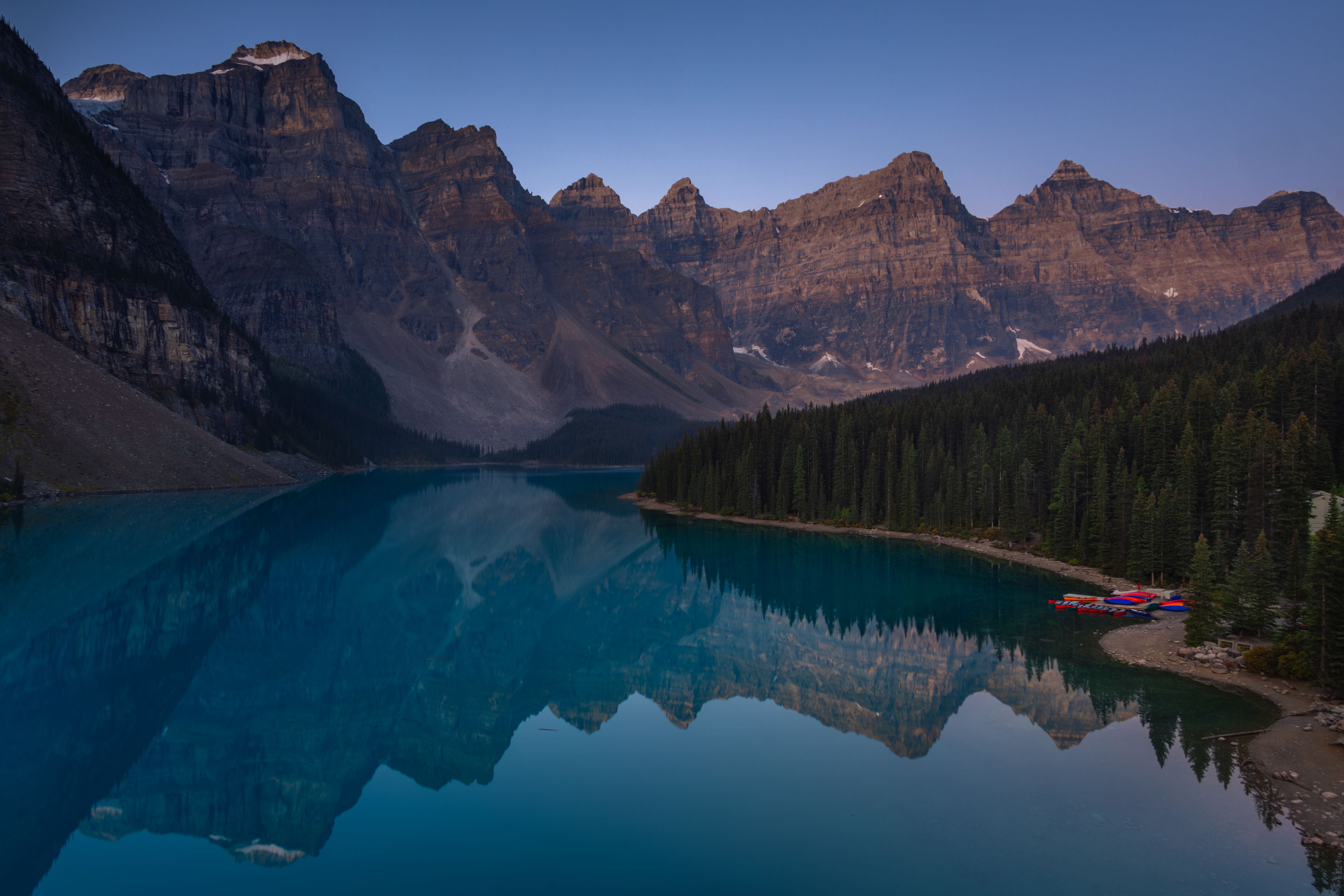
Before the sun arrives, Lake Louise can feel almost monochrome—blue-gray water under a colder blue sky, the mountains holding their shadows. Then the ridge line finally gives, and light touches the upper slopes first, not the lake. For a few minutes, everything is layered: warm gold on rock, cool shade on the water, and a band of soft mist or breath-like haze hovering just above the surface if the night was cold. The turquoise doesn’t announce itself immediately; it gathers. As the sun angle rises, the suspended glacial silt begins to read as color rather than just brightness, and the lake shifts from steel to milky aquamarine. In that narrow window, reflections behave differently too—cleaner, less broken—because winds often haven’t started yet. If you wait until the first tour buses, you’ll still see the view. You’ll miss the transformation.
The Reflections
On a windless sunrise, the lake holds a near-symmetrical line: dark firs stitched into the water, mountains doubled with only slight wavering at the edges. As the first breeze arrives, the mirror doesn’t shatter—it softens, turning sharp peaks into brushed shapes.
The Water
The water reads as pale turquoise to milky jade when light reaches the suspended rock flour carried from the glaciers above. Earlier in the morning, it can look more slate-blue; the color strengthens as the sun climbs and the silt begins to glow from within the surface layer.
The Landscape
Mount Victoria and the surrounding ridges frame the lake like a quiet amphitheater, with the Victoria Glacier feeding the story in the background. The shoreline pines and the simple curve of the beach give your eyes a resting place between stone and ice.
Best Angles
Lakeshore path near the Fairmont Chateau Louise canoe dock
Face west-northwest toward the glacier; keep the dock low in the frame for scale and let the mountains stay quiet and dominant.
Far end of the lake near the Lake Louise Lakeshore Trail (toward the Plain of Six Glaciers start)
Walk away from the hotel presence; look back for a calmer composition where the lodge becomes small and the waterline leads the eye.
Left shoreline (south side) where rocks meet shallow water
Creators often skip the low angle; crouch close to the water to catch thin ice plates or ripple texture with the glacier softened behind.
Bench zones along the lakeshore path, slightly back in the trees
Turn your body away from the main viewpoint for a minute; listen for melt clicks and the occasional distant rockfall before you lift the camera.
Crowd pattern — quietest at sunrise; by mid-morning the lakeshore becomes busy, and evenings can be crowded until after dinner.
Effort level — minimal walking on flat paths, but expect cold temperatures at sunrise even in summer.
Access note — Banff National Park entry pass required; parking fills early and may be managed in peak season.
What to bring — a warm layer, gloves for waiting still, a thermos, and footwear with grip if shoulder-season ice lingers near the path edges.
Handpicked Stays & Tables
Places chosen for beauty and intention, not algorithms. Each one is worth your time.

Fairmont Chateau Lake Louise
On the lakeshore at Lake Louise

Lake Louise Inn
Lake Louise village area

Louiza
Fairmont Chateau Lake Louise

Bill Peyto’s Café
Lake Louise village (Samson Mall area)
If you give Lake Louise your early minutes, it gives you back a quieter way of seeing it.