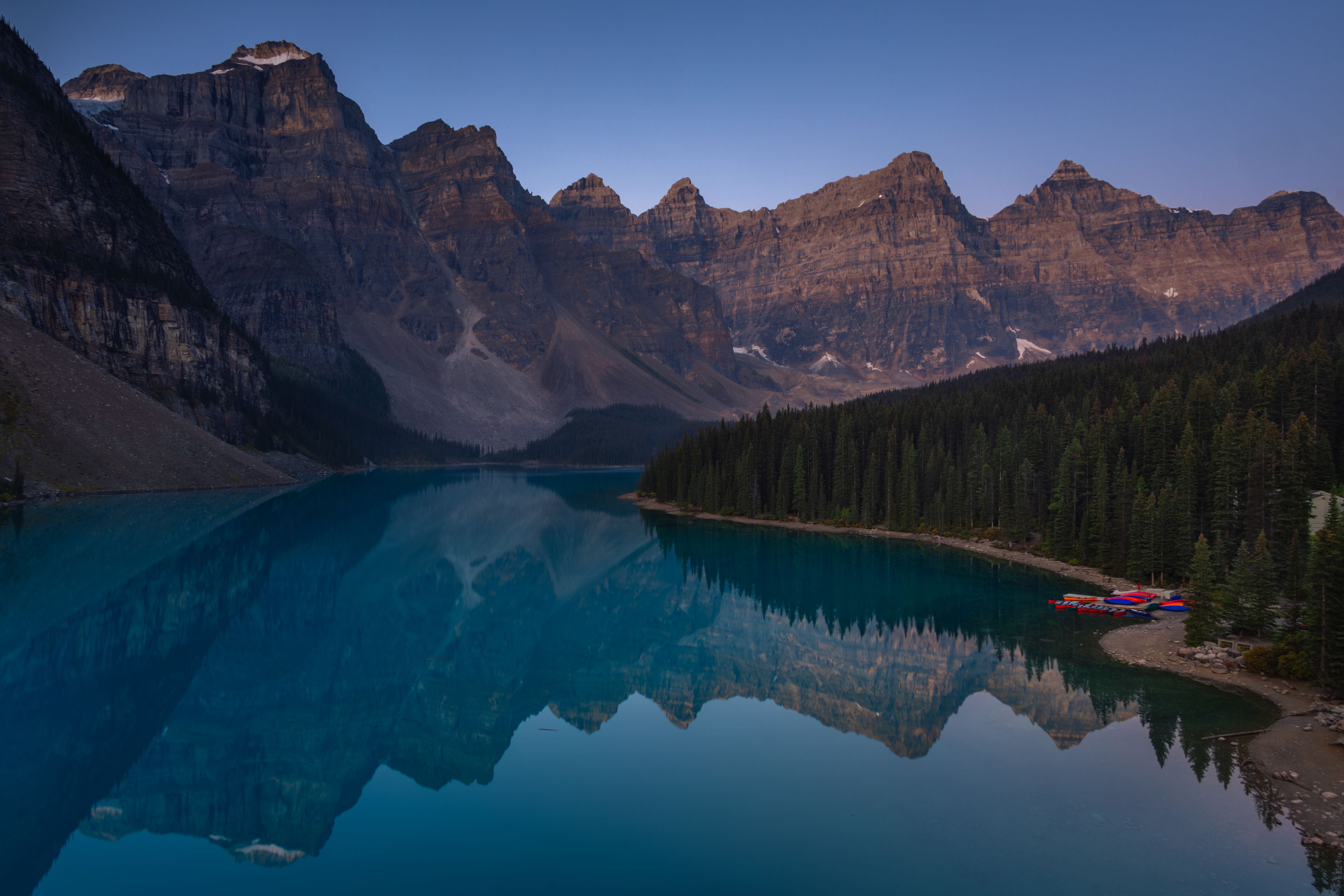
Lake Louise Sunrise
Before the valley wakes, the lake relearns its own color.
Lake Louise is a quiet basin of glacial water held under steep, pale rock.
Unlike many mountain lakes, its first light arrives in layers—shadow, then a thin wash of warmth.
It pulls you in because the change is slow and visible, like watching a place come back into itself.
The Lake Before the Parking Lot Breathes
Most visitors meet Lake Louise after it has already been narrated—by tour buses, paddle rentals, and the constant click of lenses looking for the same symmetry. But if you climb toward Fairview Lookout before dawn, you hear the lake unedited: the small crack of shoreline ice if it’s early season, the muted rush of Louise Creek, the occasional hollow wingbeat passing somewhere above the trees. From that height, the famous turquoise is absent at first. The water reads as dark slate, almost black, and the valley feels wider than it looks from the shoreline path. Headlights on the road below move like slow fireflies, then stop. You start to notice the hotel’s windows, a few squares of light suspended at the edge of the lake, and how much of the scene is actually shadow. Lake Louise isn’t performing yet—it’s waiting, and the waiting is the part most people never see.
When the First Sun Touches the Glacier and Not the Lake
The transformation doesn’t begin on the water. It starts high—on the shoulder of Mount Victoria and the pale ice of the Victoria Glacier—where the first sun finds something to hold. For a few minutes, the peaks brighten while the lake stays dim, a mirror that refuses to give anything back. The contrast is the whole point: light above, silence below. Then the treeline lifts out of the dark. The far shore becomes legible—individual firs, the curve of the path, the thin seam where the lake meets moraine. The water loosens from black into deep blue-green, and the surface begins to show its temperature: a faint steam in cold snaps, a glassy stillness after a windless night, or a soft corrugation when morning air finally moves. From Fairview Lookout, you can watch Lake Louise arrive in stages, like someone turning up the world’s exposure one careful notch at a time.
The Reflections
On calm mornings the lake reflects Mount Victoria as a dark, clean silhouette first, then gradually picks up detail as light increases. The best reflections happen before the first breeze slides down the valley—when the surface still looks poured.
The Water
The classic milky turquoise comes later, once daylight strengthens and suspended glacial silt starts to glow rather than disappear into shadow. At dawn it often reads as steel-blue with a green undertone, especially from above, before the brighter cyan takes over.
The Landscape
A steep amphitheater of peaks frames the water: Mount Victoria’s mass, the glacier’s pale tongue, and a tight treeline that makes the lake feel held. From the lookout, the Fairmont sits like a quiet boundary marker between wilderness and human routine.
Best Angles
Fairview Lookout (upper viewpoint)
Stand at the outer edge of the platform and frame the lake diagonally with Mount Victoria high left; shoot toward the glacier as it catches first light.
Shoreline near the canoe dock (pre-dawn)
Face southwest toward the glacier before the dock area fills; keep the dock low in frame and let the dark water carry the silence.
Lakeshore Trail, a few minutes toward the far end
Walk past the first clusters of people and use the bend in the path to compress the hotel and the lake; this angle softens the scene and reduces visual noise.
A still spot in the trees just above the shoreline trail
Step off the main flow (without damaging vegetation) and listen; the intimate angle is the one where you stop trying to capture it and simply watch the light change.
Crowd pattern — Sunrise is quieter, but expect photographers; by mid-morning the lakeshore becomes continuously busy, especially July–August.
Effort level — Fairview Lookout is short but uphill; in the dark it feels steeper, and the descent can be slick if there’s frost.
Access note — National park entry fee required; seasonal parking management and shuttle systems may apply, and trails can have wildlife advisories.
What to bring — Headlamp, warm layer even in summer, traction if temperatures are near freezing, and a thermos for the wait at the lookout.
Handpicked Stays & Tables
Places chosen for beauty and intention, not algorithms. Each one is worth your time.

Fairmont Chateau Lake Louise
On the lakeshore at Lake Louise

Baker Creek by Basecamp
Between Banff and Lake Louise, near Castle Junction

Lakeview Lounge (Fairmont Chateau Lake Louise)
Lakeshore, inside the Fairmont

Laggan's Mountain Bakery
Samson Mall, Lake Louise Village
From above, you don’t just see Lake Louise—you watch it slowly decide to be turquoise again.