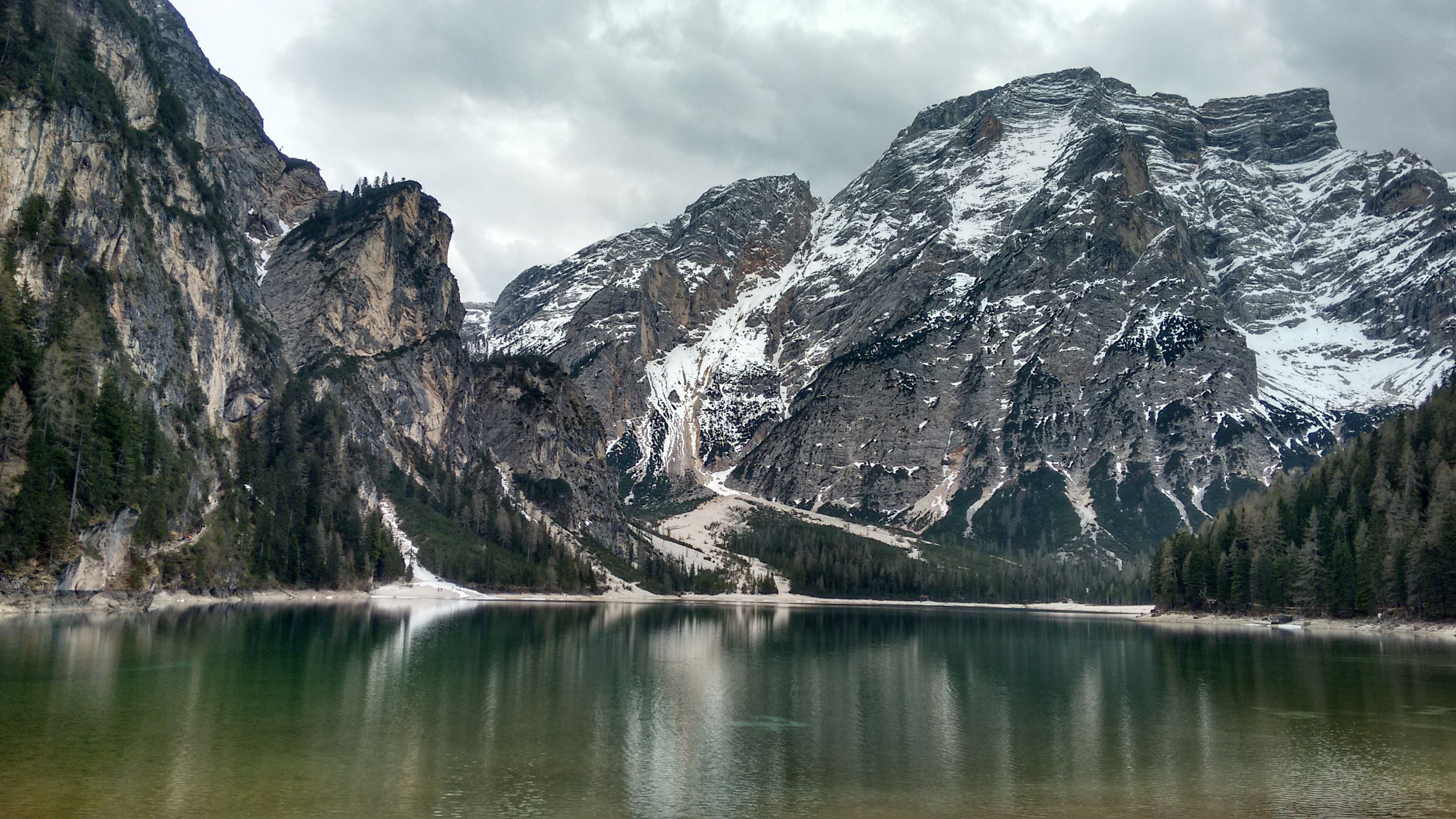
Lake Braies
Rain presses the peaks down, and Braies learns a quieter color.
Lake Braies sits like a held breath at the end of a narrow valley in the Dolomites.
Most alpine lakes sell clarity; Braies is more interesting when the clarity disappears into weather.
It matters because it teaches you to stop waiting for “perfect” light and notice the honest one.
The Lake After the First Rain Bus Leaves
Most visitors arrive for the postcard: emerald water, clean peaks, a tidy line of boats. What they miss is how quickly Braies becomes private the moment rain starts and schedules loosen. After the first wave turns back—often mid-morning on a wet day—the shore noise thins out. The rental boats sit still, their varnish darkened, oars resting like closed wings. Walk a few minutes away from the boathouse toward the quieter eastern curve of the lake path. Here the boards and gravel collect rainwater in shallow mirrors, and the trees drip in a slow, metronomic way. The lake stops performing. The mountains don’t “tower”; they lower, their edges softened by cloud and runoff. Even the color changes—less jewel, more mineral. If you wait long enough, you’ll notice the soundscape shift: rain on fir needles, occasional stonefall in the distance, and the soft slap of small waves against the shore. It’s the same lake, but it feels newly serious.
The Twenty Minutes When Rain Turns to Mist
Braies transforms in the narrow window after steady rain eases but before the sky opens. It’s often late morning or early afternoon in summer storms, or any gray, patient hour in late September. The surface, stirred by earlier drops, begins to settle. Mist lifts off the forest first—thin veils that hover just above the waterline—while the cliffs of Croda del Becco remain half-erased. In those twenty minutes, the lake’s mood changes from dramatic to intimate. The shoreline darkens, the wood of the boathouse looks older, and the water stops being “blue-green” and becomes slate with a cold sheen. Reflections don’t disappear; they simplify. Instead of a crisp mountain portrait, you get a graphite sketch: tree silhouettes, a faint ridge line, the pale seam of cloud. This is when Braies feels most like a place you found by accident. Not empty, not silent, but softened—like the landscape has lowered its voice so you can hear your own pace on the path.
The Reflections
In light rain or just after, the reflections become matte rather than mirror-bright, as if the lake is drawing with charcoal. Trees read as dark vertical strokes, and the mountains appear in fragments—one ridge, one cloud gap, then nothing.
The Water
The water shifts from its usual milky turquoise to a steel-slate tone when clouds flatten the light and runoff clouds the shallows. It’s the combination of overcast sky, wind-ruffle, and suspended minerals that removes the “glow” and leaves a mineral calm.
The Landscape
The Dolomite walls don’t feel tall in rain; they feel close. Low cloud sits in the saddle lines, and the forest tightens around the lake, making the basin feel like a room with dimmed lamps.
Best Angles
Boathouse dock (La Palafitta / boat rental area)
Stand at the end of the dock facing south-southwest toward Croda del Becco; frame the boats as dark shapes against slate water when clouds sit low.
Eastern shore curve on the lakeside path (a few minutes from the boathouse)
Face back toward the boathouse for a quieter, layered scene—wet pines in the foreground, lake mid-tone, cliffs dissolving into cloud.
North end of the lake near the outflow
Creators often miss the way the lake narrows here; frame the tightening valley and the darker water where the surface texture shows wind and rain’s last ripples.
A bench or rock on the shaded forest side
Turn away from the landmark view and watch the near-shore water: raindrop rings, drifting needles, and the slow return of stillness—this angle is for staying, not proving.
Crowd pattern — very busy in mid-summer from late morning through mid-afternoon; quieter at opening hours, during rain, and in late September onward.
Effort level — minimal; expect a short walk from parking and a mostly easy lakeside loop with a few narrower, uneven sections.
Access note — seasonal traffic management and parking controls can apply in high season; check current Pragser Tal/Valle di Braies access rules and parking availability before you go.
What to bring — a waterproof shell and shoes that handle wet gravel/roots; a small cloth for lens/phone in drizzle; and one warm layer even in summer storms.
Handpicked Stays & Tables
Places chosen for beauty and intention, not algorithms. Each one is worth your time.

Hotel Lago di Braies
On the shore of Lake Braies

Hotel Dolomiten
Dobbiaco/Toblach

Ristorante dell’Hotel Lago di Braies
Lakeside, by the boathouse area

Hans Pizzeria Restaurant
Dobbiaco/Toblach
If you let the rain arrive, Braies stops being a picture and becomes a presence.