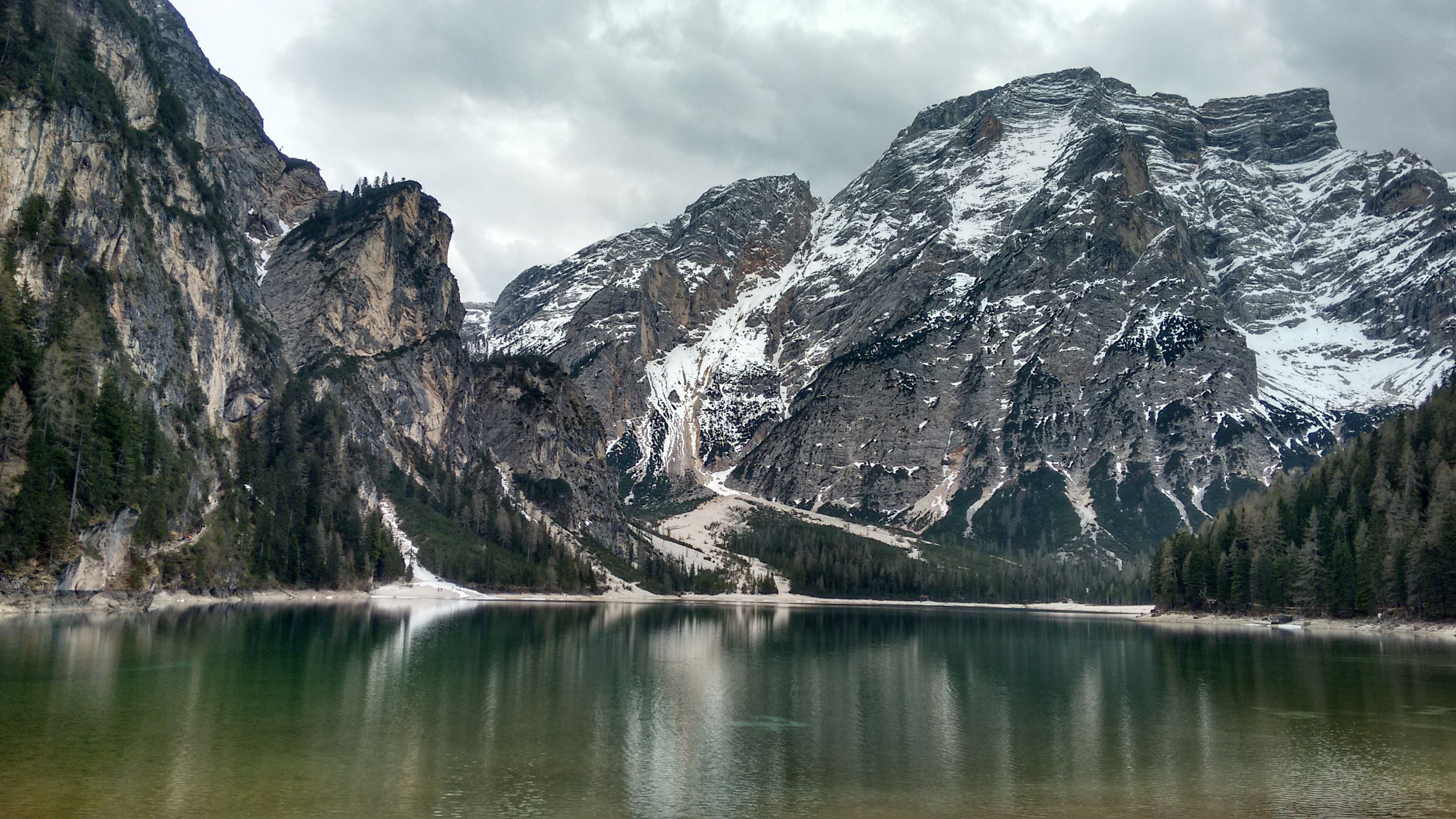
Lake Braies
Where the lake begins, and the noise finally arrives late.
Lake Braies is often seen as an image before it is felt.
What sets it apart is the way its color and sound change within a few steps—boardwalk to stones, crowd to hush.
It matters because it teaches you to look away from the obvious view and listen for the lake’s quieter beginning.
The Inlet Stones, Before the Footsteps Catch Up
Most visitors arrive for the classic view: the boathouse, the neat line of rowboats, the pale water in front of a wall of rock. They rarely stay long at the lake’s inlet, where the shoreline loosens and the scene stops posing. On the north end, the water enters softly over stones that look dark until you notice the green inside them—algae, shadow, and the lake’s own tint layering together. Here, Braies doesn’t feel like a mirror. It feels like a throat clearing. The water makes small, repeated sounds as it slips between rocks, and the lake’s surface breaks into tiny, nervous patterns that never happen in the postcard bay. If you stand still for a minute, the place starts to separate itself from the rest: fewer voices, less camera choreography, more of the lake’s actual temperature. It’s not dramatic. It’s simply where Braies stops being a scene and becomes a presence.
The First Quiet After the Day Parking Opens
Braies transforms in a narrow window that isn’t quite dawn and isn’t yet daytime: the first 20–40 minutes after the road and parking access begins for the day. The air is still cool enough to keep sound close to the ground. The water hasn’t been stirred by boats, and the reflections hold without trembling. Walk past the familiar foregrounds and go to the inlet stones. In this short interval, the lake’s color looks deeper—less turquoise, more like green glass—because the sun hasn’t climbed high enough to bleach it into brightness. The mountains read as heavy shapes rather than landmarks, and the treeline along the shore feels thick, almost protective. Then it changes quickly. The first groups arrive, doors close, voices rise, and the lake begins to perform. The inlet keeps its small sounds, but they’re harder to hear. If you want Braies to feel like water and not a destination, this is the moment to take seriously.
The Reflections
When the wind is absent, Croda del Becco sits on the surface with a hard edge, like a drawing laid on glass. Near the inlet, reflections fragment into small tiles as the current threads through stones.
The Water
The water reads as milky emerald with a blue lift, caused by suspended glacial minerals and the lake’s pale limestone basin. In low sun it turns darker—green bottle tones—especially where the depth drops near the inlet channel.
The Landscape
Steep Dolomite walls press close, making the lake feel contained and attentive rather than wide. The forested rim softens the rock with dark greens, and in cool mornings a thin mist sometimes clings low to the far shore before it loosens and disappears.
Best Angles
North inlet stones (where the stream meets the lake)
Stand low on the rocks facing south; frame the water texture in the foreground with the mountain mass softened behind. Best when the surface is barely moving.
East shore footpath, mid-lake (between trees and waterline)
Pause where the pines open; shoot west across the water for layered greens and the mountain’s pale face. This angle feels quieter than the boathouse view.
Far west shore, just past the busiest boardwalk stretch
Turn back toward the boathouse from a distance; include more shoreline and less sky. It shows how small the postcard scene really is inside the basin.
A bench moment near the inlet (no camera priority)
Sit facing the moving water, not the mountain. Let the small sounds take over; this is where Braies feels least like an image.
Crowd pattern — The boathouse area fills fast mid-morning to mid-afternoon; the inlet stays quieter, but only early. Weekdays outside July–August are noticeably calmer.
Effort level — Mostly flat walking on well-made paths; the full loop is easy but can feel long if it’s crowded.
Access note — Parking and road access can be regulated seasonally with fees and time windows; check current Pragser Wildsee access rules before you go.
What to bring — A light layer for the cold shade at the north end, grippy shoes for wet inlet stones, and something to sit on if you plan to stay still.
Handpicked Stays & Tables
Places chosen for beauty and intention, not algorithms. Each one is worth your time.

Hotel Lago di Braies
On the lakeshore

Naturhotel Leitlhof
San Candido (Innichen)

Restaurant Hotel Lago di Braies
At the lake

Pizzeria Hans
San Candido (Innichen)
At the inlet stones, Braies stops posing and starts speaking in small sounds.