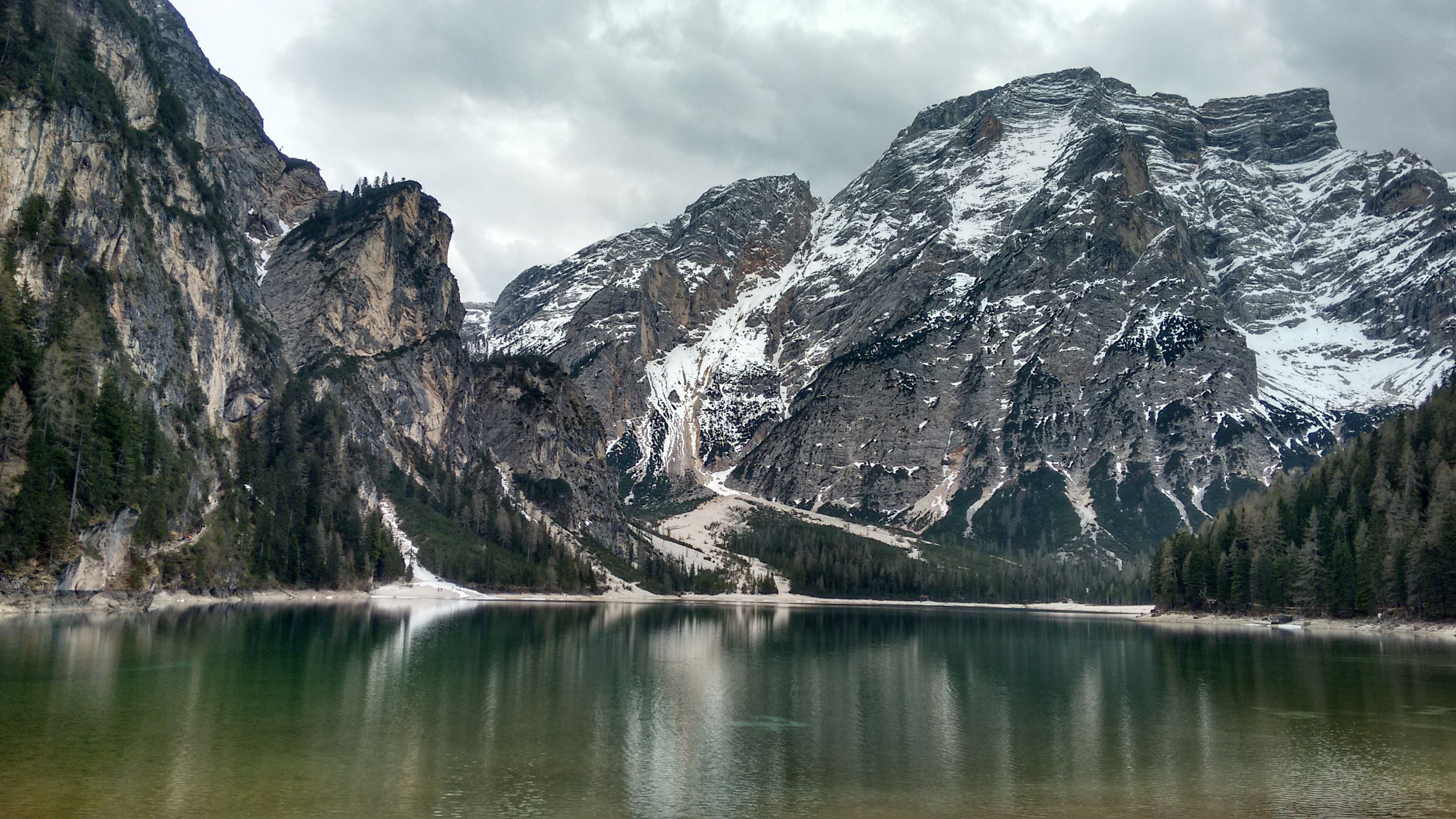
Lake Braies
Where the oars stop and the shoreline becomes a mirror.
Lake Braies is small enough to feel personal, even when the world knows its name.
Unlike many alpine lakes, its mood changes not with distance, but with a single step away from the dock.
It pulls you in with a simple promise: if you wait for the water to settle, it will show you everything twice.
The Shadow Line Behind the Boathouse
Most visitors stand on the front dock and aim straight down the lake, chasing the postcard symmetry. What they miss is the thin, quieter corridor behind the boathouse itself, where the shore bends and the noise thins into footfalls and creaking wood. In that pocket, the lake behaves differently. The boathouse throws a clean band of shade onto the water, and the surface—protected from the usual ripple pattern—often holds still a little longer. Look closely and you’ll see the reflection line: a faint seam where shade meets light, where turquoise shifts toward ink, and the mountains reappear with sharper edges than they do out in the open. It’s not dramatic; it’s precise. The boats, pulled close and tethered, become small dark commas in the mirror. Even in summer, when the path is busy, this angle gives you a rarer feeling at Braies: not spectacle, but privacy.
The Five Minutes After the Rental Boats Return
There’s a small reset that happens at Lake Braies when the last rental boats come back and the dock workers begin to tidy the lines. The lake doesn’t turn silent all at once; it narrows into silence. Oar drips stop. The clack of wood against wood fades. People hesitate, checking whether the day is over, and the shoreline briefly stops migrating. In those five minutes, the water relaxes. The surface doesn’t become perfectly flat—Braies is too exposed for that—but the ripples lose their direction. Instead of a textured shimmer, you get a softer skin, like brushed glass. Reflections begin to connect: the pale scree slopes stitch into the dark pines, and the pale limestone walls of Seekofel/Croda del Becco settle into the lake as if they belong there. It’s a narrow window, easiest in late September or early October when evenings cool quickly. If you stay for it, you see the lake shift from being watched to simply being itself.
The Reflections
When the wind drops, the mountains don’t just reflect—they align, forming a crisp hinge where rock becomes water. Near the boathouse shade line, the reflection sharpens, and the treeline looks almost etched into the surface.
The Water
The water reads as milky turquoise in sun, caused by fine glacial rock flour and the lake’s pale limestone basin. In shade or toward evening it deepens to a green-blue, and the clarity feels colder, more mineral than tropical.
The Landscape
Steep limestone walls press close, with dark conifers ringing the lower slopes and a narrow strip of path keeping you near the water. Mist, when it comes, sits low and thin—more like a softening of edges than a veil.
Best Angles
Behind the boathouse (shore-side, not the main dock)
Stand just past the boathouse corner where the shade meets light; face across the cove to frame tethered boats, the dark treeline, and the first slice of limestone wall.
Eastern shore path, a few minutes north of the hotel
Walk until the boathouse is no longer central; shoot back toward it with the lake widening behind—this reverses the usual composition and makes the human scale feel quieter.
North end viewpoint near the far bend
Creators often stop at mid-lake sightlines; go farther until the path tightens and you can compress the cliffs with the waterline for a calmer, less familiar frame.
A low kneel at the water’s edge near a small inlet
Forget the mountains for a minute: frame only the surface, a single oar-mark, and a strip of reflected pine—an intimate record of stillness rather than a landmark.
Crowd pattern — busiest from late morning through mid-afternoon in summer; calmest at opening-light mornings and the final hour of the day, especially in shoulder season
Effort level — short, easy access to the shore; the full loop is moderate in time but not strenuous, with some narrower sections
Access note — parking and shuttle rules can be seasonal; arrive early to avoid restrictions and check local policies for peak months
What to bring — a light layer for the temperature shift near water, shoes with grip for damp path sections, and a cloth to wipe lens mist during blue hour
Handpicked Stays & Tables
Places chosen for beauty and intention, not algorithms. Each one is worth your time.

Hotel Lago di Braies
On the lakeshore

Casa al Lago (Dobbiaco/Toblach area)
Near Dobbiaco/Toblach

Restaurant at Hotel Lago di Braies
Lakeside, by the main shore

Hans Pizzeria Restaurant (Dobbiaco/Toblach)
Dobbiaco/Toblach
Step behind the boathouse, wait for the last ripple to forget its direction, and the lake will hold the mountains for you.