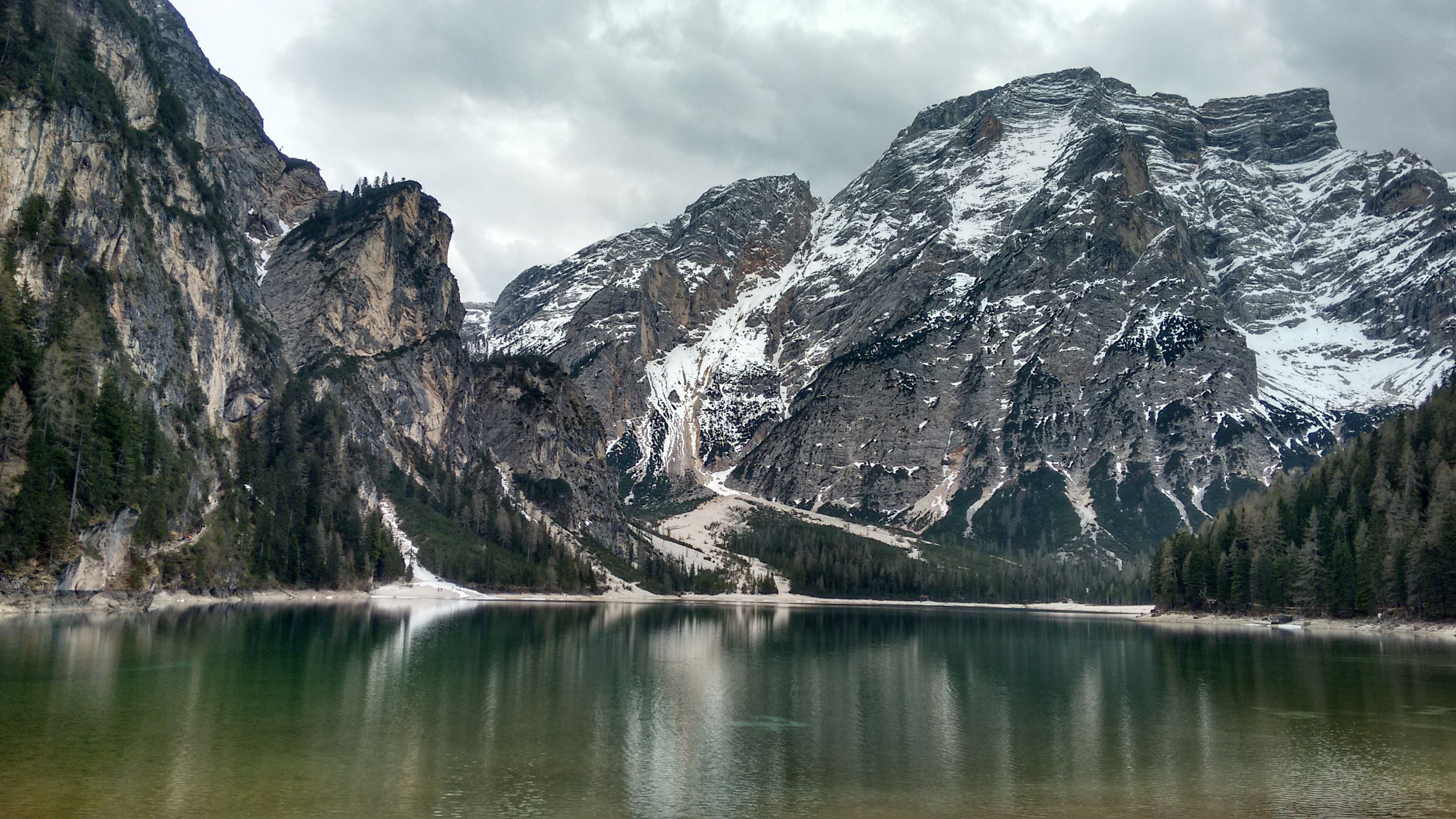
Lake Braies Sunset
When the last oar drip becomes the evening's first sound.
Lake Braies is a small basin of water that holds the Dolomites close and quiet.
It’s not the color alone, but how quickly the mood changes when the day releases its grip.
If you stay late, the lake stops posing and starts breathing like a real place again.
The Shoreline After the Rental Dock Closes
Most visitors treat Lake Braies like a front-facing scene: the boathouse, the rowboats, the straight-on view toward Croda del Becco. They take the picture and leave while the boards are still warm underfoot. What they miss is how the lake reorganizes itself the moment the oars are stacked and the last boat nudges in. The shore quiets first, then the water follows. Small sounds that were hidden by chatter—swallows snapping at insects, a strap clicking on a rucksack, the thin creak of mooring rope—become the main track. Walk away from the dock toward the shaded edge under the trees and you’ll find a different lake: darker, more mineral, with the scent of resin and wet stone. The postcard view stays bright for a while, but the side water turns to glass sooner, holding a muted reflection that feels private. It’s the same place, but finally it belongs to itself.
The First Cold Breath of Evening (About 20 Minutes After Sunset)
Sunset at Lake Braies isn’t a single event—it’s a handover. The warm light slips off the rock faces, and you can almost see the temperature change as it arrives across the water. About twenty minutes after the sun drops behind the ridgeline, the lake begins to look less turquoise and more like polished stone. This is when the surface settles. The daytime texture—tiny ripples from boats, wind, and movement along the path—thins out until the reflections sharpen. The boathouse darkens into a simple shape; the mountains stop performing and become heavier, more dimensional. If swallows are still out, they skim low and fast, stitching brief lines across the mirror without breaking it. Then the first real chill moves through the basin, down from the forest and the scree. People pull sleeves over their hands. Voices soften. It’s a subtle shift, but it changes everything: the lake stops being scenery and turns into atmosphere.
The Reflections
In the calm after boat traffic fades, the water reflects Croda del Becco with clean edges, like a dark graphite drawing laid on glass. In blue hour, the reflections deepen and simplify—trees become a single band, the peaks a darker mass hovering just above their double.
The Water
In late afternoon it can still read as milky turquoise, the color coming from glacial flour and limestone sediments suspended in the water. As the light cools, the turquoise retreats and the lake shifts toward jade and steel-blue, especially along the shadowed northern edge.
The Landscape
The lake sits tightly cupped by forest and steep Dolomite walls, so the sky feels like a narrow opening rather than a ceiling. Croda del Becco anchors the view with a blunt, pale face that holds onto the last light while the treeline turns ink-dark around the rim.
Best Angles
The rental boathouse edge (Lago di Braies boat dock)
Stand just off the dock, frame the boathouse low-left and aim toward Croda del Becco; best when the last boats are returning and the water starts to settle.
West-side path under the trees
Walk a few minutes away from the main dock into the shade; shoot back toward the lighter cliffs for contrast—cool foreground, warm rock, quieter mood.
The far end near the outflow (southwest end of the loop)
Most creators don’t go here at day’s end; frame the lake lengthwise with fewer people, and let the water turn darker—less postcard, more depth.
A bench or flat stone above the shoreline
Sit facing the water without composing; watch for the moment the surface stops carrying ripples and begins holding silence.
Crowd pattern — busiest from late morning to mid-afternoon; the lake thins out noticeably in the last hour before sunset, and becomes quietest after blue hour as day visitors leave.
Effort level — minimal walking for the main views; the loop is gentle and helps you escape the densest shoreline in a few minutes.
Access note — parking and road access can be regulated seasonally; check current local rules and any shuttle requirements before you go.
What to bring — a light insulated layer for the temperature drop after sunset, a small towel for damp benches/rocks, and a headlamp for the path back if you stay into the dark.
Handpicked Stays & Tables
Places chosen for beauty and intention, not algorithms. Each one is worth your time.

Hotel Lago di Braies
On the lakeshore

AMA Stay (San Vigilio di Marebbe)
Val Badia area (short drive)

Ristorante Hotel Lago di Braies
Beside the lake

Mountain hut stop on the Braies valley routes (seasonal)
Along nearby trails/roads in Val di Braies
Stay until the oars are silent, and you’ll hear the lake become itself.