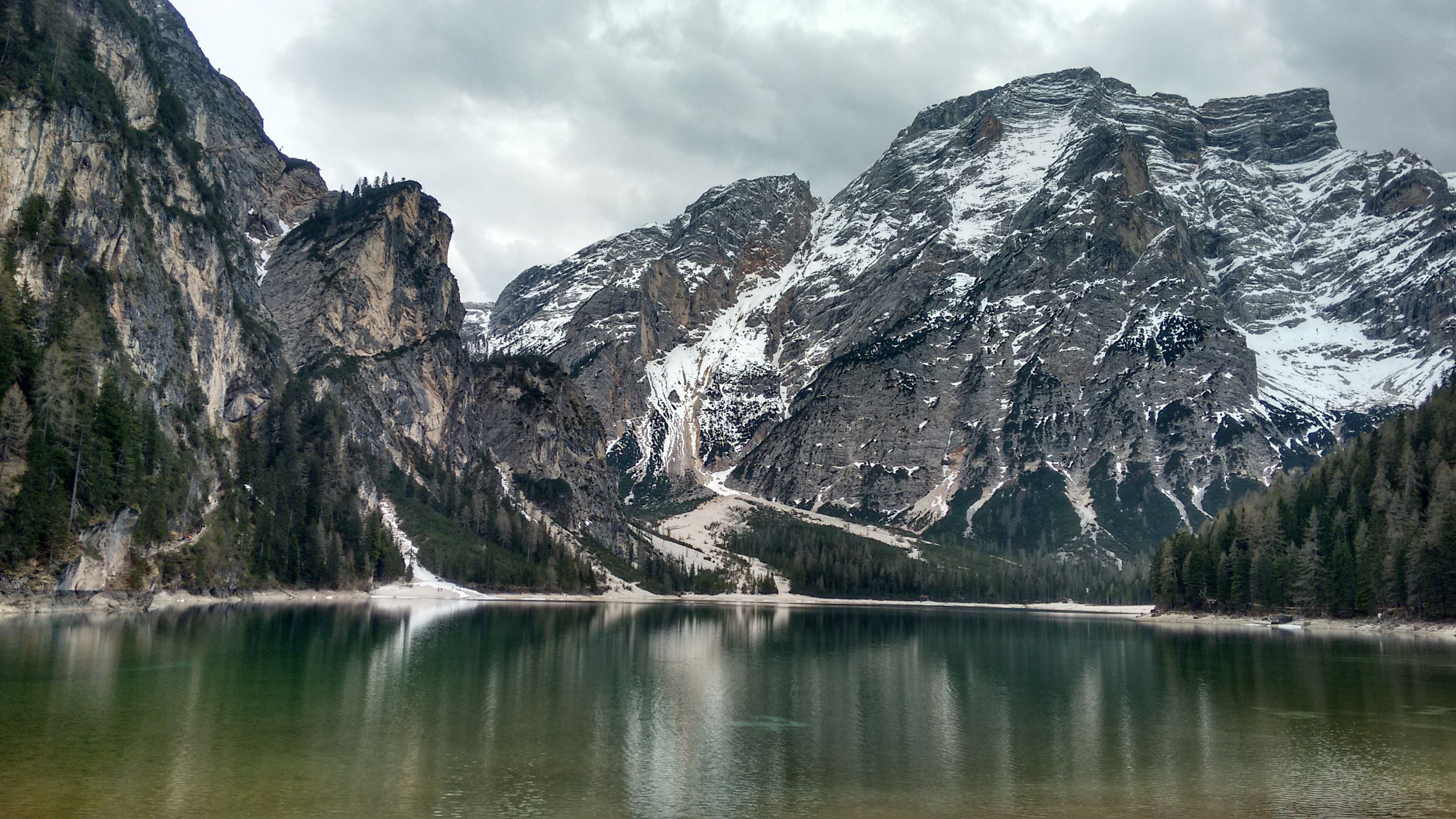
Lake Braies Sunset
At sunset, the lake turns quiet—and the forest keeps speaking.
Lake Braies is a small, enclosed bowl of water where sound carries softly.
It feels different because the shoreline is close and tactile—wood, stone, needles, and cold air all within a few steps.
It pulls people in not through scale, but through the way it makes you slow down without asking.
The Larch Needles at the Waterline
At Braies Sunset, everyone faces the water, waiting for the mountains to tint and the boats to stop moving. What gets missed is lower—right at the edge where shoes meet shore. In autumn, larch needles gather in thin drifts along the path and among the pale stones, turning the ground softly gold. They fall into the water too, floating in small rafts that catch the last light better than the surface does. If you walk the boardwalk and keep your eyes down for a minute, you’ll notice how the needles change the sound of footsteps—less crunch, more hush—and how they warm the color of everything near them. Even in other seasons, the shoreline has its own quiet details: resin-dark twigs, a line of wet rock that marks the day’s level, the faint pattern of ripples tapping the planks. It’s a second sunset, happening underfoot, while the crowd watches the obvious one.
The Ten Minutes After the Last Paddle
The lake changes not exactly at sunset, but just after the final boat turns back and the oars stop making that soft, regular slap. There’s a brief window—often ten minutes, sometimes less—when the surface unlearns movement. The reflections tighten. What was a loose mirror becomes a still one, and the mountains look less like scenery and more like weight. In summer, this moment arrives late, when the air cools abruptly under the trees and the shoreline feels suddenly narrower. In early autumn, it’s sharper: the light drops faster, and the larches start to glow, then fade, like a lamp being turned down. People begin to leave, but the lake doesn’t empty all at once; it quiets in layers. First the voices thin out, then the water steadies, then the color shifts toward slate. If you stay through that sequence, Braies stops being a postcard and becomes a place with its own pace.
The Reflections
When the wind settles, the Seekofel massif and the treeline sit in the water with clean edges, as if printed. Even a small ripple breaks the mirror into stitched fragments, so the stillness feels earned rather than guaranteed.
The Water
In calm light the water reads as milky turquoise, fed by alpine minerals and the lake’s pale, stony bottom. As the sun drops behind the surrounding walls, the color cools toward green-blue and then a quieter steel tone, especially along the shaded shore.
The Landscape
The lake is framed tightly by forest and limestone, which makes the horizon feel close and intimate. The chapel and the boathouse add human scale without breaking the silence; they sit like punctuation marks at the edge of the trees.
Best Angles
Boathouse dock (La Palafitta)
Stand at the outer edge facing southwest toward Seekofel; frame the boats as dark shapes and let the mountain sit centered in the reflection.
Chapel side of the shore (Kapelle am Pragser Wildsee)
Move a few meters off the main path and shoot low across the stones; the chapel becomes a quiet foreground note rather than the subject.
East shore trail, halfway around
Most people stop early; keep walking until the boardwalk sections thin out, then frame the lake through trunks for a more private, layered view.
Waterline stones near the larches
Forget the horizon—photograph the needles, wet rock, and a thin slice of reflection; it captures the evening’s texture more than its drama.
Crowd pattern — busiest from mid-morning to late afternoon, especially in summer; the shoreline loosens up in the last hour before sunset as day-trippers leave.
Effort level — minimal walking for the classic views; the full loop is gentle but can feel slow in crowds on narrow sections.
Access note — parking can be regulated seasonally with time slots or restrictions; check current Pragser Tal access rules and bus timetables before you go.
What to bring — a light jacket even in summer (shade arrives fast), shoes with grip for wet stones, and a small cloth for lens/phone as humidity rises near dusk.
Handpicked Stays & Tables
Places chosen for beauty and intention, not algorithms. Each one is worth your time.

Hotel Lago di Braies
On the lake shore

Hotel Union
Dobbiaco/Toblach

Restaurant Hotel Lago di Braies
At the lake

Gasthaus Huber
Braies (Prags) valley
When you finally look down, the evening is already there—soft, gold, and easy to miss.