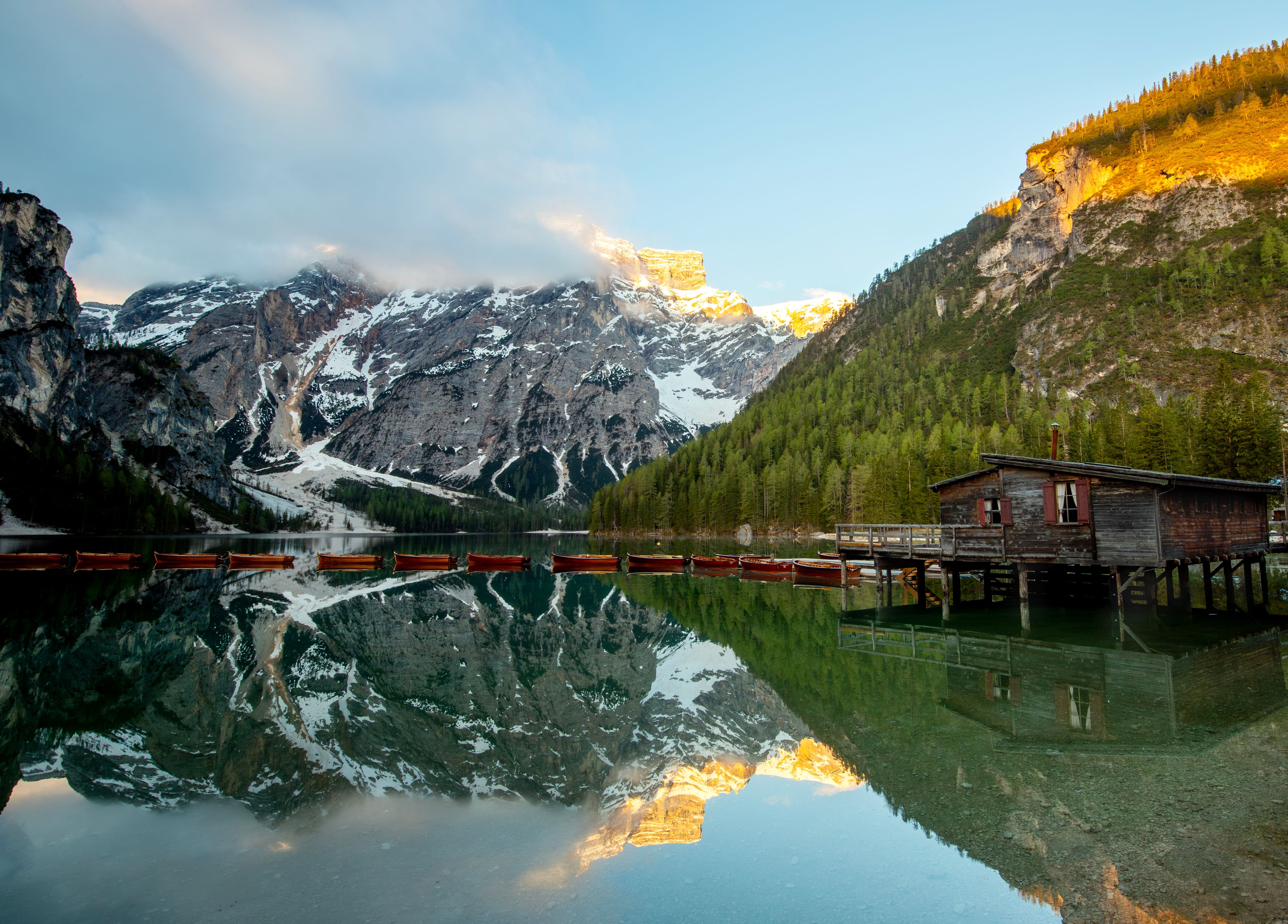
Lake Braies Sunrise
Before the first oar touches water, the lake holds its breath.
Lake Braies sits in a pocket of stone and spruce, small enough to feel personal.
Its water is alpine-bright, but its mood changes minute by minute as the cliffs wake up.
At sunrise, it asks for patience—then rewards you with a kind of quiet you can keep.
The Dock Before It Becomes a Stage
Most people arrive for the rowboats and the postcard angle, then leave when the lake starts to fill with movement. What they miss is the dock in its unused hour—when the boats are still chained, covers beaded with cold, wood dark from night moisture. The air has that thin, clean smell of larch and wet rope. You can hear footsteps on the gravel long before you see anyone, and the sound travels in a way it won’t later. Stand back from the waterline and watch the small, almost shy changes: the first pale tint creeping into the turquoise, the reflection sharpening and then softening as a faint breeze comes down the valley. Even the boathouse looks different before it’s “for” anyone—more like a shelter than an attraction. This is the version of Braies that feels lived-in, not visited.
When the Chains Stay Quiet and the Mountains Turn on Their Color
The transformation happens in the narrow window after first light but before direct sun reaches the water. It starts as a dim blue presence—mountains as silhouettes, the lake like a piece of glass left out overnight. Then, almost imperceptibly, the rock faces opposite the boathouse begin to take on warmth. It isn’t a sudden flare; it’s a slow ignition, a blush that climbs the limestone while the water remains cool-toned. This is when Braies feels most itself: the rowboats still restrained, the dock empty enough to hear the lake’s tiny sounds—water tightening against timber, a bird cutting across the surface without leaving a wake you can follow. The first walkers move with a softer pace, as if the quiet has instructions. Ten minutes later the spell loosens; the light becomes practical, and the lake turns from atmosphere into scenery.
The Reflections
On calm mornings the water holds the mountains with near-symmetry, crisp enough to read the tree line like ink. When a light valley breeze arrives, the reflection breaks into long, brushed strokes that make the cliffs look closer than they are.
The Water
The water reads as milky turquoise with a pale jade edge, fed by mineral-rich alpine inflow and the lake’s light-colored sediments. In the earliest minutes it leans steel-blue, then returns to green as the sky brightens and the shallows begin to show.
The Landscape
Steep Dolomite walls press in at the far end, while a ring of dark conifers keeps the shoreline feeling enclosed and quiet. The boathouse and dock add a human line to all that stone, making the scale feel intimate instead of overwhelming.
Best Angles
Boathouse dock (classic front view)
Stand slightly left of center on the dock and frame toward the far cliffs; keep the boathouse edge as an anchor. Best when the boats are still chained and the water is unbroken.
West shoreline footpath (toward the far end)
Walk 5–10 minutes along the trail and shoot back toward the boathouse with the lake widening in front. This angle feels quieter, with fewer faces in frame and a longer ribbon of reflection.
East shoreline near the first bends in the path
Most creators rush the dock; here you can catch the water color in the shallows and the trees mirrored tight to the edge. Face across the lake for layered greens before the sun flattens the contrast.
A bench or rock just off the path, away from the waterline
Turn your body slightly away from the lake and watch it in peripheral vision; the point is the sound and temperature shift, not the shot. You’ll notice when the first breeze arrives because the lake changes texture.
Crowd pattern — quietest before sunrise; after about 8:30–9:30 the dock becomes busy, especially June through August and on weekends
Effort level — minimal walking, but expect standing in the cold and moving slowly on damp wood and gravel
Access note — parking can be limited and regulated in peak season; check current local rules and any shuttle/entry restrictions for Val di Braies before you go
What to bring — a warm layer for the dock, shoes with grip for wet boards, and a small towel/cloth for lens condensation in the cold air
Handpicked Stays & Tables
Places chosen for beauty and intention, not algorithms. Each one is worth your time.

Hotel Lago di Braies
On the lakeshore at Lago di Braies

Hotel Pragserhof
Braies (Prags), lower in the valley

Restaurant Hotel Lago di Braies
Lakeside, at the hotel

Restaurant Pragserhof
Braies (Prags)
If you arrive while the boats are still chained, Braies feels less like a place to visit and more like a morning you’re allowed to share.