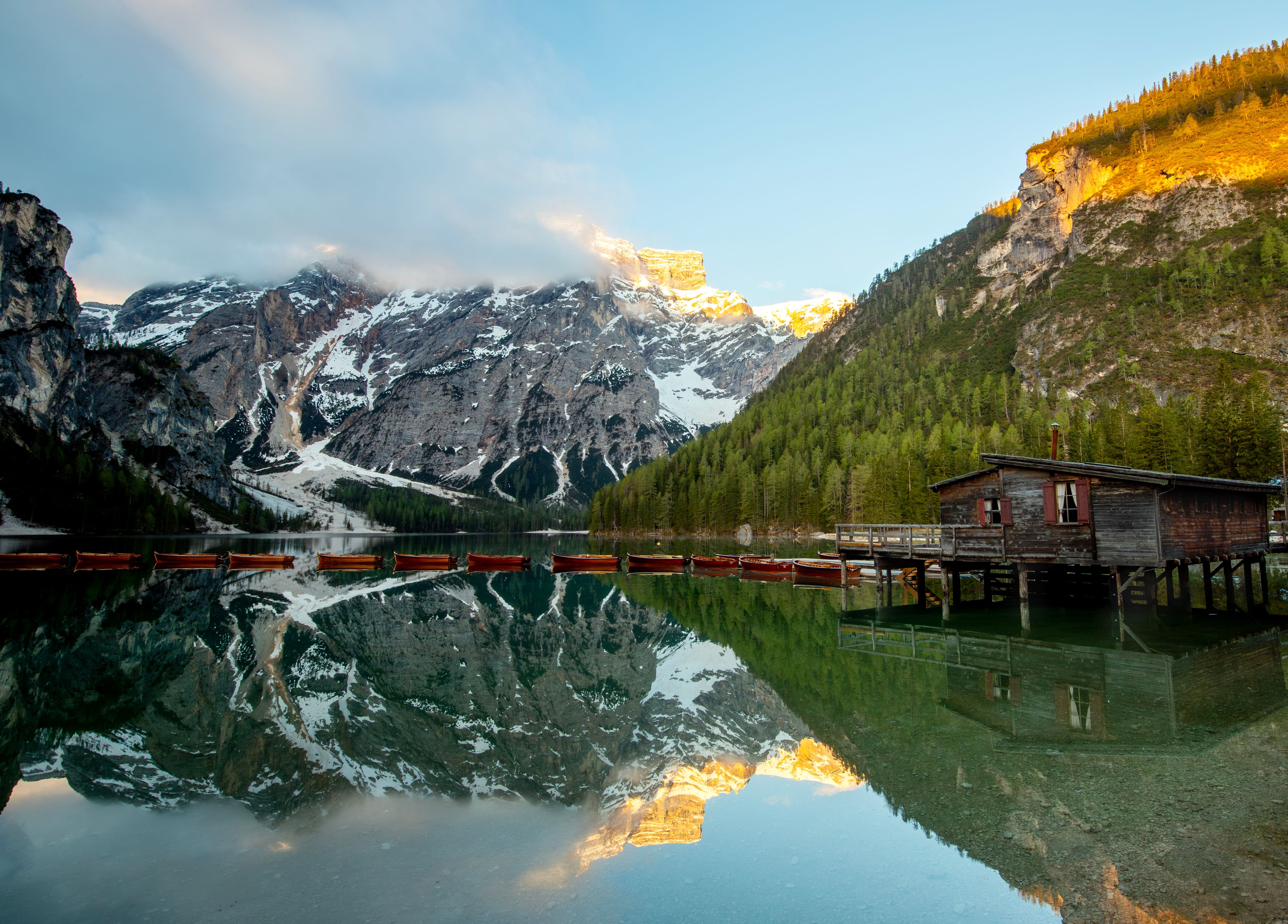
Lake Braies Sunrise
A wider sunrise, away from the boards and the waiting.
Lake Braies is a small basin of water that holds the Dolomites close.
Unlike many alpine lakes, its first light is staged—wood, boats, and a single iconic edge.
Step away from that edge and it becomes personal again: quieter, slower, and easier to feel.
The West Bank Before the Jetty Wakes Up
Most mornings at Lake Braies begin with the same idea: the jetty, the symmetry, the proof that you were there early. The west-bank path offers a different kind of arrival. Instead of walking into a scene, you walk alongside it—water on your left, dark timber and rock underfoot, the lake widening in your peripheral vision. In the pre-dawn, the west side stays colder and more shaded. The air smells faintly of wet spruce and old wood from the boathouse, and your footsteps are softened by damp gravel. From here, the lake doesn’t look like a postcard; it looks like a real surface that changes every minute. You notice how the boats are still tethered, how the shoreline reeds hold a thin line of frost in shoulder seasons, how a single ripple from a fish can erase an entire reflection. The jetty collects people. The west bank collects silence.
When the First Sun Hits the Far Wall of Rock
Lake Braies transforms just after sunrise, not at it. The first light arrives cautiously—blue hour clinging to the water while the upper cliffs begin to lift out of shadow. Watch the far side of the basin: the rock face and treeline across from the west bank take the first direct sun, and the entire lake suddenly has something to mirror. For a brief window—often ten to fifteen minutes—the surface behaves like glass if the night has been calm. The mountains don’t simply reflect; they appear to sit inside the lake, slightly darker, with a thin bright seam where the new light meets the cold water. The jetty is usually behind you now, and the sounds are smaller: a strap tightening on a backpack, a low murmur carried too far, a distant door from the hotel. Then the spell loosens. Wind slides down the valley, the water grains up, and the lake returns to being water.
The Reflections
On still mornings, the west-bank view gives you long, uninterrupted reflections—mountain mass and treeline stretching cleanly across the lake. As the first breeze arrives, the mirror breaks into brushed strokes, and the reflections turn painterly rather than perfect.
The Water
The water reads as deep teal with a milky, pale edge near the shore, shaped by glacial minerals and the lake’s limestone setting. At dawn it leans cooler—blue-green under shadow—then warms slightly as sunlight reaches the far slope and the surface brightens.
The Landscape
Steep Dolomite walls frame the basin tightly, with dark spruce rising straight from the shore. The west bank holds the lake at a slight diagonal, so you feel the valley’s depth and the way light moves across it rather than just facing a single front-on view.
Best Angles
West-bank path, halfway between the hotel and the boathouse bend
Stand with water to your left and face diagonally toward the far cliffs; frame the lit rock above the dark treeline for a layered reflection.
Just past the boathouse, looking back toward the jetty
Use the shoreline curve to compress the scene; the jetty becomes a small accent rather than the subject, and the crowd feels distant.
The narrow shaded pocket under trees on the west bank
Most creators skip this because it’s darker; it’s where you can catch the lake’s teal depth and subtle mist when the rest is already bright.
A quiet step-off on the west shore, close to the waterline
Lower your viewpoint until the surface fills the frame; let the sound of lapping replace composition—stay long enough to see the first ripples arrive.
Crowd pattern — The jetty fills quickly from sunrise onward in summer; the west bank stays noticeably quieter for the first hour, then becomes busier as the loop walk begins.
Effort level — Flat, short walking on a maintained path; the main effort is timing and the chill before the sun reaches the valley.
Access note — Seasonal traffic and parking controls can apply at Lago di Braies (especially summer); check current local rules, fees, and early-hour access before you go.
What to bring — A warm layer even in summer dawn, a small headlamp, quiet shoes for wet gravel, and a thermos if you plan to wait for the post-sunrise reflection moment.
Handpicked Stays & Tables
Places chosen for beauty and intention, not algorithms. Each one is worth your time.

Hotel Lago di Braies
On the lake’s edge

Hotel Trenker
Villabassa (Niederdorf)

Restaurant at Hotel Lago di Braies
Lakefront

Gasthof Huber
Villabassa (Niederdorf)
Walk the west bank while the boards are still empty, and let the lake widen around you.