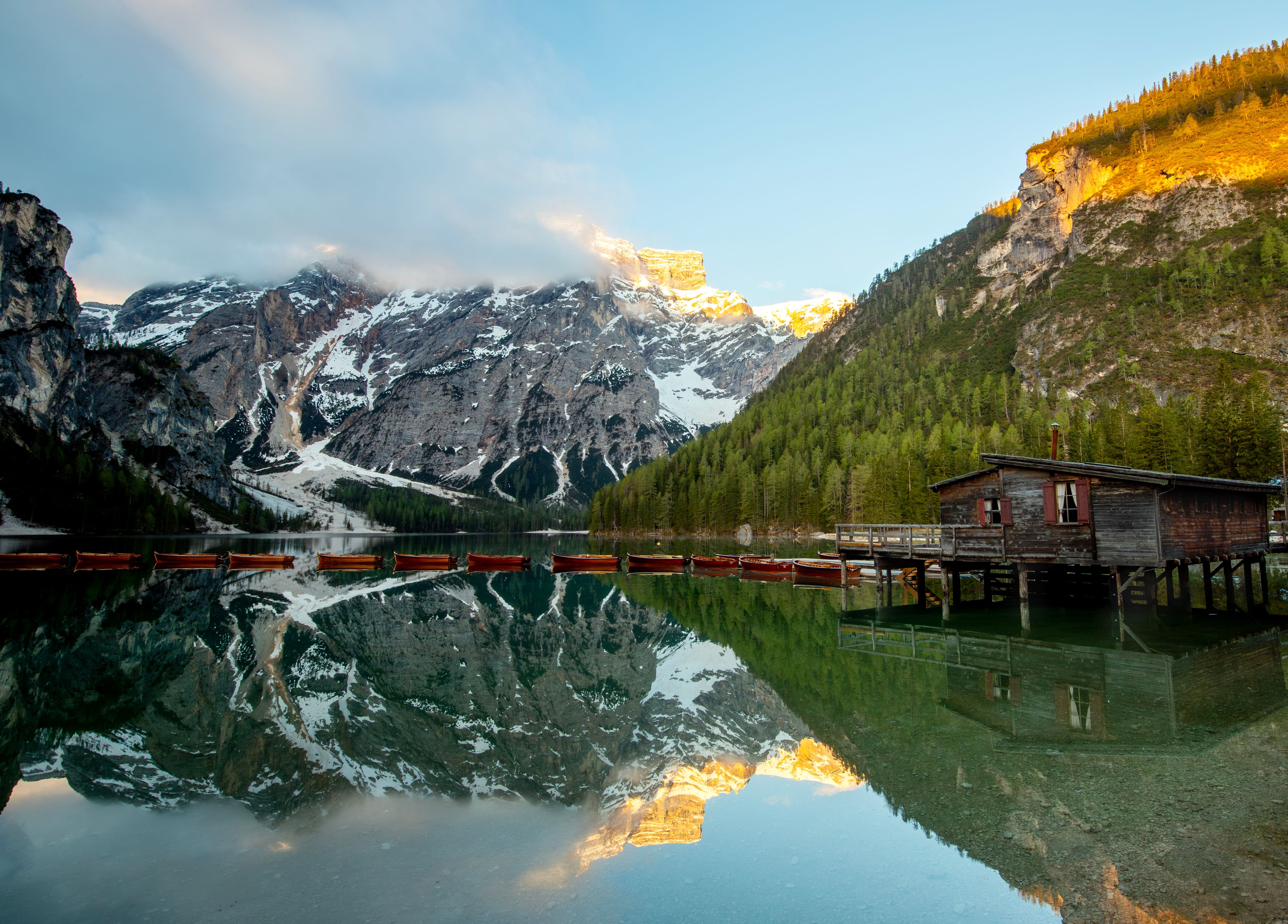
Lake Braies Sunrise
Before the oars arrive, the lake speaks in pale blue.
Lake Braies is small enough to feel held, yet bright enough to feel unreal.
It changes faster than most alpine lakes: light, color, and sound shift in minutes.
At sunrise, it asks you to look past the famous view and notice what’s left when nothing moves.
The Silence Behind the Boathouse Before It Opens
Most mornings at Lake Braies are approached like a checklist: the dock, the chalet, the mountain reflected cleanly enough to prove you were here. What gets missed is how quickly the lake becomes a stage once the first doors click open. Before that, the shoreline has a different grammar. Stand a little behind the boathouse, where the boards mute your footsteps and the trees hold the cold. The water there is darker, more ink than turquoise, and it carries sound strangely—one zipper, one quiet voice, a distant engine far down-valley. The iconic reflection is still present, but it’s less perfect and more truthful: faint ripples, a soft skew in the peaks, a thin seam of mist that keeps rebuilding itself. This pocket of shade is where the postcard view loosens its grip, and the lake feels like a place again, not an image.
The First Sunline on Croda del Becco
The transformation happens just after the horizon finds the upper rock—when Croda del Becco (Seekofel) catches a narrow band of sun and the lake is still mostly in shade. For a few minutes, the mountains separate into two temperatures: warm stone above, cold air below. The water responds in layers. The near edge stays steel-blue, almost opaque, while the center begins to brighten from within, as if the color is rising rather than reflecting. This is the brief interval when the lake feels quieter than it will all day, but also more awake: birds cut across the surface, a single oar-test squeaks somewhere, and then stops. If you arrive earlier, it can feel like waiting in the dark. If you arrive later, the light becomes more even and the spell thins. That first sunline is the cue; the lake changes its voice right then.
The Reflections
In windless conditions the peaks appear as a slightly softened duplicate, with the treeline forming a dark, steady border that makes the reflection feel anchored. As the first light reaches the upper rock, the reflected ridge gains a pale highlight while the lake remains shaded, creating a two-tone mirror.
The Water
The water reads as milky turquoise where light penetrates, caused by fine glacial silt suspended in the lake. At sunrise it often begins as cold blue-gray near the shore, then turns jade toward the center as the sun strengthens and the color lifts through the surface.
The Landscape
Steep forested slopes funnel your gaze toward Croda del Becco, which sits like a pale wall at the end of the basin. The boathouse, dock lines, and tight shoreline make the scene feel composed, while the surrounding trees keep the air still and cool in the early hours.
Best Angles
The main wooden dock by the boathouse
Stand near the left edge of the dock and aim toward Croda del Becco; keep the boathouse low in frame to avoid dominating the scene and let the reflection carry the center.
Eastern shoreline path toward the far end
Walk 5–10 minutes along the right-hand (east) side; shoot back toward the boathouse for a quieter composition with trees framing and less direct symmetry.
Behind the boathouse in the shaded pocket
Face the darker water and include a small strip of boardwalk or timber; this angle trades postcard clarity for mood—better for the lake’s early silence.
A low crouch at the waterline near the first bend of the path
Get close to the surface and let small ripples become the subject; it’s an intimate frame that records the lake’s temperature and stillness more than the mountain.
Crowd pattern — sunrise is the quietest window; by mid-morning the shoreline becomes continuous movement, and late afternoon can be busy again in summer.
Effort level — minimal walking to reach the water, but plan on slow pacing if you want quiet: the loop is easy and invites lingering rather than distance.
Access note — seasonal traffic management and parking limits can apply in peak months; check current regulations for Valle di Braies/Pragser Tal before you go.
What to bring — a warm layer even in summer dawn, quiet shoes for wet boards and gravel, and a small thermos; a microfiber cloth helps with lens fog from cold air over water.
Handpicked Stays & Tables
Places chosen for beauty and intention, not algorithms. Each one is worth your time.

Hotel Lago di Braies
On the lake’s shore

Hotel Tschurtschenthaler
Dobbiaco/Toblach

Restaurant at Hotel Lago di Braies
Lakeside

Hans Pizzeria Restaurant
Dobbiaco/Toblach
If you stay until the first boats loosen the surface, you’ll notice how quickly silence becomes a souvenir.