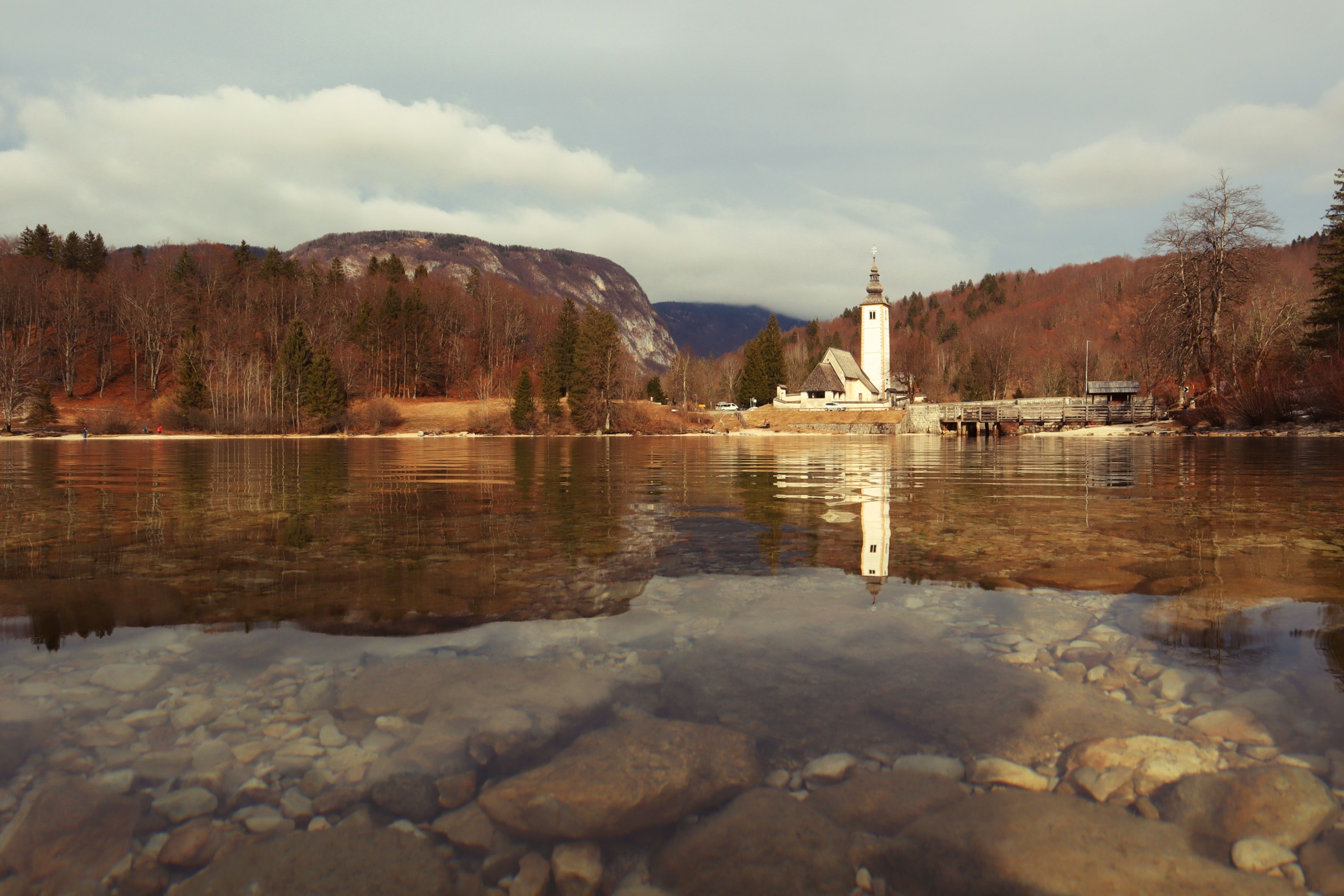
Lake Bohinj
When Vogel releases its mist and the lake learns its own face.
Lake Bohinj sits wide and quiet at the end of a glacial valley, holding the Alps softly.
It isn’t arranged for postcards; its shores feel lived-in, with weather and shadow doing most of the design.
The pull is subtle: a lake that changes character in minutes, then asks you to notice why.
The West End When the Valley Is Still Asleep
Most visitors meet Bohinj at midday, when the surface is broken by paddles and the light turns literal. The lake’s gentlest side happens earlier, around Ukanc at the western end, where the valley narrows and the water seems to pause before it becomes a river. Stand near the Savica mouth and watch how the air behaves: mist arrives in layers, not as one curtain, sliding low across the water and then lifting in slow sections as the sun reaches over the ridge. The sound is different here too—less shoreline chatter, more muffled resonance from the forest and distant birds. When the first boats launch at Ribčev Laz, the west end often stays quieter a little longer, as if it’s holding onto night. People miss that the lake is not one scene; it’s several rooms connected by water, and the west end is the one that keeps its voice down.
The Ten Minutes After Mist Drops Off Vogel
There is a brief shift that happens when Vogel’s slope stops catching cloud. It’s usually early—often between 06:30 and 08:00 in late summer and early autumn—when the night’s cool air finally loosens its grip on the lake. The mist that had been pinned to the mountain face starts to slide down in thin veils, then breaks apart, as if the valley is exhaling. For a few minutes the water goes unreasonably still, not because nothing is moving, but because everything is moving in the same direction: fog lifting, light widening, birds cutting straight lines across a surface that refuses to ripple. The mountains begin to appear as shapes first, then as textures—dark tree bands, pale rock, a single bright patch where sun finds grass. If you arrive right as this happens, Bohinj stops being a landscape and becomes a mirror you can stand beside.
The Reflections
When the wind drops, Vogel and the treeline duplicate themselves with clean edges, the reflection darker than the real thing. If mist is present, it softens the copy first, so the mirrored mountain fades before the mountain does.
The Water
Bohinj reads as deep green-blue, with a cold, mineral clarity that shifts with cloud cover. In sun it turns more emerald near the shallows, where pale stones and submerged grasses brighten the tone.
The Landscape
The lake is framed by broad forested slopes and the higher Julian peaks, with Vogel’s mass dominating one side like a closing door. Mist doesn’t just hover here; it travels along the valley, using the lake as a runway.
Best Angles
Ribčev Laz bridge (near the church of St. John the Baptist)
Stand on the bridge and face west toward Ukanc; frame the lake’s narrowing corridor with the church edge as an anchor. Best early morning when the surface is still and the valley feels longer.
Ukanc shoreline near the Zlatorog statue
Walk a few minutes away from the central path and face east; the lake opens wide and Vogel sits heavier in the frame. This angle carries more shadow and more mist, especially after cool nights.
South shore footpath between Ribčev Laz and Stara Fužina
Creators often stay on the main nodes; this quieter stretch gives low, intimate reflections of reeds, stones, and leaning trees. Shoot parallel to the shoreline to let small ripples read as texture, not distraction.
A still bench or flat rock on the north shore (away from the piers)
Sit facing slightly southwest, not directly at the peaks; let the lake fill most of your view. This is for noticing—how light moves across water—more than for collecting a shot.
Crowd pattern — Ribčev Laz is busiest late morning to mid-afternoon; Ukanc stays quieter earlier, and the lake feels most empty before 08:30.
Effort level — mostly flat walking on lakeside paths; expect short strolls rather than climbs unless you add viewpoints.
Access note — parking is commonly paid; parts of the area sit within Triglav National Park, so stay on paths and follow local signage and seasonal restrictions.
What to bring — a light layer for chilly mornings, a small towel if you sit near damp grass, and a thermos; for photography, a polarizer helps once the sun is higher, but skip it at dawn if you want pure reflections.
Handpicked Stays & Tables
Places chosen for beauty and intention, not algorithms. Each one is worth your time.

Hotel Bohinj
Ribčev Laz

Eco Hotel Bohinj
Bohinjska Bistrica

Gostilna Danica
Bohinjska Bistrica

Foksner Burger
Bohinjska Bistrica
If you arrive while the valley is still deciding what kind of day it will be, Bohinj tells the truth in reflections.