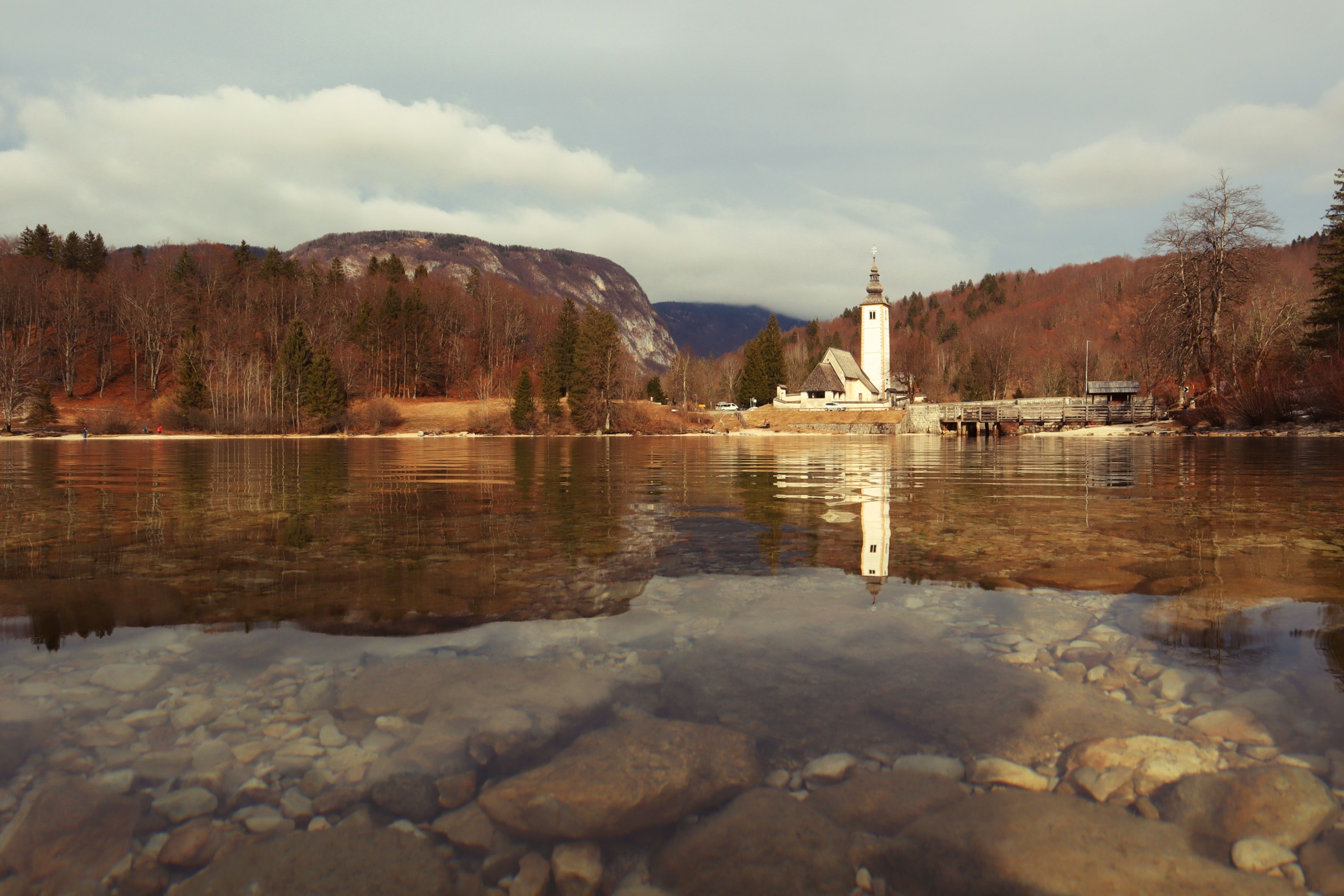
Lake Bohinj
Where reedbeds keep their own small weather.
Lake Bohinj sits quiet and heavy in its valley, letting sound travel farther than you expect.
Unlike the nearby lakes that perform for the road, Bohinj changes by inches: wind, shade, and the slow breathing of springs.
It pulls you in with restraint — a place that doesn’t ask for attention, only for time.
The Springs Beneath the Reeds by St John
Most people stop at the Church of St John the Baptist, take the picture, and leave with the lake still “intact” — a single surface. Walk past the church toward the reedbeds at the eastern end and the water starts to separate into layers. There are small upwellings under the reeds, cold and clear, that change the texture of the shallows: a faint trembling in an otherwise still sheet. Look for it on a quiet morning when the tour chatter hasn’t arrived. The reeds make a soft barrier, and behind them the lake feels less like open water and more like a living margin — half lake, half wetland. You’ll notice how the color shifts from bottle-green to pale, mineral transparency near the springs, and how the stones on the bottom seem closer than they should. If you stop speaking, you can hear the place better: light clicking of reed stems, a distant bell from Ribčev Laz, and the nearly inaudible movement of water rising from below, as if the lake is being filled in secret.
The Minute the Valley Shade Reaches the Water
Lake Bohinj transforms when the sun slips behind the mountains and the valley shade begins to slide across the surface — not at sunset itself, but earlier, when the light changes direction and the warmth leaves the shore. On clear days it happens fast: a thin line of shadow advances from the southern side, and the lake’s expression tightens. The water stops sparkling and starts holding detail. Reflections become less busy, more exact: the treeline sharpens, the ridges look closer, and the church tower by the bridge becomes a dark mark rather than a postcard subject. Even the air feels different — cooler, more resinous, with the scent of damp wood rising from the banks. Stand near the bridge at Ribčev Laz and watch the change arrive. Boats that looked cheerful in sun begin to look like silhouettes; conversations drop in volume as people sense the temperature shift. For a short window, the lake feels older and quieter, as if it’s returning to itself for the night.
The Reflections
In calm conditions, Bohinj reflects in bands: a dark treeline stripe, then a softer mountain wash, then a thin sky glaze. Near the eastern reeds, reflections blur subtly where springs disturb the surface, like someone exhaled under the water.
The Water
The water reads deep green with a slate undertone, colored by depth, forest shadow, and the mineral clarity coming down from the Julian Alps. In the shallows near the reedbeds and springs, it lightens into a cold, glassy turquoise where the bottom becomes visible.
The Landscape
Mountains close the lake in, so the horizon is made of slopes, not distance. Mist often lingers low at the ends of the basin, and when wind drops, the lake looks held in place—contained, listening.
Best Angles
Ribčev Laz bridge, facing west
Stand on the bridge and frame the church with the lake opening behind it; aim slightly left to catch the darker mountain mass and a quieter water surface.
Reed edge east of the church (shore path)
Step off the main photo line and follow the path until the reeds thicken; shoot low along the reeds to show texture and the subtle spring-ripples.
Ukanc western end, looking back east
Most creators stay near Ribčev Laz; from Ukanc you get the lake as a long, shaded corridor with mountains compressing the scene and fewer distractions.
A bench or stone at the waterline near the church, after shade arrives
Don’t frame—just sit close enough to hear the reeds and watch the surface change from sparkle to mirror; this is for timing, not proof.
Crowd pattern — Ribčev Laz gets busy mid-morning to mid-afternoon in summer; arrive before 09:00 or come late afternoon when people drift back toward the road.
Effort level — mostly flat walking on lakeside paths; the real effort is patience and moving slowly away from the bridge area.
Access note — parking can fill in peak season and may be paid; Lake Bohinj sits within Triglav National Park rules, so stay on paths and respect quiet zones near reedbeds.
What to bring — a light layer even in summer (shade cools fast), insect repellent for reed-edge evenings, and shoes that handle damp ground if you linger near springs.
Handpicked Stays & Tables
Places chosen for beauty and intention, not algorithms. Each one is worth your time.

Hotel Jezero
Ribčev Laz, near the lakeshore

Eco Hotel Bohinj
Bohinjska Bistrica

Gostilna Danica
Bohinjska Bistrica

Restavracija Vogel
Ukanc (near the cable car area)
Beyond the church, the lake stops posing and starts speaking in small, cold movements under the reeds.