Jökulsárlón
When the ice stops drifting, it starts speaking.
Jökulsárlón is a lagoon that feels less like a destination and more like a pause.
It isn’t defined by shoreline or depth, but by moving ice and the slow breath of the tide.
People come for the blue, then stay—if they slow down—for the small sounds that make it real.
The Reeds at the Outflow, Where the Ice Clicks
Most visitors watch the big bergs and the seals, then leave with the image they came for. But the quieter story happens lower, near the lagoon’s narrow outflow toward the sea, where thin reeds and stranded grass collect along the edges. Small ice fragments—coin-sized, palm-sized—get trapped there and begin to behave differently than the larger floes. Instead of gliding, they pivot. They touch, separate, touch again. On a calm day the sound is delicate: a dry clicking, like porcelain tapped under water, or a handful of tiny stones stirred slowly. It’s not loud enough to carry across the parking lot, which is why people miss it. You have to stand close, not over the water, just near it, and wait until your own footsteps stop being part of the scene. The reeds make a soft boundary. The ice answers it, one small contact at a time.
The Slack Tide After the Boat Noise Fades
Jökulsárlón changes when the lagoon stops choosing a direction. There is a short window—often after the last boat tours and before full evening—when the tide loosens its grip. The current at the channel quiets, and the ice that was being pulled begins to hesitate. Pieces that looked busy a minute ago settle into a slower choreography. This is when the lagoon’s surface turns more precise. The ripples flatten enough to hold reflections, but not so flat that everything becomes a mirror. The bergs rotate slightly as they find new balance points; the smallest shards drift into the reed line and start their faint ticking. The air cools fast here, and you feel it first on your hands. In that slackness, the place stops performing. It becomes ordinary in the best way: water, ice, a muted current, and time you can actually hear.
The Reflections
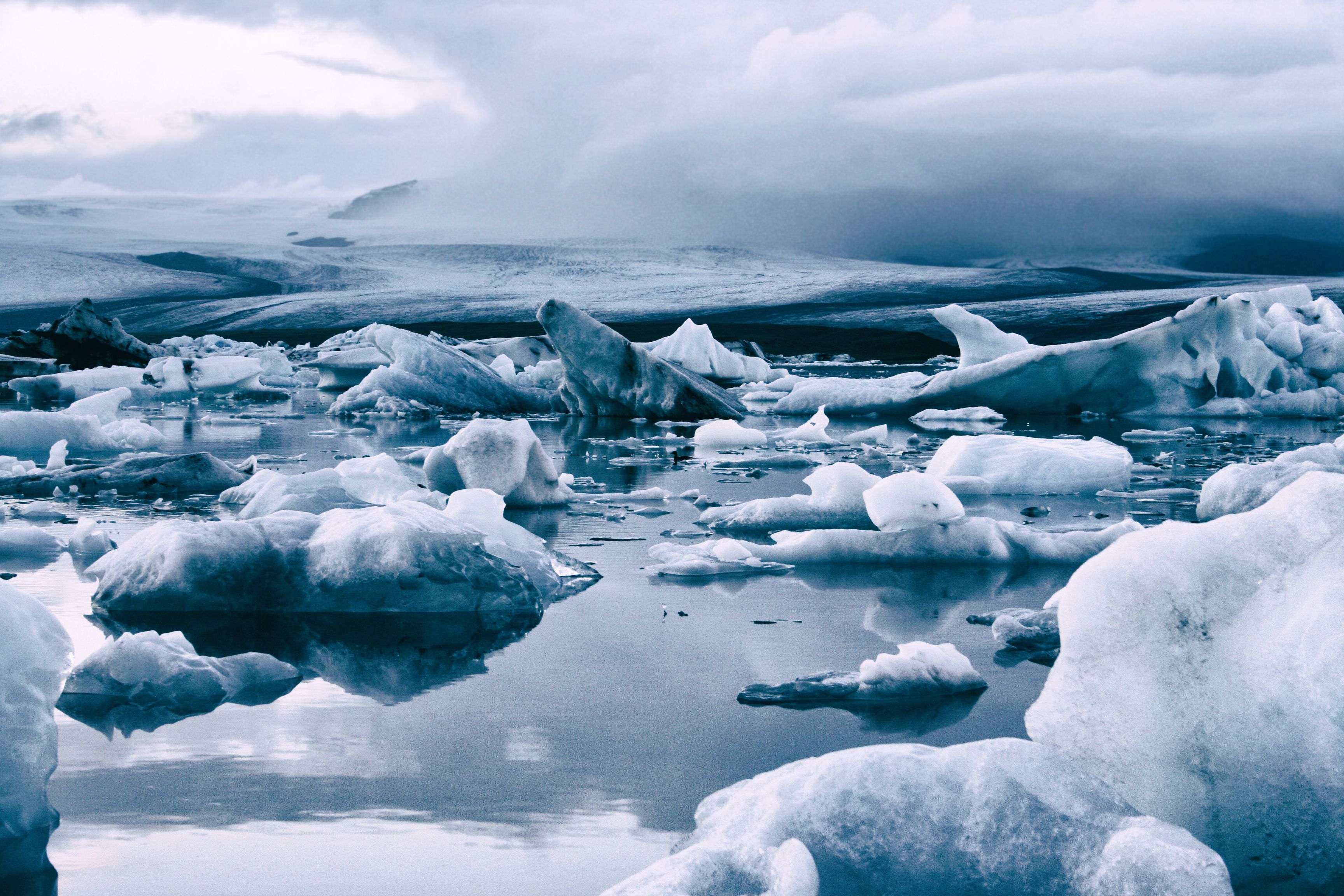
When the wind drops, the lagoon holds the darker undersides of ice like ink sketches. The bergs don’t reflect as whole shapes so much as bright fragments—white edges, blue seams, a sudden clean curve repeated on the surface.
The Water
The water is a deep, cold gray-green with a glacial milkiness that shifts as silt moves through the lagoon. Near the ice, it can turn steel-blue, lit from below by the bergs’ compressed interior.
The Landscape
Behind the lagoon, the glacier sits like a pale wall, and beyond it the low, dark ridges keep the horizon grounded. The scene feels open, but never empty; there is always motion somewhere, even if it’s only a berg turning a few degrees.
Best Angles
Footbridge over the channel (near the Ring Road)
Stand on the bridge and look back into the lagoon, not out to the sea; frame the channel as a dark ribbon with ice moving through it. Best when the current is gentle and the surface isn’t chopped.
Eastern shore path (parking side), slightly away from the main cluster
Walk 5–10 minutes away from the crowd line and shoot along the shoreline, keeping the ice low in the frame and the glacier as a soft backdrop. This angle feels quieter and less postcard-perfect.
Outflow edges where reeds gather (downwind side)
Most creators stay wide; instead, go close and frame small ice pieces against reeds and dark water. The mood becomes intimate, and the sound—the clicking—starts to matter.
A still pocket between grounded ice near shore
Turn your back to the main viewpoint and look for a sheltered inlet where the water is calmer. Don’t compose for scale; compose for texture—wet ice skin, tiny bubbles, the slow rotation of a shard.
Crowd pattern — busiest from late morning to mid-afternoon; noticeably calmer early morning and the last hour before dusk, especially outside peak summer.
Effort level — short, flat walking on gravel and compacted paths; expect cold hands and a persistent edge-of-water chill.
Access note — parking is paid and weather can close or slow travel on Route 1; check road conditions and avoid stopping on the roadside outside marked areas.
What to bring — a windproof outer layer, gloves thin enough to handle a camera/phone, and something to sit on if you want to wait for slack water without rushing.
Handpicked Stays & Tables
Places chosen for beauty and intention, not algorithms. Each one is worth your time.

Fosshotel Glacier Lagoon
Between Jökulsárlón and Skaftafell (Route 1)

Höfn Guesthouse (town stays in Höfn)
Höfn

Pakkhús Restaurant
Höfn

Heimahumar (food truck)
Höfn harbor area
If you give Jökulsárlón enough quiet, the ice stops being scenery and becomes a voice.