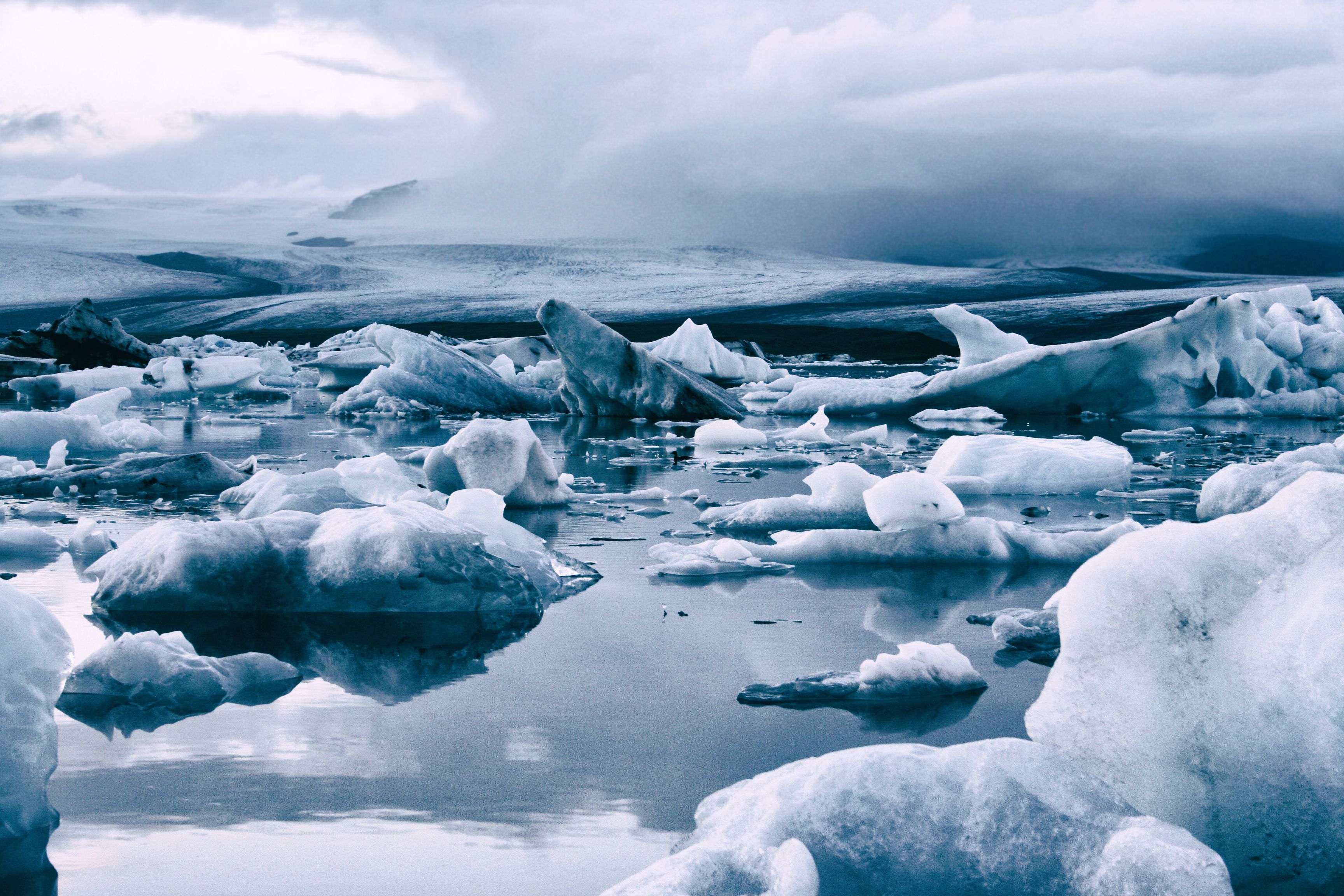
Jökulsárlón
Where the lagoon exhales, and the ice remembers it must leave.
Jökulsárlón is a lake that is always in the act of becoming something else.
Unlike most lakes, its surface is a moving archive: ice pages turning toward the sea.
It pulls at you because everything here is temporary, and you can watch it happen.
The Outflow Channel When Everyone Looks Back at the Glacier
Most people stand on the lagoon side and keep their eyes on the glacier, waiting for a crack, a calving, a dramatic sound. But the quieter story is downstream, where the lagoon narrows into the outflow and the whole place starts to behave like a sentence ending. Walk toward the bridge and watch the ice decide what it is: a wide, pale slab becomes a rotating coin; a blue shard flips once and suddenly looks almost black; pieces that seemed still begin to slide as the current gathers them. The water here isn’t calm-lake water. It has a direction, and you can feel it in how the surface tightens and then loosens again. If you stand a little away from the rail, you’ll notice the sound changes too—less open lagoon, more channel: a low pour, occasional ice-on-ice clicks, and the hollow tap when a small piece bumps the rocks. It’s not an overlook. It’s a threshold.
The First Slack Tide After Dawn, When the Channel Pauses
The transformation happens when the tide eases and the outflow briefly loses its insistence—often shortly after dawn, when the sky is already bright but the lagoon still holds night in its color. For a short window, the channel under the bridge slows enough that the ice stops racing and starts drifting with deliberation. You’ll see bergs hesitate, pivot, then commit. Some turn broadside and flash a clean, glacial blue; others roll to show their dirt-streaked backs, the part that’s been underwater, the part that has carried sand. The pause makes the lagoon feel less like a spectacle and more like a living system taking a breath. Light arrives gently here, not as a sunrise burst but as a thinning of grey. The mountains stay muted; the ice becomes the brightest thing. In that slackness, the journey is visible—ice not merely floating, but leaving.
The Reflections
On windless mornings, reflections don’t form as a perfect mirror—they fracture around ice edges, making the sky look cut into pieces. Near the channel, reflections stretch into soft ribbons as the current pulls them downstream.
The Water
The lagoon reads as milky blue-grey, colored by glacial silt suspended in the water. When clouds thin, the color lifts toward pale turquoise; when overcast deepens, it turns to steel with a faint jade undertone.
The Landscape
The glacier sits back like a quiet engine, while low mountains and wide, dark sand plains keep the horizon simple. The bridge and the narrow channel add a human line that makes the movement of ice easier to notice.
Best Angles
Bridge (lagoon side) facing the outflow
Stand on the south side of the bridge and look east toward the sea; frame the narrowing channel with bergs lined up like slow traffic, and keep the horizon low to emphasize water movement.
Footpath along the lagoon’s near shore (parking-side shoreline)
Walk a few minutes away from the main cluster and shoot back toward the glacier; the ice looks more scattered and quiet, and the soundscape thins out with distance.
Under-bridge angle from the bank (safe distance, low viewpoint)
From the bank near the bridge, drop your viewpoint close to the water and frame the underside shadow against a bright berg; creators often miss how the channel turns reflections into lines.
A still moment on the rocks away from the rail
Sit where you can hear the water pour without seeing many people; don’t photograph—watch the small ice pieces spin, touch, separate, and leave.
Crowd pattern — busiest late morning through mid-afternoon, especially in summer; quietest early morning and later evening when buses thin out
Effort level — flat, short walking on gravel paths; cold wind can make it feel more demanding than it looks
Access note — no permits for viewpoints; conditions can change quickly and storms can close roads; follow local safety guidance and stay off unstable edges and ice
What to bring — windproof layers, gloves that allow camera control, a lens cloth for spray and mist, and waterproof footwear for wet gravel near the shoreline
Handpicked Stays & Tables
Places chosen for beauty and intention, not algorithms. Each one is worth your time.

Fosshotel Glacier Lagoon
Between Skaftafell and Jökulsárlón

Hali Country Hotel
Near Jökulsárlón (Hali)

Heimahumar (Höfn)
Höfn

Pakkhús Restaurant
Höfn harbor area
Stay by the bridge long enough, and you’ll see the lagoon isn’t holding ice—it’s letting it go.