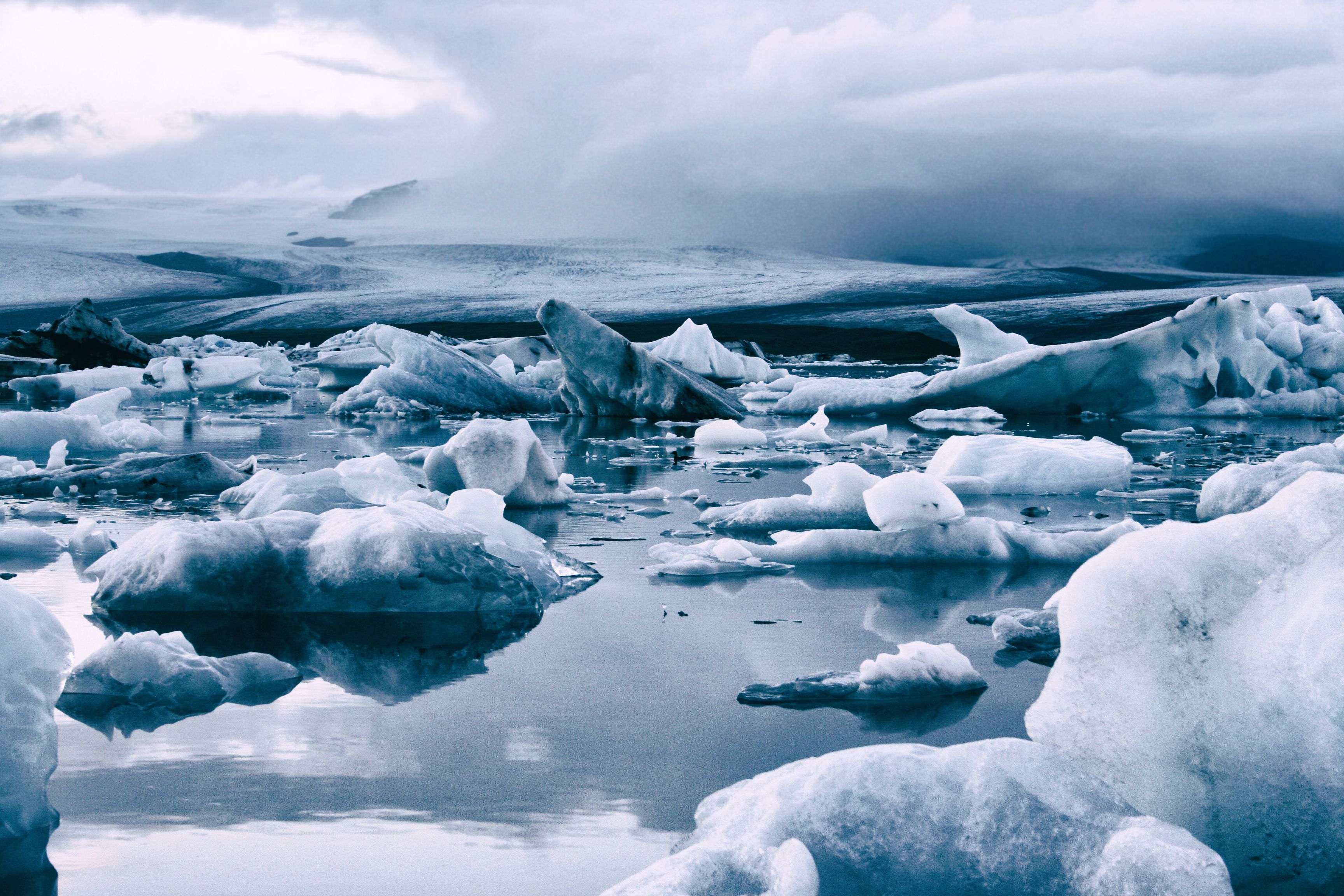
Jökulsárlón
When the ice pauses, and the lagoon chooses which way to breathe.
Jökulsárlón is a lagoon that feels more like a slow sentence than a place.
It is not fed by springs or rainfall, but by a glacier that keeps letting go—quietly, repeatedly.
You come for the blue, then stay because the water seems to be thinking.
The Still Hour Between the Outflow and the Return
Most visitors read Jökulsárlón as a spectacle: ice, color, motion. They stand at the main railings and follow the largest bergs as if the lagoon has a single direction. But the lagoon is tidal, and there is a narrow, easily missed window when it feels undecided. The outflow toward the ocean weakens, the surface loosens, and the smaller pieces stop traveling with purpose. They begin to rotate instead—slow quarter turns, lazy pivots—like they are testing their balance. This is when the silt shows itself: a faint milkiness gathering in seams and eddies, softening the water’s edge around each ice fragment. You can watch a line of foam hesitate, then slip back inland, as if the lagoon has changed its mind. It’s not dramatic. It’s the kind of shift you only notice if you stop narrating and start waiting.
Ten Minutes After the Wind Drops
Jökulsárlón transforms when the wind gives up. Not when it calms—when it stops with a clean, sudden finality. The ripples flatten, and the lagoon becomes a sheet that can finally hold an image. Ice that looked restless a moment ago turns solemn. The smallest pieces of glacier-ice—clear as glass, threaded with bubbles—begin to show their inner structure, because the water no longer breaks the light into fragments. Sound changes too: the distant road dulls, the boats feel far away, and you can pick out the small clicks of ice touching ice, the soft scrape of a berg turning in place. If a fresh calving has happened earlier in the day, the lagoon carries a different tension—new fragments drift with sharper edges, still too clean to look weathered. In this windless pocket, time feels visible, like a slow current you can finally see.
The Reflections
When the surface settles, reflections appear in pieces rather than panoramas: a strip of sky, a dark ridge, the underside of an iceberg. The ice throws back pale light, while the water keeps the mountains muted, as if unwilling to compete.
The Water
The water holds a cold, green-blue tone that shifts toward steel depending on cloud cover. Fine glacial silt suspended in the lagoon gives the color a faint opacity, especially where currents braid and overlap near the channel.
The Landscape
The lagoon sits low and open, framed by the dark, scraped slopes of Breiðamerkurjökull and distant, snow-streaked ridgelines. Everything feels wide and exposed—so the smallest changes in mist, wind, and light register immediately.
Best Angles
Main shoreline by the parking area railings
Stand a few steps back from the crowd and frame across the lagoon toward the glacier tongue; shoot slightly down to include the silt-dark water as a contrast field for the ice.
The bridge on Route 1 over the outlet channel
Face seaward at falling tide to watch the ice commit to the ocean; face inland at rising tide to catch the moment the current reverses and the lagoon pulls pieces back.
The quieter eastern edge (short walk away from the main cluster)
Most creators stay near the boat activity; walk until you can hear fewer voices, then frame the smaller, clearer ice pieces where the water looks calmer and the reflections hold.
A low, wind-sheltered pocket along the shore
Forget the wide shot and sit with one iceberg for five minutes; watch it turn, listen for contact, and notice how the waterline redraws itself with each small movement.
Crowd pattern — busiest from late morning through mid-afternoon, especially when tour coaches arrive; quietest early morning and after dinner when the lagoon feels less performed.
Effort level — minimal walking, but expect cold, persistent wind and long periods of standing still if you want the subtle shifts.
Access note — parking is paid at many South Coast sites; conditions can change fast in winter with ice and strong gusts near the shoreline.
What to bring — windproof outer layer, thin gloves for camera handling, a lens cloth for spray and drizzle, and footwear with grip for icy, wet ground.
Handpicked Stays & Tables
Places chosen for beauty and intention, not algorithms. Each one is worth your time.

Fosshotel Glacier Lagoon
Between Skaftafell and Jökulsárlón

Höfn Guesthouse (local options in town)
Höfn

Pakkhús Restaurant
Höfn

Heimahumar (food truck)
Höfn harbor area
Leave after you’ve watched the current change its mind at least once.