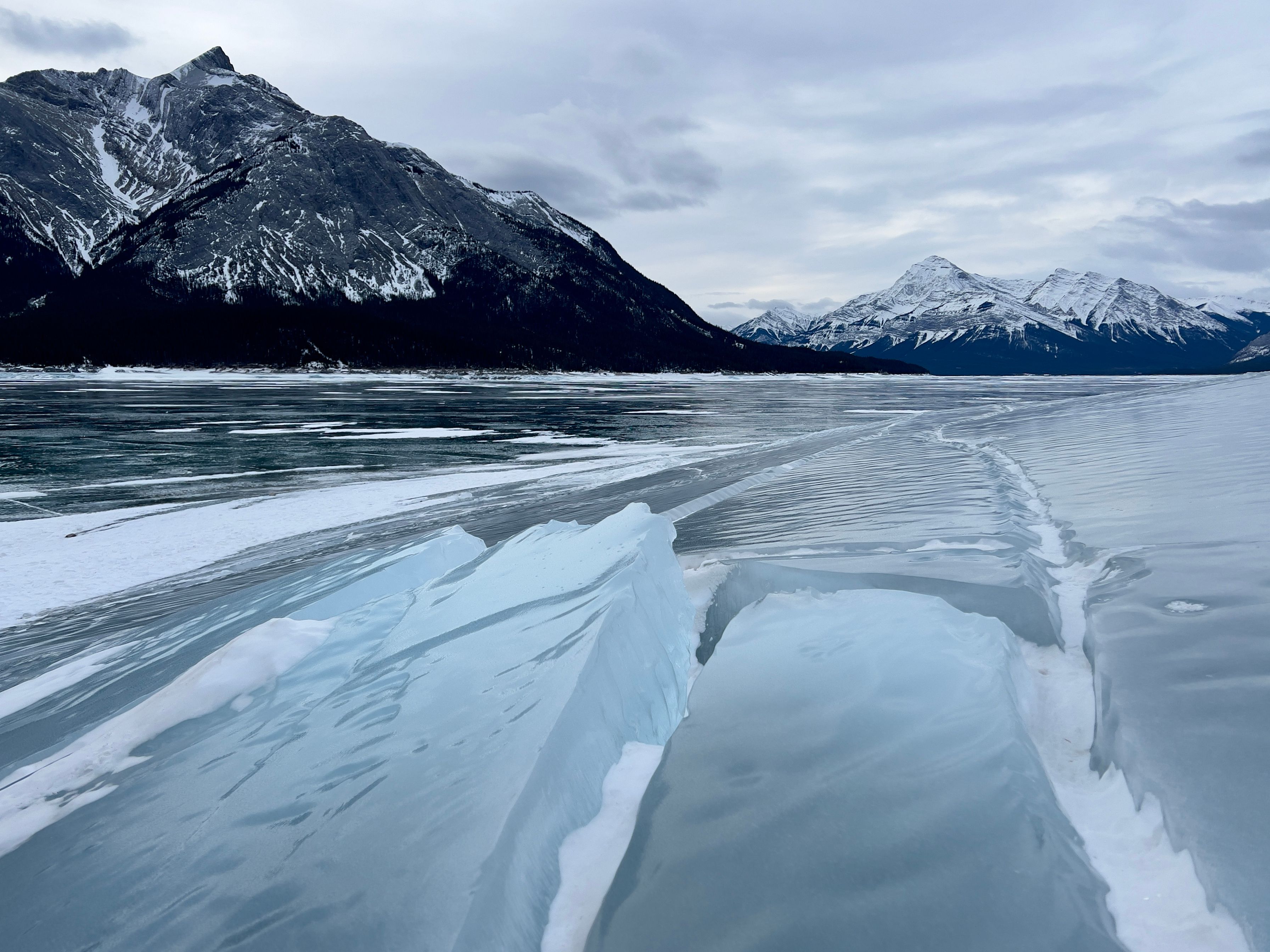
Abraham Lake
When the wind combs the ice and the blue stays open.
Abraham Lake is a long, working reservoir that behaves like a wild lake in winter.
Its wind-scoured ice, trapped bubbles, and sudden blue cuts don’t repeat the same way twice.
It matters because it teaches patience: you climb, you wait, and the surface changes its mind.
The Blue Cut Is Not a Color — It’s a Gap in the Story
Most people come down to the ice and stay there, face-to-surface, collecting the bubbles like stamps. They miss how Abraham Lake reads from above. Climb a short ridge and the scene rearranges: the famous turquoise doesn’t look painted anymore. It looks structural—like an opening. From a higher line, the lake shows its seams. Wind has planed certain bays to matte white while other stretches remain dark and clear, a hard blue channel that feels poured in later. You can see where the current has kept a corridor thinner, where pressure ridges kink the surface, where yesterday’s drifted snow has already been combed into ribs. Down on the ice, the wind is an annoyance. From the ridge, it becomes the editor. It strips the lake clean, reveals what’s under, then hides it again in minutes. The blue cut is the lake’s most honest detail: not decoration, but motion made visible.
Midmorning After a Cold Night, Before the Day Warms the Edges
Abraham Lake shifts most clearly after a deep freeze, when the night has tightened the surface and the day hasn’t softened it yet. Aim for midmorning—roughly 9:30 to 11:00—when the sun has cleared the ridge line but the air is still sharp enough to keep the ice quiet. This is when the “blue cut” wakes up. The light stops skimming and starts entering. Clear sections turn from black-glass to a saturated, mineral blue, while the snow-dusted plates stay pale and chalky. The contrast sharpens until it looks intentional, like a map drawn in two inks. You’ll feel the wind first on the ridge: it presses sound flat, pulls heat from your hands, and keeps the lake from feeling gentle. Then, for a few minutes, the gusts line up with the surface and you can watch the texture change—spindrift slides, tiny crystals flash, and the blue corridor seems to deepen rather than brighten. The lake becomes less like a viewpoint and more like a moving diagram.
The Reflections
In winter, reflections are selective: clear ice mirrors the sky in dark panels while snowed-over sections swallow detail. On calm intervals between gusts, the mountains appear as broken, angled fragments rather than a single clean reflection.
The Water
The signature color isn’t always “turquoise”—it ranges from ink-blue to glacial cyan depending on how clear the ice is and how much light can enter. The blue cut forms where wind and current keep areas thinner and cleaner, letting the lake’s depth and sediment tint the light.
The Landscape
The lake is framed by steep, dry slopes and the blunt geometry of the Rockies, with a sense of open corridor rather than a sheltered bowl. Pressure ridges, snow ribs, and long shoreline lines give the scene a drawn, almost graphic clarity.
Best Angles
Windy ridge above the North Saskatchewan River corridor (south shore pullouts)
Climb a short, open slope above the highway pullouts and face down-lake to frame the blue cut as a long diagonal. Keep the horizon high and let the ice patterns do the work.
Shoreline edge where clear ice meets drifted snow
Stand back from the lip and shoot parallel to the seam so the surface reads as layers: chalk, glass, and blue. This angle holds the wind’s texture without needing a wide panorama.
Pressure ridge lines crossing the lake
Most creators isolate bubbles; instead, use ridges as leading lines from foreground to the mountains. The lake feels more like a living surface than a gallery of details.
A quiet pause on the ridge with your back to the water
Turn away for a minute and listen to the wind moving through scrub and snow. When you face the lake again, the blue reads less like a photo opportunity and more like weather passing through.
Crowd pattern — Weekends in February are busiest near easy pullouts; early weekdays can feel empty, with long quiet stretches between cars.
Effort level — The ridge is short but exposed; expect wind, uneven snow, and a steady, bracing climb rather than a long hike.
Access note — Conditions change fast; avoid venturing onto ice without local knowledge and current safety guidance. Some pullouts can be icy or buried after storms.
What to bring — Windproof outer layer, warm gloves you can still operate a camera/phone with, traction (microspikes), and a thermos; the wind drains you faster than distance does.
Handpicked Stays & Tables
Places chosen for beauty and intention, not algorithms. Each one is worth your time.

Aurora Borealis Motel
Nordegg

Sundance Lodges (Kootenay Plains area)
Near Saskatchewan River Crossing / David Thompson Country

Miners Cafe
Nordegg

The Crossing Resort Dining Room
Saskatchewan River Crossing
Up on the ridge, the lake stops being scenery and becomes a record of wind and time.