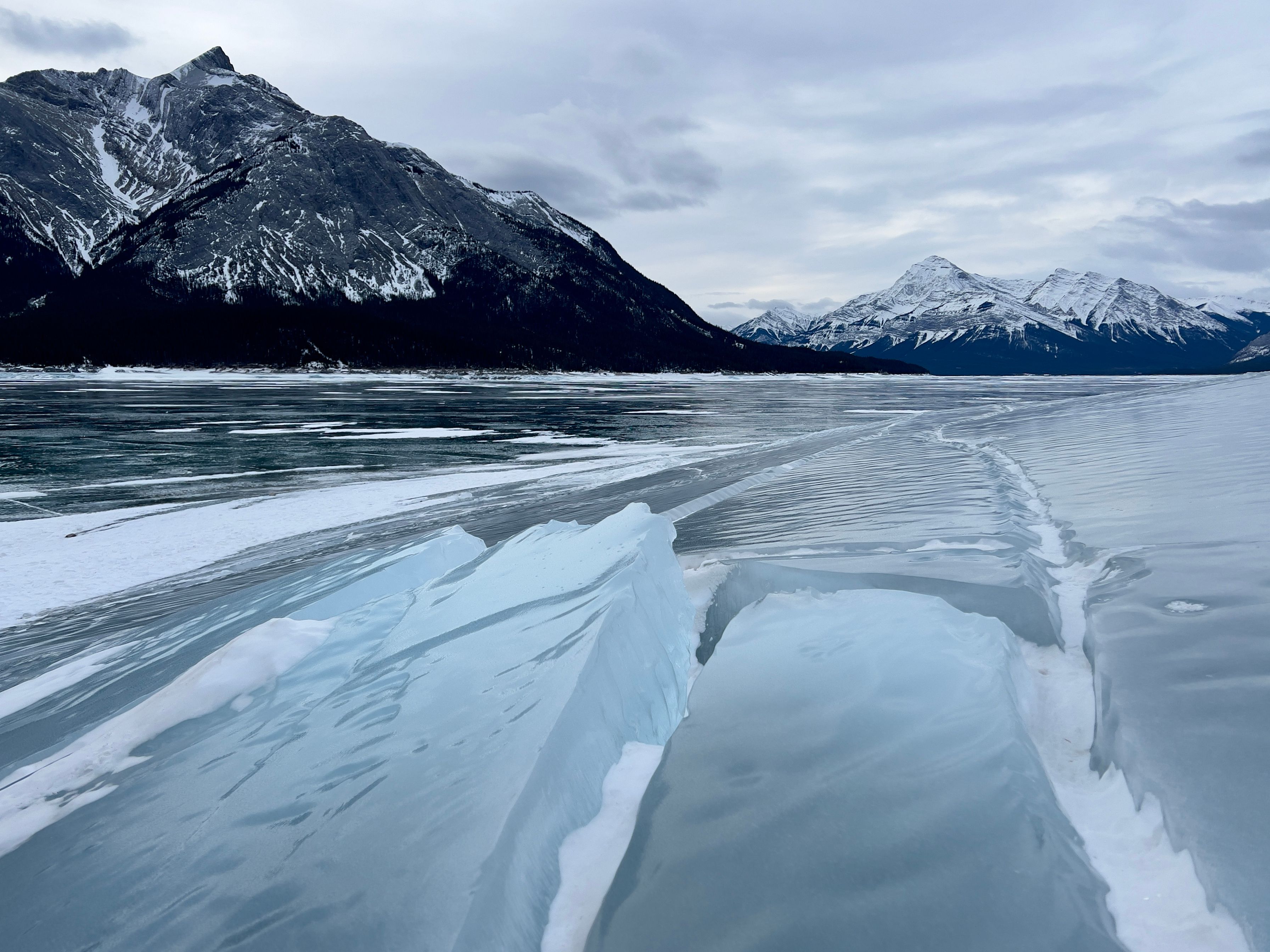
Abraham Lake
When warm wind loosens the ice and the lake quietly changes direction.
Abraham Lake sits long and open on the Icefields Parkway, where winter has room to speak.
It is a reservoir, but it behaves like a glass sheet—storing methane bubbles in clear ice, then releasing them back to motion.
It pulls you in because it teaches you to watch for small shifts: a breath of wind, a soft crack, a new sheen.
The Ice Starts Moving Before You Notice It
Most visitors come looking for perfect bubble ice—flat, clear, still. They walk out, take their frame, and leave as soon as the wind arrives, as if the lake has stopped cooperating. But Abraham is most revealing when it begins to change. On a chinook morning, warmth slides down from the ridges and the ice loses its hard certainty. The surface doesn’t melt all at once; it loosens in plates, and those plates drift almost imperceptibly, as if the lake is rearranging itself without sound. Watch the seam lines: hairline cracks that widen, then quiet again. Watch the frozen bubbles: the white discs and stacked pearls begin to sit at a slightly different angle to the light. Near the shoreline, a thin rim of water opens and closes with each faint push of wind. It’s not dramatic. It’s a small unfastening. If you stay, you see the lake stop being a photograph and become a process.
The First Chinook Breath After a Cold Night
The transformation happens in a narrow window: after a clear, deep-freeze night, when the first warm air arrives low and steady. It often feels like nothing at first—just softer cold against your face. Then the ice changes its tone. What was sharp and bright becomes slightly greyed, as if a veil has been laid over the surface. Stand still and listen for the lake’s small sounds: distant pops, the long, slow creak that travels under your feet, the hush of grit skittering across the ice. The bubble fields—those trapped, milky constellations—start to look less like objects and more like depth, like something suspended rather than fixed. In the minutes after the sun clears the ridge line, the light begins to skim instead of strike, and the drifting plates catch it in shifting bands. This is when Abraham feels different: not frozen, not open—half released, deciding.
The Reflections
When the surface is newly smoothed by overnight cold, the mountains appear as pale, stretched forms, more suggestion than mirror. As chinook wind arrives, reflections break into stitched fragments, moving slightly out of alignment from one ice plate to the next.
The Water
Where the ice thins or opens near shore, the water shows a cold turquoise-green, tinted by glacial silt carried from the North Saskatchewan River. Under clear ice, the color sits like diluted paint—subtle until the sun lifts and the lake brightens from within.
The Landscape
A long corridor of Rockies frames the lake: dark conifers at the edges, open slopes above, and broad, pale mountains that hold snow in shaded folds. The feeling is exposed and clean, with the wind given a full runway across the reservoir.
Best Angles
Preacher's Point day-use area shoreline
Walk a short distance onto the ice only if conditions are proven safe; face west-northwest to keep mountains layered behind bubble fields and leading cracks.
Cline River mouth area (south end influence)
Look for a transition zone where ice clarity changes; frame the gradient from pale turquoise water to cloudy ice for a quieter, more documentary mood.
Wind-scoured mid-lake edges near pullouts on Hwy 11
Creators often miss the scoured surfaces: low angle shots along the ice show drift lines, grit, and the first wet sheen that signals the chinook shift.
The shoreline at your feet, no horizon
Kneel close and photograph (or simply watch) the bubbles with only a thin band of light crossing them; it’s the intimate proof of change, not the postcard.
Crowd pattern — Weekends and sunny mid-mornings draw photographers; weekdays at dawn are quieter, especially in colder snaps.
Effort level — Mostly flat walking from pullouts, but expect uneven, wind-hardened snow and very cold exposure with little shelter.
Access note — Conditions change quickly; check local advisories and never assume ice is safe. Roadside parking can be icy and limited; respect no-stopping zones on Hwy 11.
What to bring — Ice cleats, windproof layers, eye protection for glare, a thermos, and a wide lens plus a polarizer (used lightly) for controlling surface sheen.
Handpicked Stays & Tables
Places chosen for beauty and intention, not algorithms. Each one is worth your time.

David Thompson Resort
Near Saskatchewan River Crossing

Nordegg Cabins (local rentals)
Nordegg area

The Miner's Cafe
Nordegg

Trading Post at Saskatchewan River Crossing
Saskatchewan River Crossing
Stay long enough to see the ice stop holding still, and you’ll understand what the wind is writing.