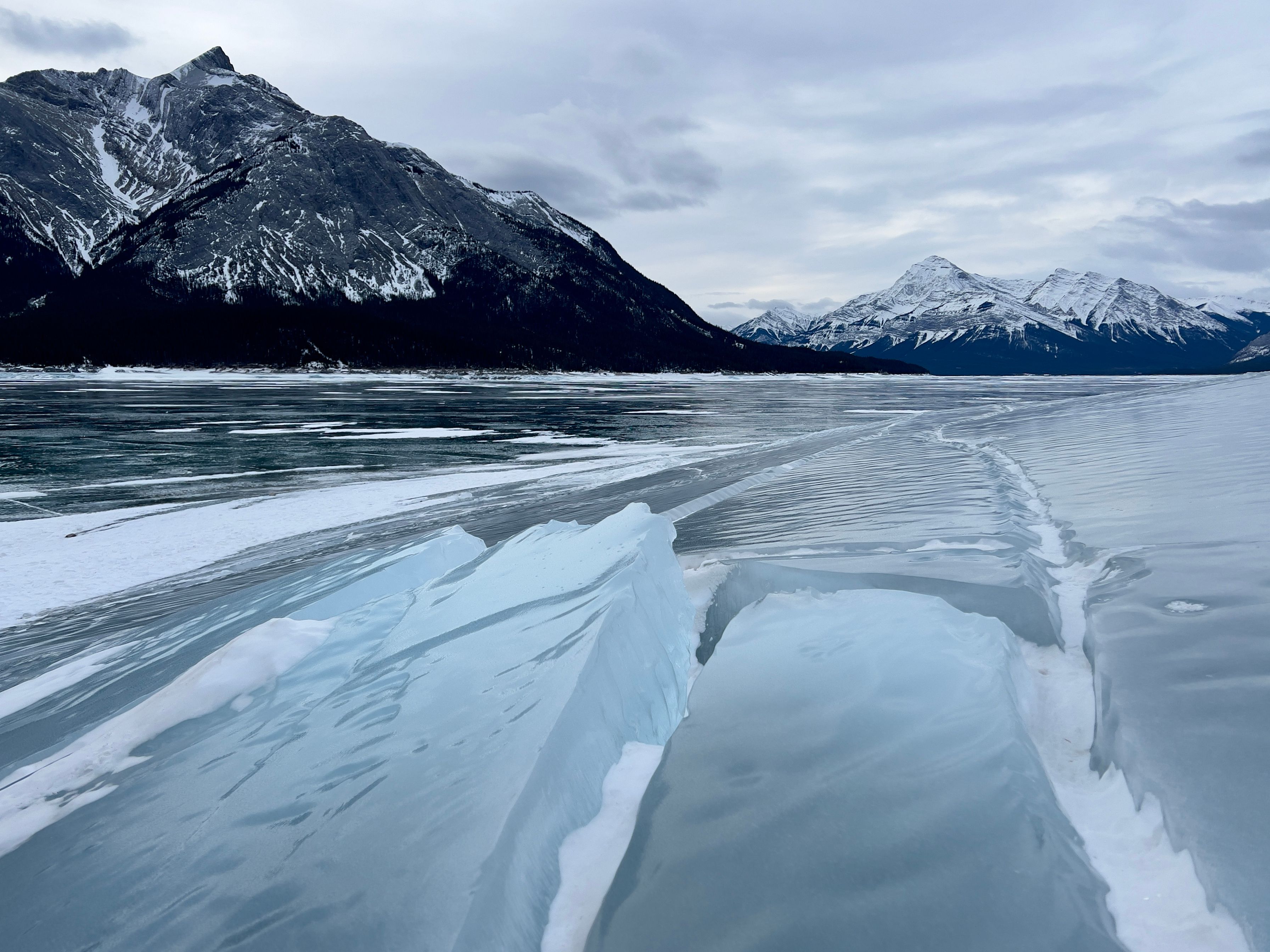
Abraham Lake
When the ice stops being a surface and becomes a voice.
Abraham Lake is a long, wind-shaped reach of water on the Icefields Parkway’s quieter edge.
In winter it turns transparent, and the lake’s famous methane bubbles become a kind of suspended weather.
But the real draw is subtler: the feeling that the ice is listening back, and answering.
The Sound Between the Bubbles
Most visitors arrive looking down, searching for the cleanest cluster of bubbles like they’re hunting for a pattern to photograph. They miss the lake at ear level. On cold days, Abraham doesn’t just sit there — it speaks in small, tense noises: a dry tick, a long creak that seems to travel under your boots, a soft boom you feel more than hear. The bubbles become a distraction from that larger, stranger thing: the ice is alive with stress and release. Step away from the busiest pullouts and give the surface time. When the wind drops, the sound becomes more legible, as if the lake is clearing its throat. The bubbles, stacked in pale discs, stop reading as a spectacle and start reading as history — trapped exhalations from the last thaw, held in place by new cold. You realize the silence here isn’t empty. It has a pulse.
The First Deep Freeze After a Chinook Break
Abraham changes most dramatically after a brief warm spell — the kind of Chinook day that softens the edges, roughens the ice, and makes everything feel slightly unstable. Then the temperature drops hard overnight. By morning, the lake has tightened itself again. This is when the crackle starts. It isn’t constant; it comes in sentences. You’ll hear a light scattering of clicks near the shore where the ice is thinner, then a deeper groan from farther out, a sound that seems to slide beneath the bubble fields. The surface looks clearer after the refreeze, the bubbles sharper, as if someone wiped the glass. Arrive early enough that the sun is still low and the shadows are long. The lake feels tense but clean, the mountains more black than blue, and every sound carries. It’s a specific kind of morning: not pretty first, but precise — the lake re-forming itself in real time.
The Reflections
When the ice is smooth and snow-free, Abraham reflects like dull glass, catching the dark triangle shapes of the peaks in broken, wavering bands. On windless days, the reflection isn’t in water — it’s in the sheen of ice, interrupted by white bubble stacks that act like a grain in the mirror.
The Water
In open seasons the lake reads as a cold, mineral turquoise, colored by glacial silt carried down the North Saskatchewan River system. In winter, the color shifts toward steel-blue and smoke-gray because you’re looking through ice thickness, air pockets, and layered bubbles, not into liquid depth.
The Landscape
The lake is framed by the saw-tooth forms of the Rockies, with Mount Michener often anchoring the view like a dark, steady weight. The shoreline is spare — stones, low scrub, and wind-shaped snow — which makes the surface feel even more exposed, like a wide page.
Best Angles
Preacher’s Point roadside pullouts (David Thompson Highway)
Stand a few steps off the road toward the lake edge and frame west/southwest with Mount Michener behind the ice fields; keep the horizon low so the bubble sheets feel endless.
Cline River inlet area
Look toward where the river feeds the lake; the ice often changes texture here, with subtle seams and milky transitions that feel quieter than the famous bubble clusters.
Leeward bays after a wind day
Creators chase the clearest ice; instead, frame the scoured-to-snowy gradient where wind has sandblasted one section and left another dusted — it shows the lake’s motion even when it’s frozen.
A low kneel beside a single bubble stack near shore
Forget the mountains for a moment; shoot parallel to the ice so the bubbles stack into a pale column, and listen for the small clicking sounds that make the scene feel close and human.
Crowd pattern — Weekends in January and February are busiest at the main pullouts; weekday mornings are noticeably emptier, with more room to slow down and listen.
Effort level — Mostly flat, short walks from roadside pullouts; the real effort is moving carefully on ice and uneven shoreline rock.
Access note — No general entry gate for the lake itself, but roadside conditions can change fast; check highway updates and respect temporary closures and no-parking zones along AB-11.
What to bring — Ice cleats, warm layers that block wind, a thermos, and a small foam pad or kneeling pad if you want low angles without soaking your knees on snow-crusted ice.
Handpicked Stays & Tables
Places chosen for beauty and intention, not algorithms. Each one is worth your time.

Aurora Borealis Cabins
Near Nordegg, Alberta

Ramada by Wyndham Hinton
Hinton, Alberta

Miners Cafe
Nordegg, Alberta

The Timberwolf Restaurant
Hinton, Alberta
If you give Abraham Lake a quiet minute, the ice will finish the story the bubbles begin.