Vik Beach
Step past the rope lines and you find the moment Vik’s black beach stops performing and starts breathing.
Vik Beach is where Iceland’s south coast turns elemental—black sand underfoot, Atlantic wind at your collar, Reynisdrangar rising like a warning carved into the horizon. It matters because it teaches you scale: the kind that makes your itinerary feel small and your senses feel newly awake.
Most people stop where the signposts, the ropes, and the camera tripods begin. They miss that the beach changes character within minutes—sound thins, footprints disappear, and the basalt drama becomes background to something quieter: the long, dark sweep toward Dyrhólaey, where the ocean’s rhythm feels less staged and more honest.
The payoff isn’t “seeing” the stacks. It’s feeling your body relax when the crowd noise drops away—when the only conversation left is surf, wind, and the soft hiss of sand sliding back from your boots.
The Beach Has Two Personalities—And You Can Choose the Quiet One
Reynisfjara’s fame has taught people to stand in the same few places, at the same safe distance, facing the same drama. You can feel it in the way everyone clusters near the basalt columns and the cave—where the ground is churned and the air is full of instructions. The irony is that the most responsible way to experience this beach is also the most rewarding: you give the water more space than you think you need, and you give the crowd a wider berth than you think you’re allowed. Walk east or west away from the main photogenic corner—keeping the surf line at a conservative distance, watching the sea for at least a full set of waves before you commit to any spot. Within minutes, the beach stops being a “site” and becomes a coastline. The sensory palette changes: you notice how the sand grades from powdery black to steel-gray where it’s mixed with shell fragments, how the wind polishes the surface into faint ripples, how the tide line carries kelp that smells like clean iodine. From this quieter stretch, the Reynisdrangar doesn’t dominate; it punctuates. You get to hold the stacks in your peripheral vision while paying attention to the living details—foam lace, gull calls, the low, drumlike resonance of waves hitting hollowed sand. It’s calmer, but it’s also truer: you’re not collecting the beach. You’re letting it happen around you.
You arrive to that familiar south-coast scene: a parking lot, a gust that tugs at your jacket zipper, people tightening beanies as if they’re bracing for a reveal. The black sand looks matte at first, then suddenly glossy where it’s wet—like obsidian dust. Reynisdrangar stands offshore, angular and dark, and the ocean keeps rearranging itself around them. Near the cave and basalt columns, you hear it all at once—shutters clicking, warnings being read aloud, the hollow boom of a sneaker wave collapsing. Then you walk away from the focal point… fifty meters, a hundred. The crowd’s sound thins to wind. Seaweed is braided into the tide line, sharp-salted and alive. The sand under your feet is fine and squeaks faintly when it’s dry, heavy and compact when it’s damp. You stop and look back: the stacks are still there, but now they feel less like a postcard and more like a presence. The beach holds you in a wide, dark silence that makes your own breathing audible.
The Water
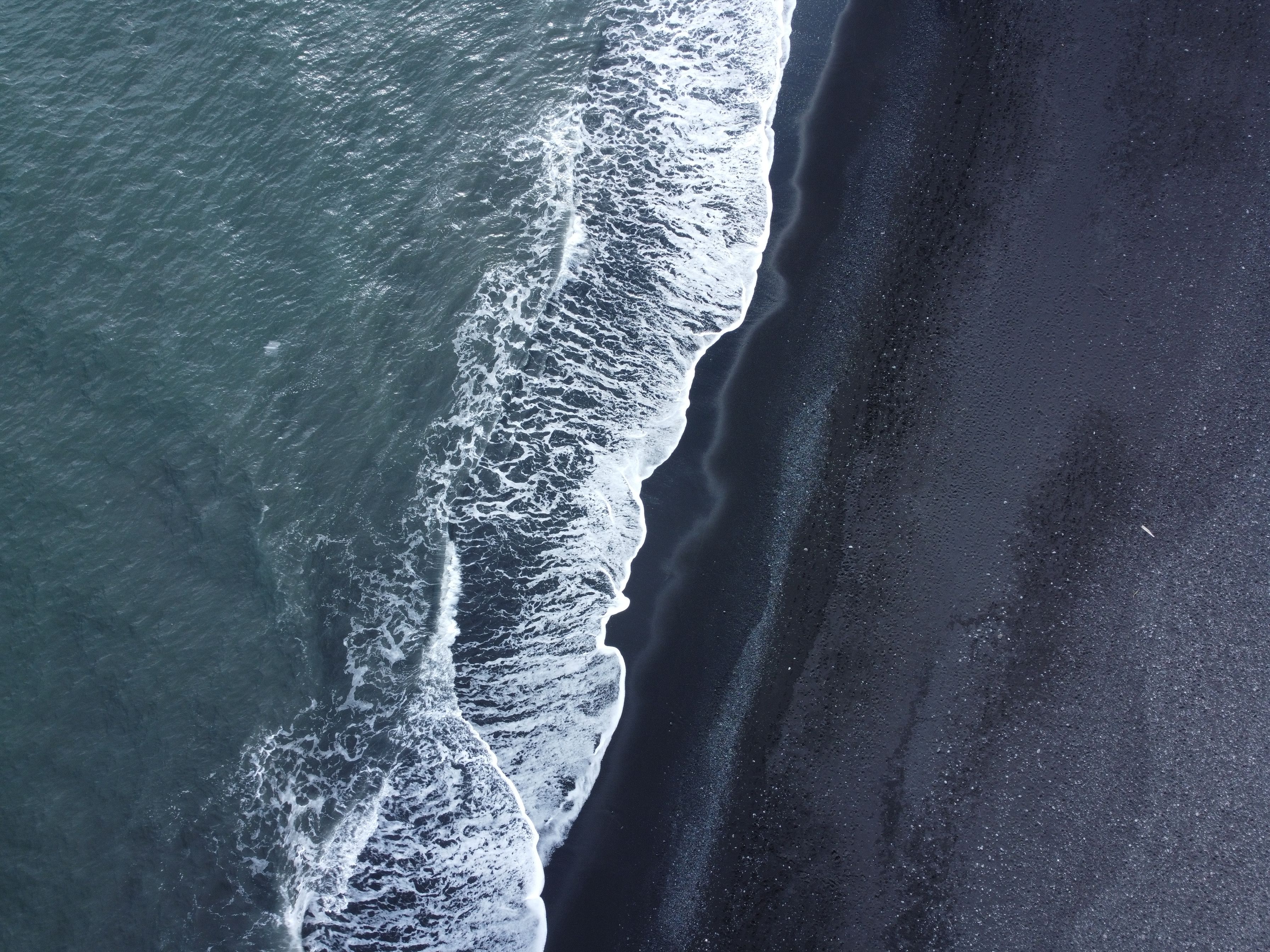
The water reads as slate and ink under cloud, then flashes bottle-green when a thin sun breaks through the mist. In closer, it turns milky and marbled as black sand churns into the foam, creating pale seams that look almost metallic.
The Cliffs
This is volcanic Iceland at sea level—basalt cliffs, columnar joints, and sand made from pulverized lava rather than shells. Reynisdrangar anchors the horizon like a set piece, but the real scale comes from the long, curved bay that funnels wind and swell straight onto shore.
The Light
Early morning gives you cooler tones and cleaner contrast—the sand looks velvet-black, the stacks look carved. Late evening softens everything; the beach becomes a gradient of charcoal to silver, and the wet sand turns into a natural mirror when the tide is low.
Best Angles
Reynisfjara main viewpoint by the basalt columns
You get the iconic geometry—columns, cave edge, and stacks aligned for a dramatic sense of scale.
Quiet walk west toward Vik’s town-facing stretch
The stacks recede into a moodier backdrop, and the beach becomes about negative space—minimal, cinematic, and calmer.
Tide line details near driftwood and kelp patches
The unexpected angle is intimate: textures of kelp, foam, and black sand tell a story most wide shots ignore.
Reynisfjall road pull-off above the beach (where safe and permitted)
For photographers, the higher perspective compresses the scene—stack silhouettes, surf bands, and the beach’s curve in one frame.
Wet-sand reflections at low tide (away from the surf edge)
The intimate angle turns the beach into a studio floor—reflections of clouds and cliffs with your subject kept well back from the water.
Read the sneaker-wave warnings on site and treat them as literal—keep a wide buffer from the water and never turn your back on the ocean.
Wear waterproof boots with grip; the sand can be heavy and the wind-driven spray can soak you quickly.
Check tide times and wind forecasts for Vík/Reynisfjara; the experience changes dramatically with swell and visibility.
Bring a lens cloth or microfiber towel—salt mist coats phone and camera glass in minutes.
If you want quiet, commit to walking a little farther than the crowds do, but stay mindful of your exit route and shifting tide.
Handpicked Stays & Tables
Places chosen for beauty and intention, not algorithms. Each one is worth your time.

Black Sand Suites
Vík í Mýrdal
Sleek, apartment-style suites with a design-forward calm that feels restorative after the wind. You get space to dry gear, cook simply, and watch the weather move across the hills.

Hótel Kría
Vík í Mýrdal
Modern, comfortable, and well placed for early starts before the tour buses arrive. The interiors lean warm and understated—exactly what you want when the coast outside is all graphite and spray.

Suður-Vík
Vík í Mýrdal
A polished dining room where local ingredients feel thoughtfully handled rather than overly formal. It’s a good place to thaw out slowly, with a view that keeps one eye on the shifting weather.

The Soup Company
Vík í Mýrdal
Casual, quick, and genuinely satisfying when you come off the beach windburned and hungry. The soups are warming and practical—fuel that doesn’t ask for attention.
When you let the stacks sit at the edge of your attention, Vik Beach stops being an attraction and becomes a coastline you can actually hear.