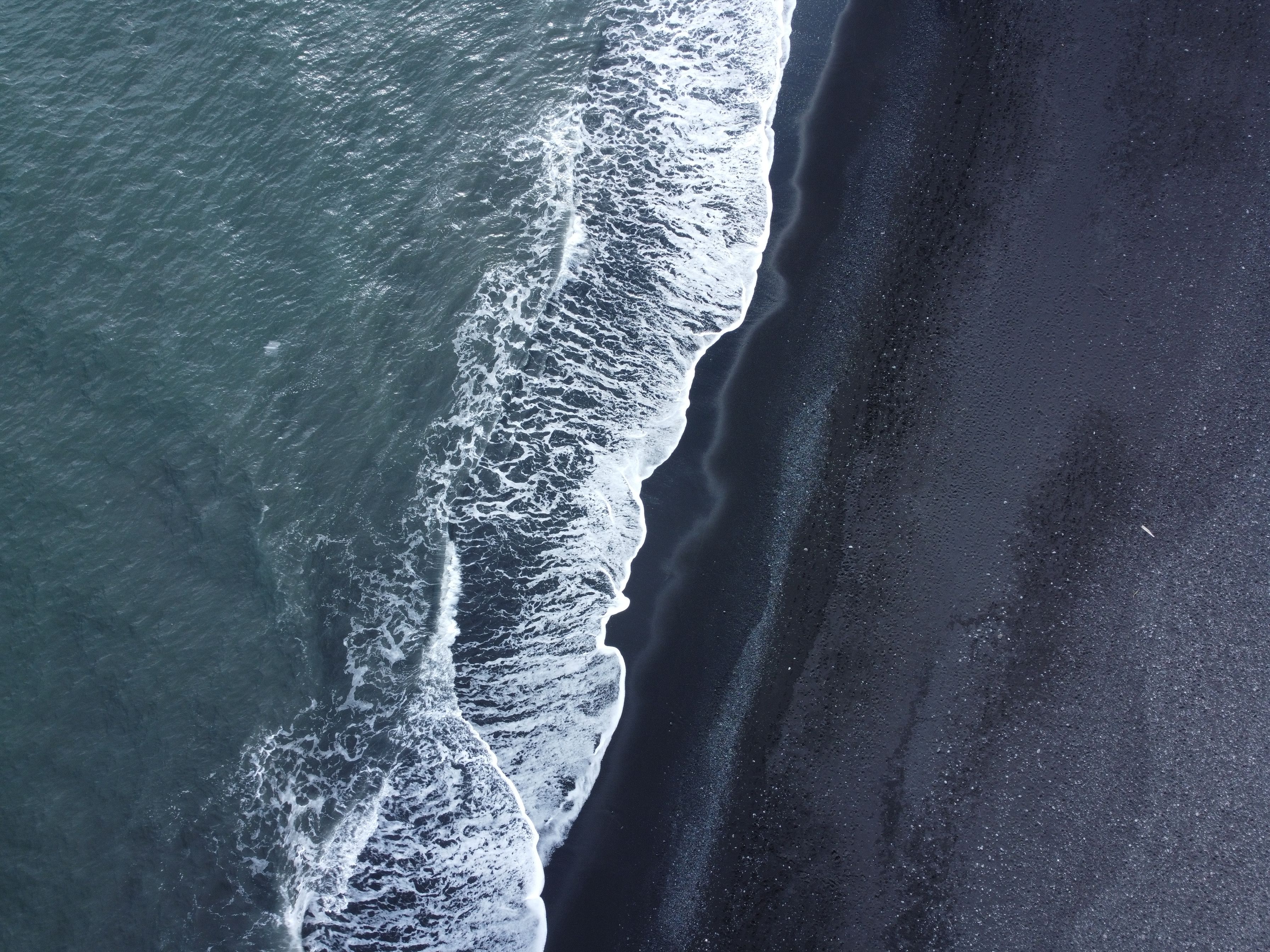
Vik Beach
In Vík’s winter whiteout, the famous black beach becomes pure sensation—sound, grit, and scale without a horizon.
Vík’s beach matters because it’s one of the rare places where a shoreline feels like geology in motion—basalt turning to sand, Atlantic energy turning to noise. In clear weather it’s dramatic; in a whiteout it’s something else entirely: a world reduced to black ground and white air, with you standing between them.
Most people come for the postcard: Reynisdrangar framed against a clean horizon. What they miss is how quickly the beach rewrites itself—light collapsing, distance flattening, the sea advancing and retreating in sets that can erase your reference points in minutes.
The payoff is intimacy with a landscape that refuses to be “seen” on demand. When the horizon disappears, you stop consuming the view and start feeling the place—cold salt on your lips, volcanic grit in your cuffs, and the steady, unsettling power of water you can hear before you can judge how close it is.
When the Horizon Vanishes, the Beach Turns Into a Sensor
In Vík, the black sand is often described as a spectacle, but in a whiteout it becomes a calibration tool. Without a horizon, your eyes can’t do their usual work—measuring distance, ranking objects, deciding what matters. The beach stops behaving like a “view” and starts behaving like an instrument. You read it through contrast: the carbon-black grains against blown snow, the dull sheen of wet sand versus the powdery matte of dry, the sudden bright scribble of foam that tells you where the water is… right now. This is also when you understand scale. Reynisdrangar aren’t just photogenic stacks; they’re the last visible punctuation marks in a sentence the storm is trying to erase. They arrive and disappear, and that flicker teaches you how fast weather can move along Iceland’s south coast. You notice the way the wind combs the surface into faint ripples, then smooths them flat again. You notice that the ocean’s “edge” is a negotiation, not a line. The most important detail is practical, not poetic: the whiteout can make the surf feel farther away than it is. The sneaker waves here are real, and when your depth perception is compromised you need to build in margin. Stand higher, watch the sets, and let the beach keep its authority. That humility is the point.
You step off the boardwalk and the first thing that hits you is the sound—Atlantic surf not as a rhythm but as a low, continuous pressure, like wind inside a tunnel. Snow moves sideways, not down, and the air is so pale it seems to glow. The sand under your boots is black and granular, a muted crunch that quickly turns slick where a thin film of ice has glazed the surface. Ahead, the sea is there and not there: a shifting band of slate and white foam that keeps dissolving into the weather. The Reynisdrangar should be obvious, but in the whiteout they appear in pieces—one dark edge, then nothing, then a blunt silhouette briefly stitched into view. You taste salt, then ash, then cold metal. A wave explodes against a hidden rock, and the spray arrives as needle-fine mist. You keep more distance than you think you need, because the beach feels wider than it is… until it doesn’t.
The Water
In whiteout conditions the water reads as leaden slate, almost inked, with foam that turns bright, chalky white the moment it breaks. In calmer gaps between squalls, the nearshore shallows can briefly show a cold steel-blue before the air closes again.
The Cliffs
This shoreline is basalt reduced to sand—volcanic material ground down by relentless Atlantic energy. Reynisdrangar and the Reynisfjall cliffs feel closer in winter weather, their dark faces emerging like cut stone from the whitening air.
The Light
The beach looks most uncanny when the sky is a uniform sheet—overcast snow or dense mist that eliminates shadows. If you catch a brief winter sun-break, it’s the contrast that stuns: black sand suddenly glossy, sea spray briefly lit, cliffs etched with hard edges before the next squall softens everything again.
Best Angles
Vík í Mýrdal Beach Boardwalk (main access)
You get the immediate contrast of black sand meeting white air, with a clean, elevated start that keeps you above the wet zone.
Reynisfjall cliffline (from the Vík side, at a safe distance)
This angle compresses the scene—dark cliff mass on one side, blank weather on the other—making the lack of horizon feel intentional.
Reynisdrangar silhouettes (when visibility allows)
Wait for the stacks to appear in fragments; the partial reveal is more powerful than a fully clear view.
High tide line textures
For photographers: shoot low and close to capture peppered snow on black grains, foam residue, and wind-drawn ripples—details that survive the whiteout.
Sheltered dip behind a sand rise near the access path
The intimate angle: you can hear the ocean without facing it head-on, and the wind feels sculptural rather than punishing.
Check the Icelandic Met Office forecast (wind and visibility matter more here than temperature) and don’t force the beach if gusts are severe.
Treat the surf as unpredictable: stay well back from the waterline, watch several wave sets, and never turn your back on the ocean.
Wear waterproof outer layers and gaiters or tall boots—the sand is fine and migrates into cuffs fast, especially in wind.
Bring a microfiber cloth and keep your phone/camera sheltered; sea spray in freezing air leaves a salt film that blurs images quickly.
If you drive, plan extra time and fuel margin—Route 1 conditions can change rapidly around Vík, and whiteouts can slow you down dramatically.
Handpicked Stays & Tables
Places chosen for beauty and intention, not algorithms. Each one is worth your time.

Hótel Kría
Vík í Mýrdal
Modern, clean-lined comfort that feels calm after a weather-heavy day outside. Rooms are warm and quiet, and you’re positioned perfectly for quick returns to the beach between squalls.

Black Beach Suites
Vík (near Reynisfjara area)
Apartment-style stays with big windows and a pared-back aesthetic that suits the landscape. Ideal if you want space to dry gear, make coffee, and watch the weather shift without leaving your room.

Smiðjan Brugghús
Vík í Mýrdal
A relaxed brewpub with hearty dishes that make sense after cold exposure. Good for settling in, warming up slowly, and listening to the wind outside while you recalibrate.

Suður-Vík
Vík í Mýrdal
A more refined stop in town with an emphasis on Icelandic ingredients and clean flavors. It’s the kind of room where you can thaw out properly and let the day’s grit feel earned.
When Vík turns white and the sea turns to sound, you realize the beach was never a backdrop—it’s an experience that edits your senses down to the essentials.