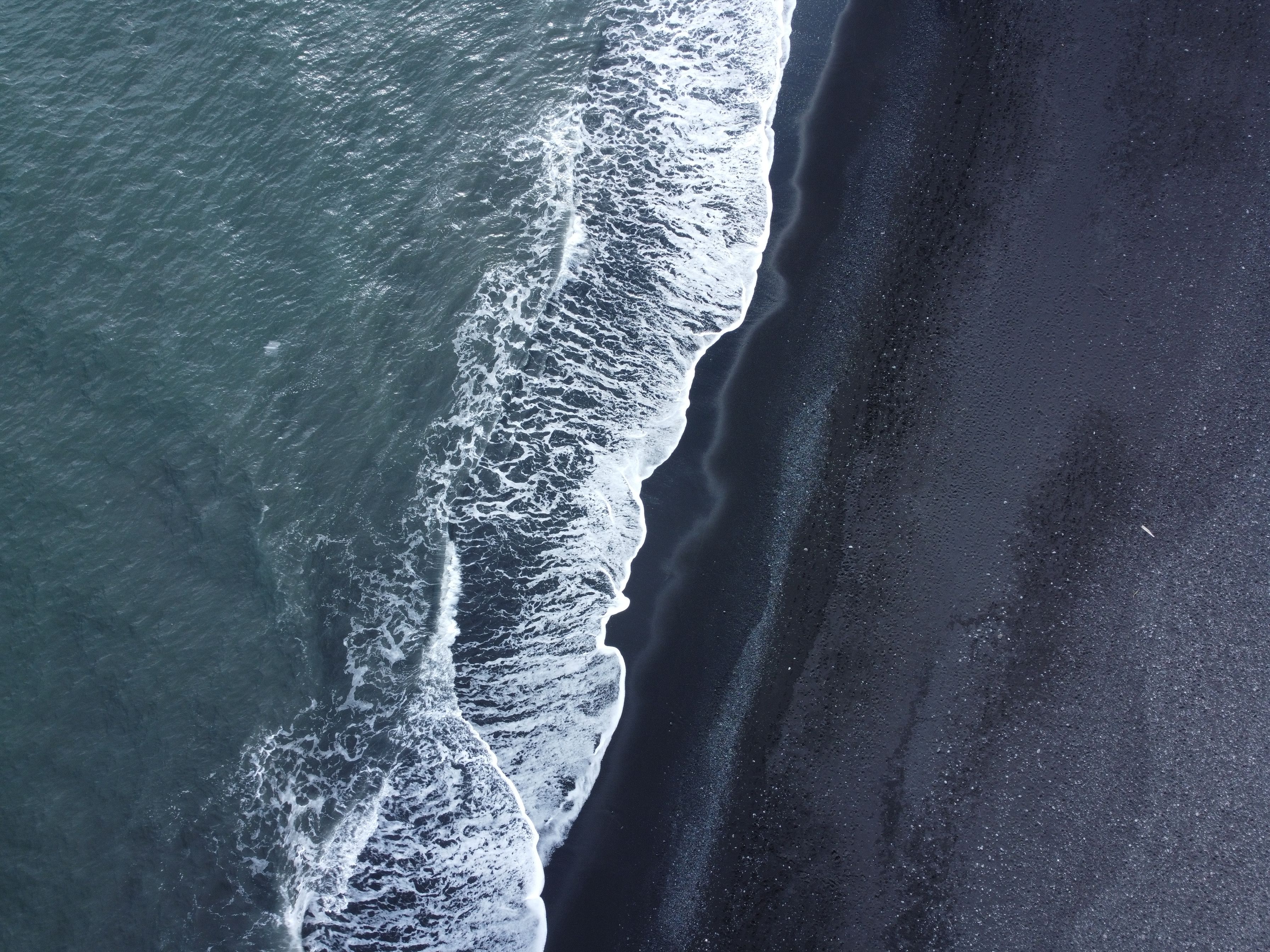
Vik Beach
On Vík’s black shore, the ground becomes geometry—basalt tiles that feel engineered by the earth.
You come to Vík expecting drama—black sand, Atlantic muscle, weather that changes its mind mid-sentence. What matters here isn’t just the coastline’s scale, but the way it makes you feel small in a clean, clarifying way, as if the world has been simplified to three elements: rock, water, sky.
Most people look out to the Reynisdrangar sea stacks and miss what’s underfoot: a basalt “puzzle” where cooling lava fractures into blunt hexagons and rectangles, then gets planed by sand and storm until it reads like a floor laid by an impatient architect.
When you finally slow down and study the pattern, the beach turns intimate. The fear you feel of the surf’s power softens into curiosity—and you leave with the rare sense that you didn’t just visit a landmark, you noticed it.
The Hexagons Aren’t a Wall—They’re a Floor That’s Been Turned Up
Most visitors treat Reynisfjara like a single postcard: black sand, roaring surf, basalt organ pipes. They aim their camera outward, as if the only story is on the horizon. But the basalt puzzle under your boots is the quieter proof of how Iceland is built—and how quickly it’s reworked. Basalt forms when lava cools and contracts. The contraction cracks the rock into columns, often hexagonal, because that shape distributes stress efficiently. At Vík, you’re seeing two chapters at once: some columns still stand as a wall, while others have collapsed, snapped, and been tumbled into tiles. The sea then takes over as editor-in-chief—grinding edges, sanding faces, slipping fine black grains into the seams until the blocks look mortared into place. If you arrive after rain or at the tail end of a receding wave, the pattern sharpens. Thin films of water fill the joints and reflect the sky, turning the puzzle into a mosaic of matte black and mirrored silver. Crouch low and you’ll see how the “straight lines” aren’t perfect at all—there are micro-fractures, tiny steps, and bruised corners where the ocean has tested the geometry. It’s not a man-made pattern. It’s what happens when the planet cools, cracks, collapses… and then refuses to stay still.
You step off the car park path and the black sand absorbs light like velvet, swallowing your footprints almost as quickly as you make them. The air tastes of salt and wet stone. Ahead, the Atlantic doesn’t shimmer—it heaves, steel-blue under a lid of cloud, then flashes white as a wave breaks and throws spray sideways on the wind. You keep one eye on the water, because Reynisfjara teaches manners. To your right, the basalt columns rise in tight ranks, some as thick as your torso, others pencil-thin, all ribbed and cold to the touch. Then you notice the ground: a scatter of dark, angular blocks fitted together with unsettling logic… hexagons, trapezoids, seams filled with sand, edges polished by years of abrasion. When the sun slips through, the rock briefly glosses, and the puzzle becomes legible—each piece a frozen moment of lava cooling, cracking, and being edited by the sea. You crouch, you trace a joint with a gloved finger, and the beach stops being “scenery” and becomes a surface with history.
The Water
The water reads as slate and gunmetal more than blue, with sudden jade undertones when light cuts through the cloud. Breakers turn it into white foam and airborne mist, which can make the whole shoreline feel monochrome until the next bright seam of sea appears.
The Cliffs
You’re on a South Coast built from fire and then sculpted by erosion—basalt from cooled lava, sand from ground-down volcanic rock, cliffs that shed material with every storm. Offshore, Reynisdrangar rises like dark teeth, making the surf behave unpredictably as waves refract and collide.
The Light
Overcast days are a gift here—the black sand and basalt hold detail without harsh contrast, and the scene feels cinematic rather than touristy. If the sun appears, late afternoon light skims across the columns and picks out their ribs, while winter’s low angle turns wet basalt into a subtle mirror.
Best Angles
Basalt column amphitheater (Reynisfjara columns)
Stand close to the columns so their vertical lines fill your frame—then let the surf blur behind for scale and menace.
Sand-level line toward Reynisdrangar
Crouch low and let the black sand lead your eye straight to the sea stacks; it turns a wide scene into a deliberate composition.
The basalt puzzle field near the column base
Photograph down, not out—wet seams and angled tiles create a graphic pattern most people never take home.
Cliff-edge viewpoint from Dyrhólaey (west side)
From above, the beach becomes a sweeping ink-stroke; the column section reads as texture, and the waves show their full geometry.
Under the column overhang (at a safe distance from surf)
Face back toward the beach and frame people as silhouettes against the pale water—intimate, human, and wind-noisy.
Treat this as a hazardous beach: sneaker waves are real here—never turn your back to the ocean and keep well above the wet-sand line.
Wear waterproof footwear with grip; basalt and wet sand can be slick, and wind-driven spray is common.
Bring a lens cloth and protect your camera/phone—salt mist coats glass quickly and can ruin contrast.
Check road and weather conditions (especially in winter) and factor wind into your comfort; gusts can be strong enough to destabilize you near the surf.
Use the toilets at the parking area before you go down; once you’re on the beach, you’ll want to stay focused on timing and safety.
Handpicked Stays & Tables
Places chosen for beauty and intention, not algorithms. Each one is worth your time.

Black Sand Suites
Vík í Mýrdal
Modern suites with clean Nordic lines and big windows that make the weather part of the décor. It’s a calm, design-forward base for early starts to Reynisfjara.

Hótel Kría
Vík í Mýrdal
A smart, contemporary hotel with a warm, practical luxury—good beds, generous breakfast, and a lobby that feels like shelter after a wind-lashed beach walk. Convenient for both Reynisfjara and Dyrhólaey.

Sudur-Vik
Vík í Mýrdal
A polished dining room where Icelandic ingredients feel deliberate rather than performative. Expect seafood, lamb, and plates that match the landscape’s clarity—simple, precise, satisfying.

Smidjan Brugghús
Vík í Mýrdal
A relaxed brewpub with burgers, fries, and local beer—exactly what you crave when the wind has sanded your face raw. Casual, lively, and reliably warming.
At Vík, the Atlantic demands your respect, but the basalt at your feet rewards your attention—one cool, fitted stone at a time.