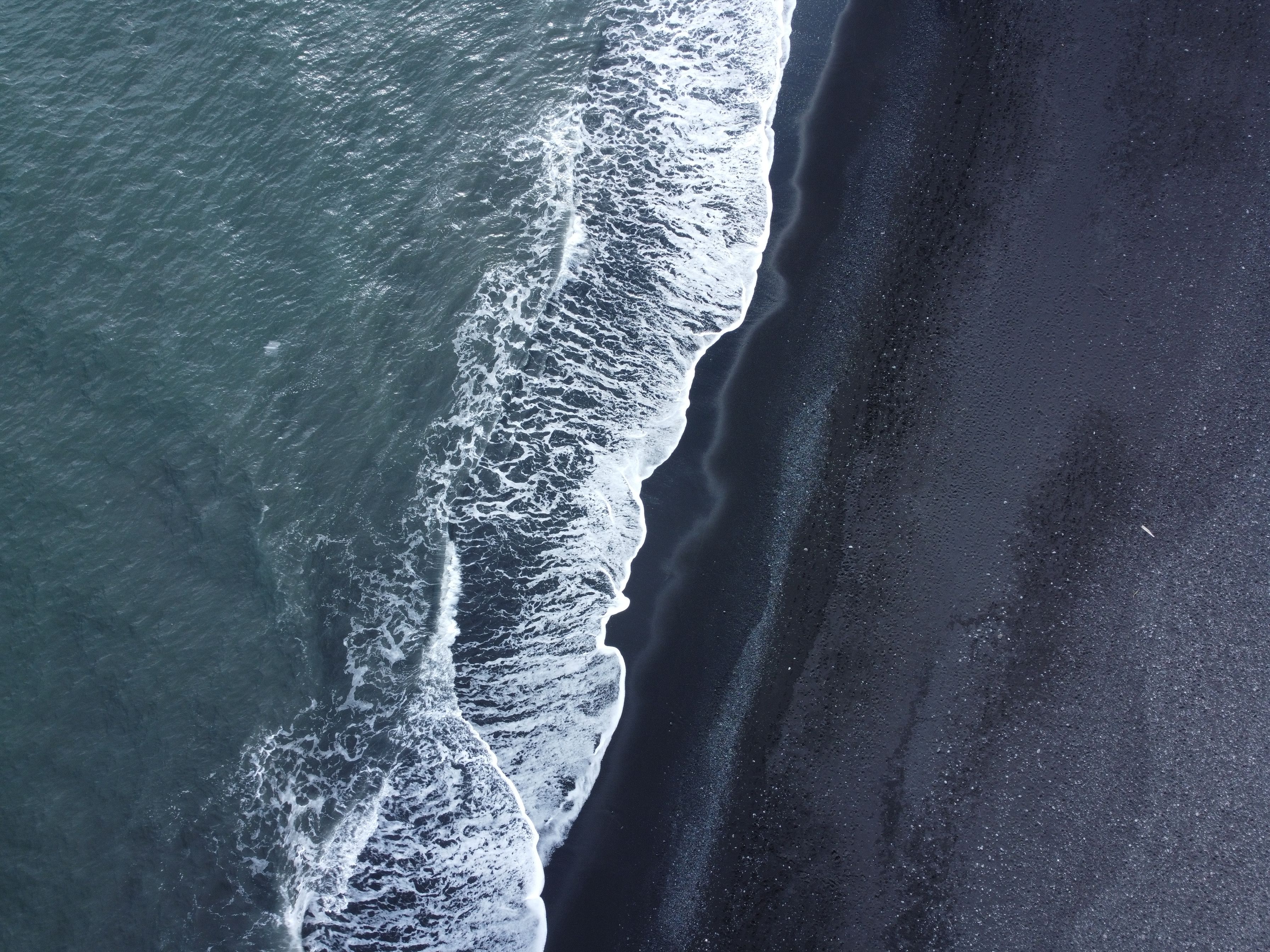
Vik Beach
On Iceland’s south coast, Vík’s black beach isn’t scenery—it’s a lesson in time, pressure, and salt wind.
You arrive at Vík’s shoreline and the world sharpens. The sand is not sand but volcanic glass ground fine, the air tastes of sea-salt and kelp, and the Atlantic doesn’t roll in so much as it gathers itself—then drops its weight at your feet.
Most people stop at the famous sea stacks and leave with a single image. What they miss is the beach’s grain: the way each footstep reveals a geology textbook written in black crystals, pale shell fragments, and temporary rivulets that redraw the surface every few minutes.
Stand still long enough and the drama turns intimate. The roar becomes rhythmic, the wind edits your thoughts, and you feel strangely calibrated—small, present, and cleanly awake.
The Beach Is a Grinder, Not a Canvas
From the road, Vík’s beach reads as a dramatic backdrop—black sand, stacks, stormy sky. Up close, it behaves more like a working machine. The Atlantic here is not decorative; it’s a constant milling force that turns lava into grain and grain into finer grain, sorting what can stay and what must be taken back. Look down for a minute and the postcard dissolves. The surface is stippled with textures: matte-black basalt sand that absorbs light, tiny glassy flecks that catch it, and occasional pale interruptions—shell fragments and quartz-like stones that feel almost out of place against all that darkness. After a wave retreats, the beach briefly shines, slick as obsidian, before the wind dries it into velour again. Those fast transitions are the point. You are watching geology happen at human scale. The cliffs and stacks get the attention, but the real intimacy is in the margins—where freshwater trickles across the sand, cutting temporary channels that look like miniature river deltas. If you come in shifting weather, the beach becomes a laboratory of light: low cloud makes the sand go ink-black; a sudden sunbreak turns it silvery, almost metallic. When you stop treating Vík as a view and start reading its grain, the place changes you from spectator to witness.
You step off the path and the first thing you notice is the sound—deep, percussive surf that doesn’t hiss like summer beaches, but thumps like a door closing in a cathedral. The sand under you is charcoal-soft yet slightly abrasive, the kind that clings to damp boots in a fine, glittering dust. Ahead, Reynisdrangar rises from the water like dark punctuation marks, their edges softened by mist when the weather turns. The light keeps changing: a strip of silver breaks through cloud, then collapses back into slate, and the ocean answers with a new shade—steel, then bottle-green, then nearly black. You walk toward the tideline and feel the pull of the place: driftwood bleached bone-white, kelp braided like rope, and the occasional glint of ice-smoothed stone carried down from somewhere colder. A sneaker wave arrives without warning, rushing higher than you expect, erasing your footprints in one clean sweep. You instinctively step back, laughing under your breath… and listen harder.
The Water
The water is often steel-gray with a green undertone, like a brushed metal sheet catching cold light. In sunbreaks it turns bottle-green at the lip of a wave, then darkens almost to black where it deepens.
The Cliffs
This is a shoreline built from eruptions and erosion—basalt cliffs, volcanic sand, and sea stacks carved into mythic silhouettes. The scale is big, but the details are precise: column-like basalt geometry, slick kelp ribbons, and driftwood laid out by storms like curated sculpture.
The Light
Overcast days are surprisingly cinematic—cloud acts like a softbox, pulling detail out of the black sand and the stacks. Near sunset in summer, the low angle light skims the beach and turns the wet sand into a mirror, while winter’s brief daylight can make everything feel monochrome and intensely graphic.
Best Angles
Reynisfjara main beach access (near the cave area)
You get the classic alignment: basalt columns to one side, stacks ahead, and waves providing scale and motion.
Basalt column wall (Hálsanefshellir area)
Stand close and shoot along the hexagonal columns—the geometry turns the beach into architecture.
High point near the warning sign line (keep a safe distance)
From slightly elevated ground, you can read the wave patterns and the way they erase tracks—more story, less scenery.
Reynisdrangar framed between wave sets
Wait for the moment a receding wave leaves a reflective sheen; the stacks double in the wet sand for a clean, high-contrast composition.
Tide-line details: driftwood and kelp wrack
Get low and tight. Against black sand, the textures—salt-bleached wood, glossy kelp, pale shell—feel intimate and editorial.
Treat sneaker-wave warnings as non-negotiable—keep a wide buffer from the water and never turn your back on the surf.
Wear waterproof, closed-toe shoes; the sand can be soft and wet, and wind-driven grit finds every gap.
Bring a windproof layer even in summer—gusts can be sudden and strong on this open coast.
If you’re photographing, pack a lens cloth and protect your gear from salt spray; fine volcanic grit can be abrasive.
Check road and weather conditions before driving the South Coast (especially in winter): safetravel.is and road.is are the baseline.
Handpicked Stays & Tables
Places chosen for beauty and intention, not algorithms. Each one is worth your time.

The Barn
Outside Vík (Reynishverfisvegur area)
Design-forward and social, with a clean Nordic aesthetic that still feels rooted in the landscape. It’s a strong base if you want early access to the beach before the day’s first buses arrive.

Hótel Kría
Vík í Mýrdal
Modern, comfortable, and calm, with rooms that feel like a warm reset after wind and salt. You’re close to town services while still minutes from the shoreline.

Suður-Vík
Vík í Mýrdal
A reliable, stylish stop for Icelandic comfort food and seafood in a setting that feels unhurried. Come in with wind-reddened cheeks and you’ll appreciate the warmth and the steady pace.

The Soup Company
Vík í Mýrdal
Simple, satisfying, and exactly what you want after a cold beach walk—hot soup, bread, and a quick return to feeling human. It’s casual, but the timing matters more than ceremony here.
When you leave Vík, the image stays—but it’s the feel of that black grain underfoot, and the ocean’s heavy breath, that follows you.