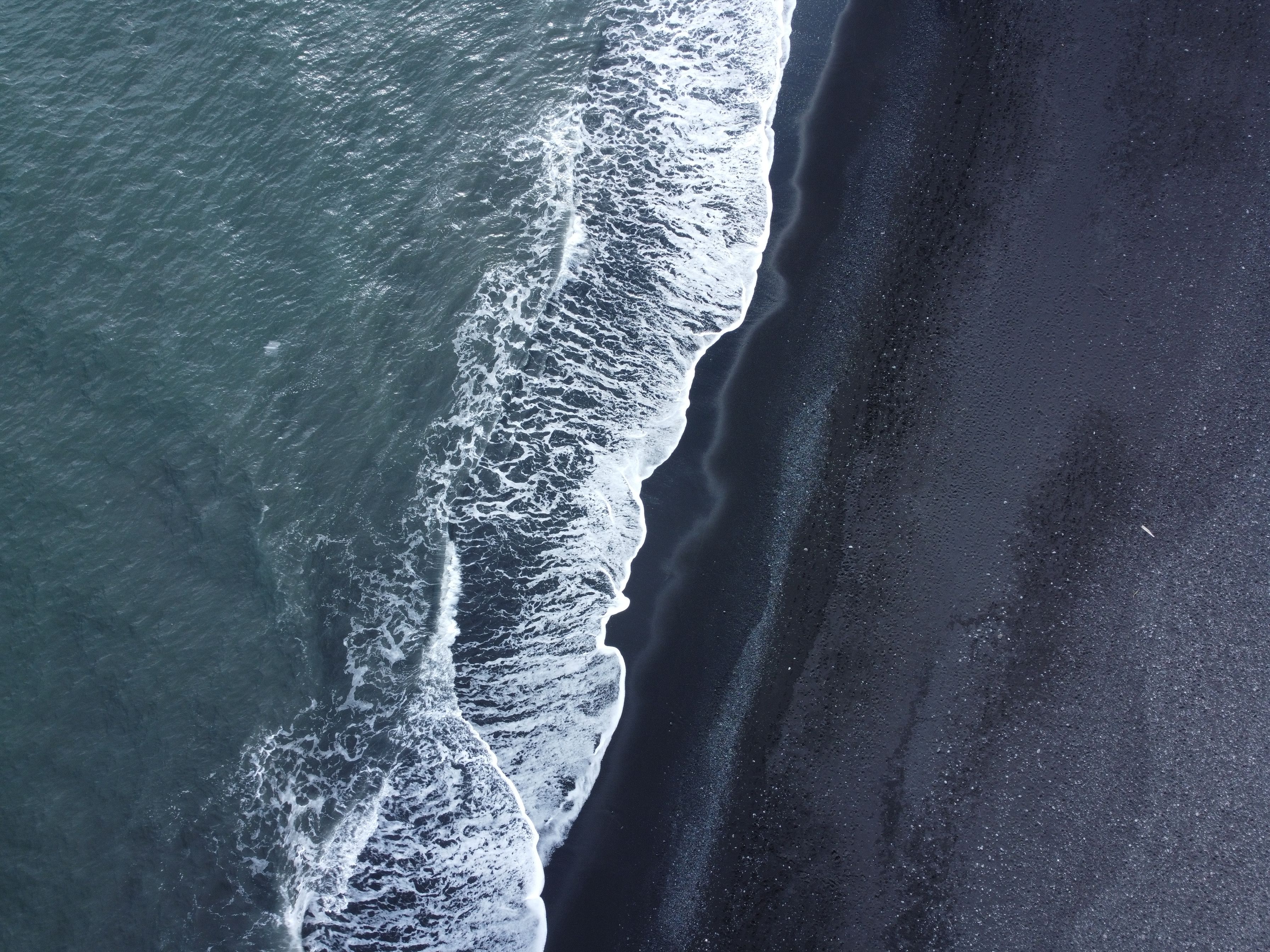
Vik Beach
Skip the obvious entrance—let Vík’s black sand reveal itself from the wind-scarred edge of Dyrhólaey.
Vík Beach isn’t about swimming or sunbathing. It matters because it shows Iceland at full volume—Atlantic wind, volcanic sand, and the kind of scale that makes you recalibrate your body in the landscape.
Most people meet it from the flatness of the parking lot, where the beach becomes a backdrop. Come from Dyrhólaey’s clifftop path instead, and you understand the coastline as a living edge—eroding, nesting, collapsing, rebuilding.
The payoff is simple and physical: you arrive already quiet, already tuned to the weather, and the black sand feels less like an attraction and more like a threshold you’ve earned.
The Coastline Only Makes Sense from Above
From the beach level, Vík is dramatic but fragmented: a strip of black sand, a few stacks, a horizon that feels blunt. The clifftop approach from Dyrhólaey rewires the whole scene. Up there, you see why the beach looks the way it does—how the headland funnels wind, how the currents comb the shoreline into dark gradients, how the surf finds weak points and worries them open. You stop thinking in “photo spots” and start reading the coast like a system. There’s a practical beauty to it, too. The clifftop path gives you time to assess conditions before you’re on the sand. You can watch sneaker waves from a safe vantage and notice how far the water runs up the beach—often farther than you’d guess from ground level. You can also see where the sand turns looser and where it firms up near the tideline, which matters when the wind is driving grit sideways. And then there’s the emotional shift. Arriving from above changes your posture. You’re not stepping out of a car into a spectacle; you’re moving through exposure into intimacy. When you finally stand at the water’s edge, the roar feels earned, the sea stacks feel less like icons and more like weathered witnesses, and the black sand stops being a novelty—it becomes the signature of everything volcanic that built this coast.
You start high, where the grass is cropped short by constant wind and the path keeps you honest—close enough to feel exposed, far enough to stay safe. The air tastes of salt and wet stone. Below, Vík’s black sand stretches like a poured ink ribbon, and the sea keeps changing its mind: slate one moment, bruised green the next, white foam stitching and un-stitching the shoreline. You walk with the sound of kittiwakes and the low percussion of surf hitting basalt, and each step gives you a new geometry—Reynisdrangar’s sea stacks shifting from teeth to towers as you angle along the headland. When you finally drop toward the beach, you don’t “arrive” so much as descend into it, trading the panoramic for the intimate: pebbles clicking underfoot, driftwood bleached to bone, sand that clings like graphite to your boots. The wind comes for your hood, the light breaks through a seam in the clouds, and suddenly Vík is not a place you look at—it’s a place you’re inside.
The Water
The water reads as steel-blue under cloud, then flashes to deep bottle-green when sun breaks through. Close to shore, the foam is stark white, and the undertow can tint the shallows a smoky gray as sand suspends in the churn.
The Cliffs
This is a basalt coastline shaped by eruption and erosion—black sand derived from volcanic rock, cliffs cut hard and clean by North Atlantic weather. Reynisdrangar rises offshore like broken columns, and Dyrhólaey’s headland frames the whole scene as a protective shoulder.
The Light
Late afternoon into evening gives you slanting light that textures the sand and pulls detail out of the cliffs. After rain, when the beach darkens and turns reflective, even a brief sun gap can make the entire shoreline look lacquered.
Best Angles
Dyrhólaey Lower Viewpoint (Kirkjufjara side)
You get the cleanest read of the black shoreline sweeping toward Reynisdrangar, with surf patterns visible from above.
Dyrhólaey Upper Viewpoint near the lighthouse
A wider, higher panorama that shows how the headland, cliffs, and beach interlock—ideal for understanding scale.
Clifftop path bend before the descent
This mid-height angle turns the sea stacks into layered silhouettes and makes the beach feel endless rather than flat.
Kirkjufjara viewpoint (safe distance, not at the cave)
For photographers: long-lens compositions of Reynisdrangar with compressing waves, especially in moody weather.
Firm sand near the tideline, south-facing along the beach
The intimate angle: you capture wet-sand sheen, footprints, and driftwood textures with the stacks looming soft behind.
Respect the Atlantic here: sneaker waves are real. Keep well back from the waterline and never turn your back on the sea.
Wear waterproof layers and eye protection if you’re sensitive—wind can drive sand hard enough to sting.
Check access advisories for Dyrhólaey; sections can close during nesting season or in severe weather.
Use grippy footwear. Wet grass and compacted gravel on the headland can be slick, especially in mist.
If you’re photographing, bring a cloth for salt spray and sand, and consider a lens hood—conditions change minute to minute.
Handpicked Stays & Tables
Places chosen for beauty and intention, not algorithms. Each one is worth your time.

Hótel Kría
Vík í Mýrdal
Modern, calm, and well-placed for early starts and late returns. Rooms are designed for weather watching—clean lines, big windows, and a sense of retreat after the wind.

The Barn
Near Vík (South Coast)
A design-forward hostel with private room options, social spaces, and an excellent base for the coast. It’s stylish without trying too hard, and the atmosphere suits travelers who like their comfort with a little edge.

Suður-Vík
Vík í Mýrdal
A warm, polished dining room where Icelandic ingredients feel thoughtfully handled rather than overworked. Come in salty and windblown, and let the calm lighting and good service reset you.

The Soup Company
Vík í Mýrdal
Casual, reliable, and exactly what you want when the weather has taken everything out of you. Hot soup, fresh bread, and a simple kind of comfort that feels earned after the cliffs.
When you come in from the clifftop, the black sand isn’t a destination—it’s the final line in a story the wind has been telling all along.