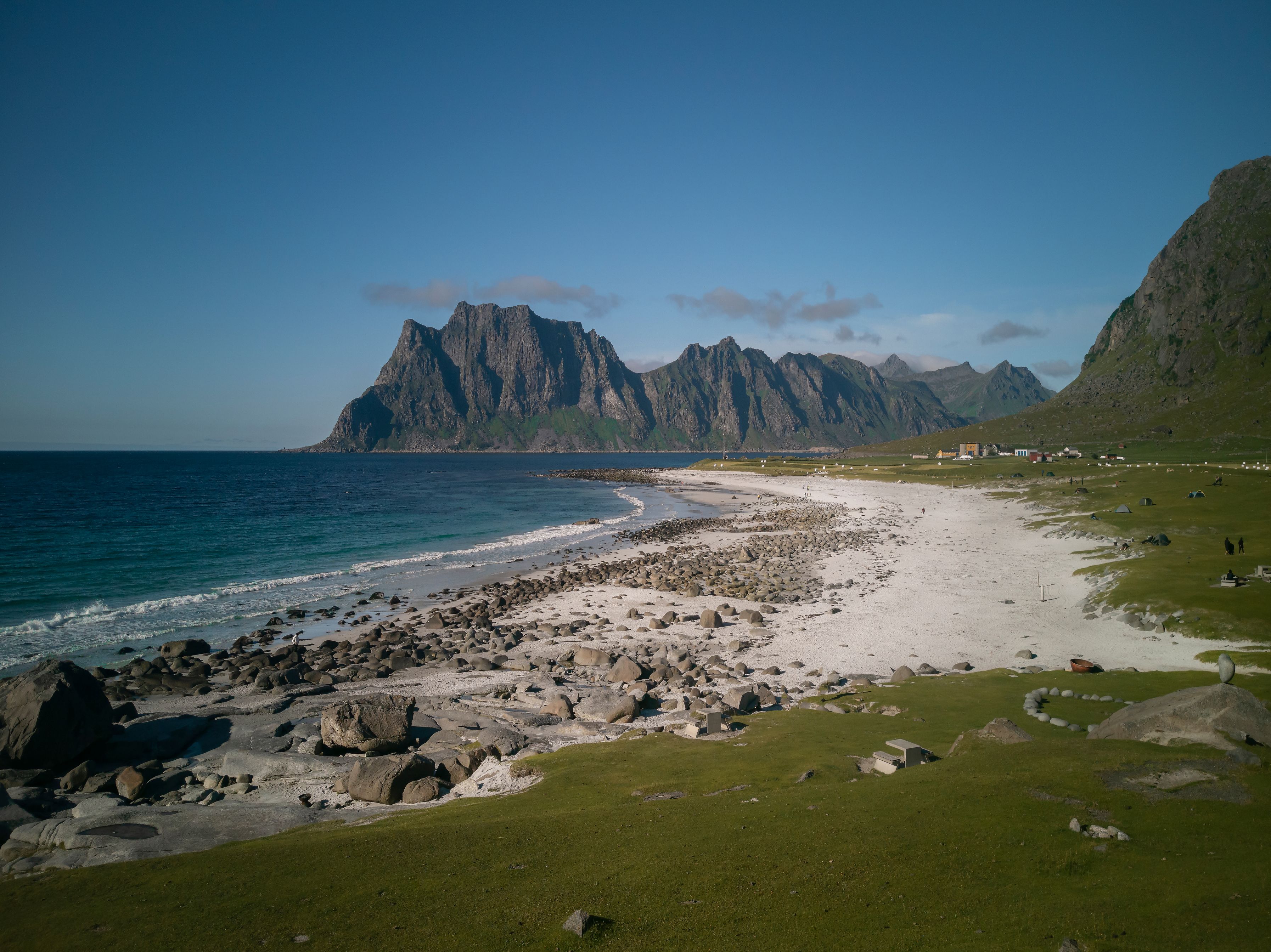
Uttakleiv Beach
On Uttakleiv, the ocean’s noise fades—until only wind and stone decide the rhythm.
Uttakleiv Beach matters because it shows you Lofoten without the performance—no postcard framing needed, just a broad sweep of sand pressed up against old rock and impatient weather. You stand at the edge of the Norwegian Sea and feel how quickly nature edits your plans… one cloud, one gust, one tide-turn and the whole bay changes tone.
Most people stop at the middle of the beach and call it done. They miss what happens past the last rock pool, where the shoreline narrows, the granite shoulder rises, and the soundscape shifts—less surf, more wind threading through seaweed and stone.
The payoff is quiet that feels earned. Not silence as absence, but as presence—your breathing, your footsteps, the soft clatter of pebbles rolling back with the water, and the sense that you’ve stepped out of the day’s momentum for a while.
The Quiet Line Beyond the Rock Pools
Uttakleiv’s reputation is built on drama—stormy skies, midnight-sun walks, the blunt power of the Norwegian Sea. But the beach’s most affecting moment is not its biggest view. It’s a threshold you cross on foot. Walk west, toward the cluster of boulders and tide pools, and you start to notice the beach behaving differently. The sand gives way to firmer ground scattered with rounded stones. The pools act like small editing rooms for the landscape: they crop the mountains into abstract blocks, flip the clouds, and—on calm days—turn the sky into something you can step around. Then comes the shift. Past the last pool, the bay goes quieter. Not because the ocean has calmed, but because the rock begins to absorb and redirect the sound. Waves still move, but their roar gets filtered into a low, private murmur. Wind becomes the main instrument—raking along the slope, tugging at your hood, pushing the scent of kelp and clean cold water into your face. This is where Uttakleiv feels less like a viewpoint and more like a place with mood. You slow down without deciding to. You stop checking your phone. You look longer at small things—the sheen on wet granite, the lace-edge of foam, the way a single pebble clicks and rolls as the water recedes. It’s the part of the beach that teaches you how to be here.
You arrive with the smell of salt already on your jacket, the road behind you dropping away into a small pull-in that feels almost too ordinary for what’s ahead. The sand is pale and cool-toned, peppered with sea-polished stones, and the first thing you notice is scale—the way the mountains hold the beach like a clenched hand. You walk toward the western end where the rocks gather, passing shallow pools that mirror the sky in quick, trembling rectangles. The wind is constant, but it changes texture as you move: sharp across open sand, then softer where the boulders break it. A thin sheet of water slides up, pauses, and retreats with a whispering drag of kelp. Out beyond the headland the sea looks darker, heavier, but inside the curve of the bay it turns glassy in patches, like someone has laid a pane over the surface. When you step past the last rock pool, the crowd noise drops away. What’s left is you, the stone, and a horizon that doesn’t hurry.
The Water
In bright weather, the shallows turn a clear, cold turquoise with a faint green edge, like diluted glacier melt. Under cloud, the water shifts to steel and ink, with lighter bands where sandbanks lift it toward the surface.
The Cliffs
Uttakleiv sits on the outer edge of Lofoten, where mountains rise abruptly from sea level and the land feels more sculpted than settled. The beach is a wide, open arc of sand pinned by dark, weathered rock—granite and gneiss textures that read as both polished and scarred depending on how wet they are.
The Light
Late evening is when the beach becomes cinematic—low sun sliding across the sand, pulling long shadows from the boulders and turning wet rock to bronze. In overcast conditions, midday can be surprisingly good too: the diffused light flattens glare on the water and makes the greens and grays feel richly layered.
Best Angles
Western rock pools
The pools give you reflections and scale—mountains and clouds framed in miniature with the sea just beyond.
Mid-beach facing south
This angle captures the full arc of sand with mountains rising behind you, emphasizing how abruptly the landscape lifts from the shoreline.
Past the last rock pool (west end)
The sound drops and the composition simplifies—fewer people, more texture, a tighter horizon that feels intimate rather than panoramic.
Low angle at the waterline
Shoot close to the wet sand to catch thin foam lines, mirrored sky, and leading lines that pull the eye toward the headland.
Between boulders at the edge of the surf
A sheltered pocket where you can frame the sea through rock—salt-stained surfaces in the foreground, moving water beyond.
Bring a windproof layer even in summer—the beach is exposed, and the temperature can drop quickly when cloud rolls in.
Wear shoes you don’t mind getting wet; the most photogenic areas involve crossing damp sand, stones, and tide-slick rock edges.
Check tide times if you plan to linger near the rock pools; the shoreline shape and access change subtly with the water level.
Pack a small towel or sit pad—the rocks look inviting but stay cold and damp, especially after rain.
Respect the conditions: sneaker waves and sudden gusts are real on the Norwegian Sea side, particularly in autumn and winter.
Handpicked Stays & Tables
Places chosen for beauty and intention, not algorithms. Each one is worth your time.

Lofoten Beach Camp
Uttakleiv
Right by the sand, with cabins and camping that put you inside the weather and the light. It’s not polished luxury, but the location is the indulgence—step out and you’re already on the beach when the sky turns.

Nusfjord Arctic Resort
Nusfjord
A restored fishing village stay with serious atmosphere—salt air, timber textures, and water right at your doorstep. It’s a good counterpoint to Uttakleiv: curated comfort after a day of raw coastline.

Lofoten Food Studio
Vestvågøy (near Leknes)
A small, intimate setting where local ingredients feel intentional rather than styled for effect. Book ahead—it’s the kind of meal that matches Lofoten’s mood: precise, clean, and quietly memorable.

Huset
Henningsvær
A refined option if you’re making a day of it, with a wine focus and a sense of occasion. Come hungry and linger—it suits a slow evening after the coast has scrubbed your senses clear.
When you leave Uttakleiv, the sand rinses off easily—but the quiet past the last rock pool stays lodged in your chest.