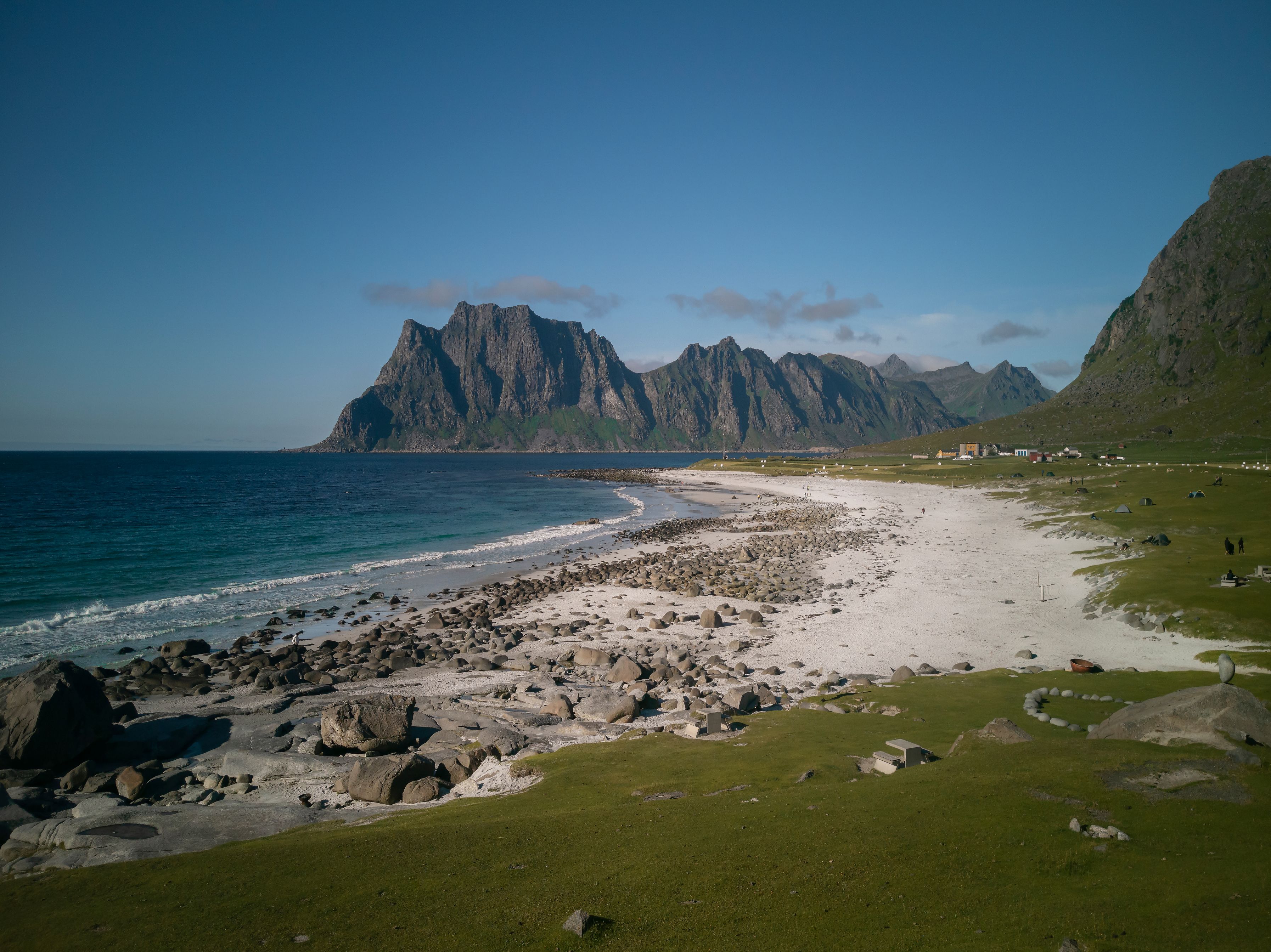
Uttakleiv Beach
On Lofoten, the sun refuses to set—and Uttakleiv turns that long pause into a tide-lit ritual.
Uttakleiv Beach matters because it shows you what the Arctic really does with light—stretch it, soften it, and lay it across stone and water until time feels negotiable. You come for a beach on the edge of Norway, but you leave with a new sense of what “day” can mean.
Most people stand at the sand and photograph the obvious sweep of bay. They miss how the shoreline changes character every few steps—cobblestones clicking under your soles, kelp glossed like lacquer, small pools holding a second sky when the tide pulls back.
The payoff is quiet and physical. You feel your shoulders drop as the horizon stays lit and the world stops hurrying you along. In that prolonged twilight, even a simple walk becomes deliberate—like you’re being taught to look again.
The Cobblestone Hour: When the Beach Becomes a Lens
Uttakleiv isn’t at its best when you treat it like a postcard. It’s at its best when you let it act like an instrument—measuring light, tide, and patience. The detail that changes everything is underfoot: that band of cobblestones along the waterline. In midday, they read as simple texture. Under the midnight sun, they become a field of tiny reflectors. Each rounded stone catches a sliver of low-angle light, and the entire shoreline starts to glow from below, as if the beach is lit internally. Walk slowly and you’ll notice the acoustics shift with the surface. Sand hushes you. Cobble announces you—tap, click, scrape—making you more careful, more present. Then the tide does its quiet editing. It rinses the stones, deepens their color from grey to charcoal, and leaves threads of kelp laid like calligraphy. Between the rocks, small basins fill with seawater and hold perfect, inverted scenes: a mountain ridge, a pale sun, a strip of cloud that looks painted on. Most visitors point their camera outward. The more interesting story is downward and sideways—light grazing texture, water turning hard, and the sense that you’re walking inside a photograph that takes its time. When you finally look up again, the horizon feels earned, not given.
You arrive late on purpose, when other places would already be closing their eyes. The road narrows and the mountains tighten around you, then suddenly releases into a wide, open bowl of beach. At Uttakleiv, the sea is calm enough to behave like metal, but it never stays the same—wind scribbles on its surface, then stops, and the water becomes a mirror again. You step from sand onto rounded cobbles that clack softly, each one cooled by the tide. Salt hangs in the air, edged with seaweed and the clean mineral scent of wet rock. The midnight sun skims low, not bright like noon but honeyed and lateral, turning every pebble into a small planet with a rim of light. Behind you, the grass is a deep, velvety green; ahead, the horizon glows as if it’s been rubbed with a match. You walk until the sound of your own footsteps feels like the loudest thing in Lofoten… and you realize you have time to stay with a moment instead of collecting it.
The Water
The water shifts between steel-blue and green-black, depending on wind and cloud cover. On calm nights it becomes a mirror with a thin sheen of gold where the sun skims the surface, as if the sea has been lightly gilded.
The Cliffs
Uttakleiv sits in a mountain-cradled bay where steep, dark rock faces make the beach feel intimate despite its width. The geology reads as blunt and honest—jagged ridges, boulder fields, and a shoreline that transitions from fine sand to polished stones like a deliberate gradient.
The Light
This is a low-angle-light location—its magic is in the long, sideways illumination that picks out texture. During the midnight sun season, the hour around midnight to 2 a.m. brings the softest gold and the least contrast, when shadows stretch and the beach looks almost three-dimensional.
Best Angles
Cobblestone waterline near the center of the bay
You get the signature texture—pebbles catching lateral light with the sea as a reflective backdrop.
Far western end by the boulder clusters
The beach compresses into a more rugged frame, giving scale to the mountains and adding foreground drama.
Tide pools after the water recedes
You can shoot inverted reflections of ridgeline and sun—small scenes that feel more intimate than the wide view.
Low angle from the sand looking toward the mountains
For photographers: keep the horizon high and let the beach lead with texture; the midnight sun gives you natural rim light.
Edge of the grass line where sand meets meadow
The transition zone is quieter—soft greens against dark rock, with the beach unfolding like a stage in front of you.
Bring a windproof layer even in summer—the bay can feel mild until a gust comes down from the mountains.
Wear shoes with grip for cobblestones and slick seaweed; barefoot looks romantic and ends quickly.
Check the tide: low tide reveals more stones and tide pools; higher tide simplifies the shoreline for cleaner compositions.
If you’re photographing, pack a microfiber cloth—sea spray and fine mist can film over lenses fast in Arctic air.
Respect the quiet: keep voices low late at night and give space to anyone camping nearby.
Handpicked Stays & Tables
Places chosen for beauty and intention, not algorithms. Each one is worth your time.

Hattvika Lodge
Ballstad, Lofoten
A design-forward rorbuer stay on the harbor, where timber, glass, and sea air do most of the talking. You wake to fishing boats and go to bed with the feeling of living inside the landscape.

Nusfjord Arctic Resort
Nusfjord, Lofoten
Historic fisherman’s cabins restored with restraint—clean lines, warm wood, and views that hold your attention. It’s a polished base for slow mornings and long, light-filled nights.

Lofoten Food Studio
Vågan (near Svolvær), Lofoten
A set-menu experience that treats local ingredients with precision rather than performance. Expect a calm room, thoughtful pacing, and flavors that feel like the coast translated into courses.

Bakeriet i Ballstad
Ballstad, Lofoten
Good coffee and serious baking in a place that understands northern appetites. It’s ideal for stocking up before a late-night beach run—cardamom, butter, and warmth in your hands.
At Uttakleiv, the day doesn’t end—it simply lowers its voice and lets the stones do the shining.