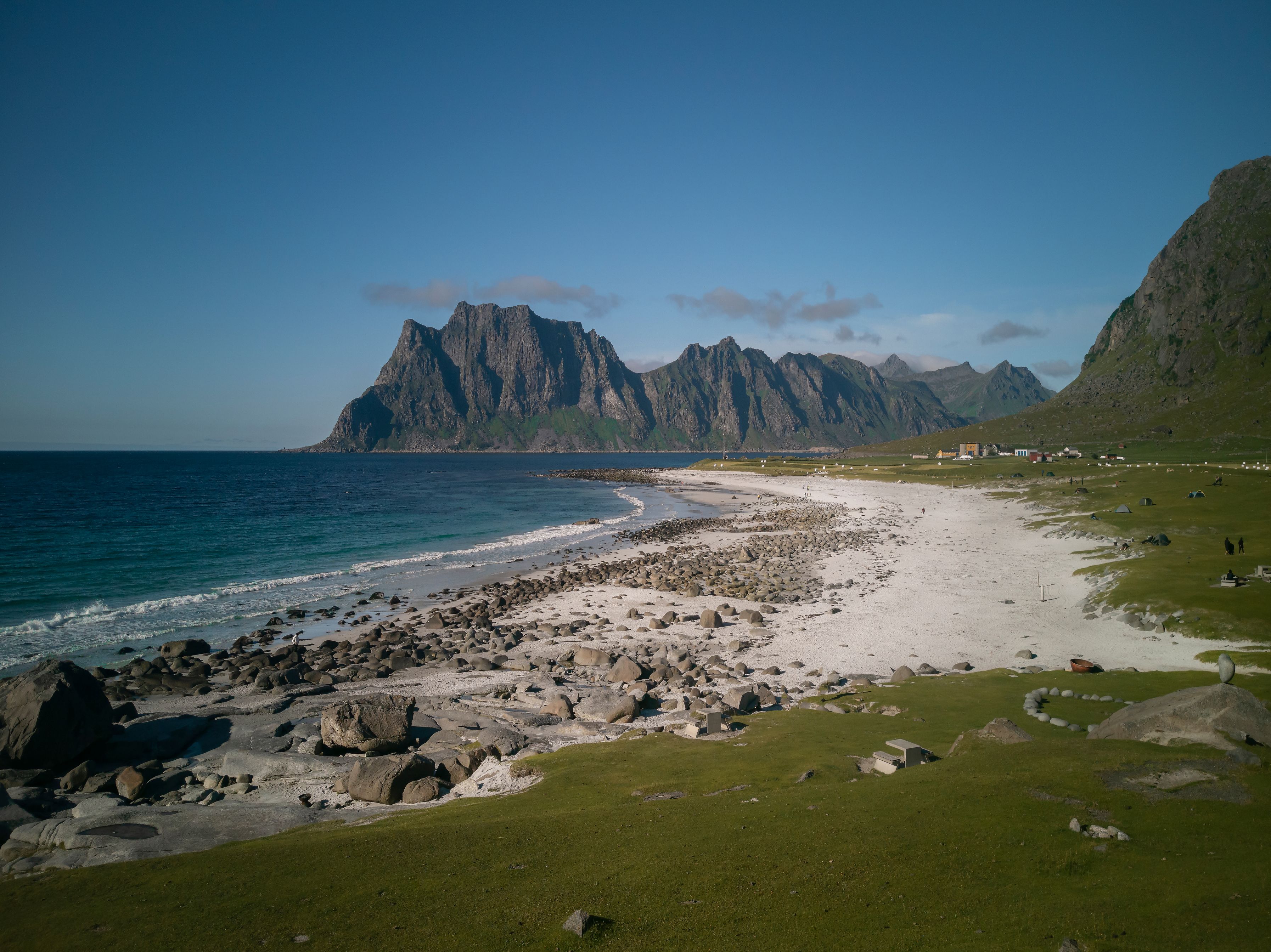
Uttakleiv Beach
A boulder field that looks accidental—until you step onto it and the beach rearranges your sense of scale.
Uttakleiv Beach sits at the end of a short Lofoten road, where mountains drop their shadow straight onto sand and sea. It matters because it’s one of the few places here where you can feel the landscape working in layers—alpine, coastal, and human—without a long hike or a boat timetable deciding your day.
Most people stop at the sand and photograph the curve of the bay. They miss the stone sea just beyond the parking lot: a broad apron of rounded boulders that reads like a frozen tide, each rock polished by years of storm push and winter pressure.
When you walk out onto those stones, the beach stops being “scenery” and becomes physical. Your pace slows, your attention sharpens, and you start listening—to water threading between rocks, to wind scraping grass, to your own footsteps finding balance.
The Shoreline That Starts After the Beach
Uttakleiv’s sand is the easy story, but the real character of the place begins where comfort ends—at the stone field that starts almost immediately beyond the parking lot. From a distance it looks like ordinary rockfall, the kind you walk around. Up close, it reads as choreography. The boulders are rounded, not sharp, and their sizes shift in bands, as if the shoreline has sorted them by weight and patience. You begin to notice micro-landmarks: a darker channel where water runs back to sea, a line of kelp stitched between stones, a single rock cupped smooth like it has been held in a palm for centuries. This is why the stone sea matters. It forces you to inhabit the coast rather than view it. Your body learns the terrain—ankles adjusting, eyes scanning, breath timing itself with the wave that slides in and then hesitates. It’s also where the light performs best: wet stones turn reflective, the sky’s gray becomes silver, and even a quiet day feels dimensional. Most visitors take their shot from sand and leave with a beautiful image. You step onto the stones and leave with a sensation—of time compressed into texture, of Norway’s edge being both harsh and strangely tender.
You step out of the car and the first thing you notice is sound—the soft percussive click of stones as the shore breathes. The parking lot is close, almost too close, and then the landscape opens and you understand why people linger: a wide band of pale sand, a steel-blue Atlantic edge, and behind it all, dark Lofoten peaks with streaks of lingering snow like chalk marks. You walk past the sand toward the boulders and the ground changes under you, from forgiving to deliberate. Each step is a decision: rounded granite, damp seams, pockets of seaweed that smell like clean salt and iron. The stones are cool even in summer, and they hold a quiet shine where waves have just receded. As you look back, the cars seem suddenly small, as if the place has absorbed them. Out here, the bay feels less like a postcard and more like a working coast—wind-driven, precise, and alive in slow motion.
The Water
The water shifts between slate-blue and cold green, with a thin, milky fringe where waves comb the sand. In calm weather, shallow pools between stones turn glassy and mirror the cloud ceiling like brushed steel.
The Cliffs
Uttakleiv is framed by steep, dark rock walls that make the bay feel contained, almost amphitheater-like. The boulder field is a working interface between mountain and ocean—rounded stones that suggest repeated storm cycles rather than a single dramatic event.
The Light
Late evening gives you the softest contrast, when the peaks go ink-dark and the beach turns pale and luminous. On overcast days, the stones become the star—wet surfaces catch diffuse light and everything looks more tactile, more precise.
Best Angles
Stone Sea Edge (by the first boulder band)
You get the immediate transition from sand to stones, which tells the story of the shoreline in one frame.
Middle Boulder Field (low angle, facing the bay)
Shooting low makes the rocks feel like a tide frozen mid-motion, with mountains rising behind like a backdrop.
Sand Curve (near the waterline, looking back toward the parking area)
This reverses the usual view and shows how quickly wilderness takes over from infrastructure.
Western End of the Beach (toward the headland)
Best for photographers chasing depth—foreground stones or sand ripples, midground surf, background peaks.
Tide Pools Between Boulders
An intimate angle where reflections, kelp, and small ripples create detail-rich, quiet images.
Wear shoes with grip—rounded boulders can be slick, especially with sea spray or rain.
Check tide and swell conditions if you plan to walk far across the stones; waves can push higher than you expect.
Bring a windproof layer even on sunny days—the bay funnels air and temperatures drop fast near the water.
If you’re photographing, pack a microfiber cloth; salt mist films lenses quickly.
Use the toilet at the parking area if available and keep the shoreline clean—this place feels pristine because people treat it that way.
Handpicked Stays & Tables
Places chosen for beauty and intention, not algorithms. Each one is worth your time.

Nusfjord Arctic Resort
Nusfjord (near Leknes)
A restored fishing village stay that leans into Lofoten’s textures—wood, weather, sea air—without feeling staged. You fall asleep to water sounds and wake up already inside the landscape you came for.

Henningsvær Bryggehotell
Henningsvær
A waterfront base with clean Scandinavian design and immediate access to harbor walks and galleries. It’s ideal if you want Uttakleiv’s raw coast by day and a more sociable town atmosphere by evening.

Lofoten Food Studio
Near Leknes (Kleppstad area)
A small, thoughtful dining experience that treats local ingredients with restraint and confidence. Expect seasonal menus and a pace that matches the region—unhurried, detail-focused.

Bakeriet i Henningsvær
Henningsvær
A warm, casual stop for coffee and baked goods that taste like they belong to this weather. Good for an easy breakfast before driving back out to the coast.
You arrive for a beach, but you remember the stones—the way they make you walk slower, and see longer.