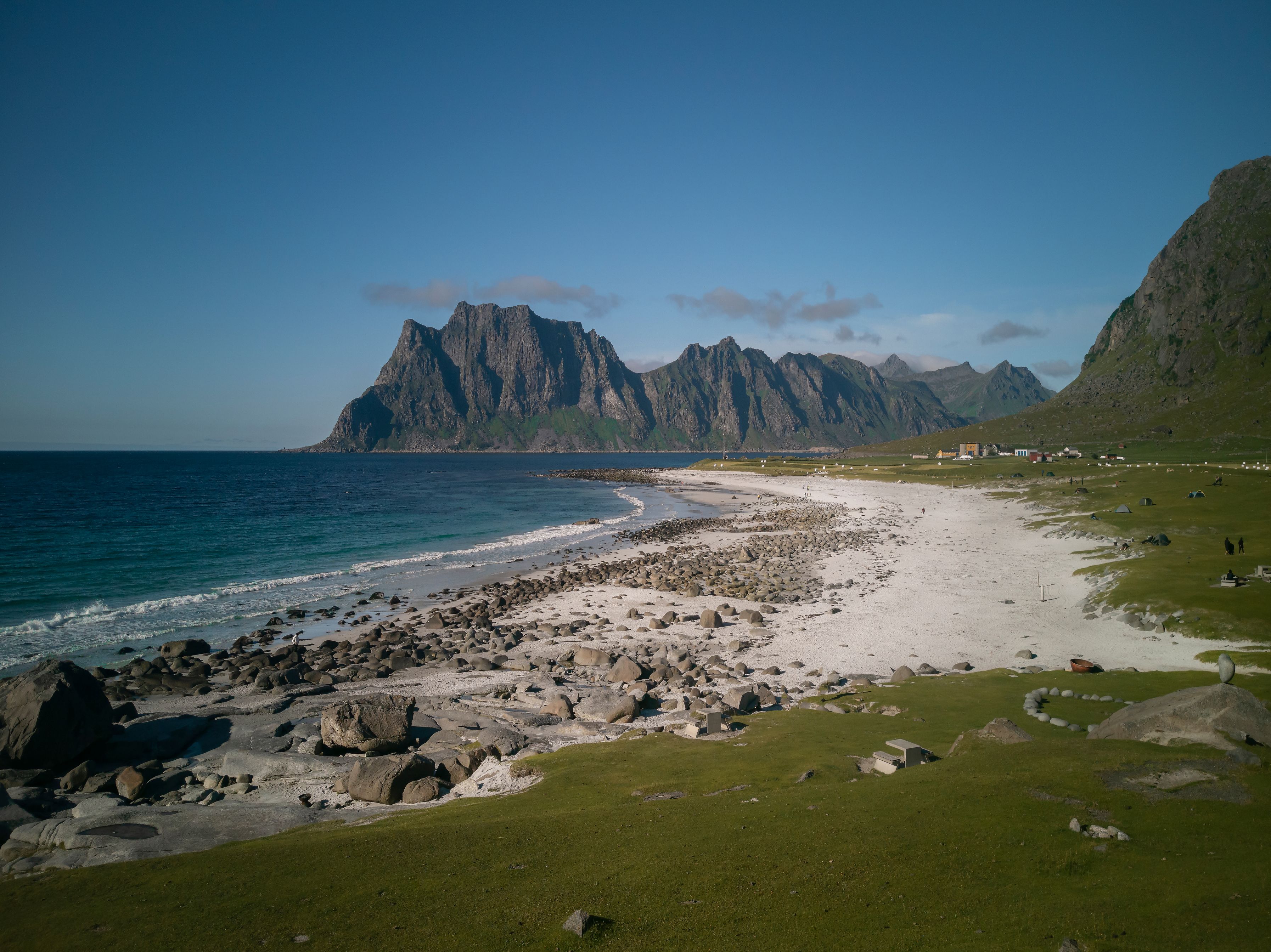
Uttakleiv Beach
Uttakleiv rewards the patient—granite keeps the day’s diary in tide lines and sea-polished seams.
At Uttakleiv Beach, the Lofoten drama happens at human scale: a curved sweep of pale sand, a low hush of surf, and black-green mountains pressing close enough to make the sky feel edited. You come for the postcard… but you stay because the shoreline keeps changing under your feet.
Most people stop at the icon shot—sand, sea, jagged peaks—then leave before noticing what the water has been writing onto the granite: faint bands, salt blooms, and pebble-scoured channels that mark the tide’s exact reach like an unrolled map.
When you slow down, the beach stops being scenery and becomes a conversation. You read time in stone, feel weather arriving before it’s visible, and leave with that rare sense that you’ve actually met a place—not just collected it.
The Granite’s Watermarks: Uttakleiv’s Quiet Timeline
Uttakleiv is photographed like a fixed stage set—sand in the foreground, peaks in the back, a strip of Arctic water between. But the beach is less a view than a process, and the most interesting evidence sits low, where your eyes don’t naturally go. Look at the granite outcrops along the shoreline and you’ll see tide lines: thin, chalky bands where salt dries, darker wet halos where the sea has just withdrawn, and subtle grooves where suspended sand and small stones have been pushed back and forth like sandpaper. These markings aren’t decorative. They tell you how the bay breathes. At higher water, the surf reaches into the rock’s shallow basins, leaving pools that act like lenses—smoothing the sky into a trembling mirror. At lower water, the beach expands and the granite becomes walkable, turning into a natural platform for framing the mountains without other people in your shot. The lines also show you where it’s slippery, where algae holds on, where the sea has been longest. Stay after you’ve taken the obvious photo. Sit with your back to the wind, watch the water climb a few centimeters, and you feel time slow into something readable. It’s a different kind of satisfaction—less about capturing grandeur, more about understanding the place’s rhythm.
You arrive with the road still in your ears, then the sound drops away into wind and a small, persistent surf. Uttakleiv opens in a soft crescent—sand the color of oatmeal, strewn with kelp ribbons that shine like wet leather. The water is clear enough to show the first stones, then it turns to a milky jade where the swell stirs the shallows. Ahead, granite humps rise from the beach like backs of sleeping animals, darkened by spray and varnished by tide. You walk past the first cluster of tripods and keep going, letting the beach widen around you. A seabird’s call snaps across the bay; somewhere behind, a camper door closes with a muffled thud. When the sun breaks through a slit in the cloud, the mountains ignite—rust, slate, and a sudden green that looks almost painted. You crouch by the rocks and see the beach’s real headline: delicate, pale lines on the granite where the sea paused, retreated, returned… each one a quiet timestamp.
The Water
The sea shifts from glass-clear at the edge to a cold jade-green in the shallows, then deepens toward steel-blue when cloud cover thickens. After rain, it can look almost luminous—green held against black rock like a backlit bottle.
The Cliffs
Uttakleiv sits inside a tight amphitheater of Lofoten peaks—angular, dark, and close enough to throw long shadows across the sand. Granite outcrops punctuate the shoreline, their surfaces polished by tide and streaked with salt and algae, turning geology into texture you can read by touch.
The Light
Late evening light is the headline—low sun sliding under cloud layers, warming the sand while the mountains stay cool and shadowed. Overcast days are underrated here too, because the water turns more transparent and the rock textures become evenly legible without glare.
Best Angles
Mid-beach, facing west toward the open sea
This gives you the classic crescent with the mountains stacked behind it—clean horizon, strong sense of scale.
Northern granite outcrops at low tide
You can shoot across tide pools that mirror the peaks, adding foreground detail that most photos lack.
Along the wrack line (kelp band) near the water’s edge
The kelp, shells, and wet sand create leading lines and texture—an editorial frame rather than a postcard.
From the small rise near the parking area
A higher perspective compresses the bay and helps at busy times—you can exclude people by framing the curve.
Right beside a tide pool, camera low to the granite
The intimate angle: tide lines, salt bloom, and ripples become the subject, with mountains softened in the background.
Check tide times if you want the granite platforms and tide pools—low tide opens the shoreline and creates reflections.
Bring a windproof layer even on bright days; the breeze off the bay can drop the felt temperature quickly.
Wear grippy shoes if you plan to step onto rock—algae-slick granite looks dry until it isn’t.
Pack a small towel or sit pad; the most rewarding viewing spots are low and damp near the tide line.
Use the toilets and pick up snacks before you arrive; services on-site are limited and the weather can make you linger longer than planned.
Handpicked Stays & Tables
Places chosen for beauty and intention, not algorithms. Each one is worth your time.

Hattvika Lodge
Ballstad (near Leknes)
Architectural rorbuer with clean Nordic lines, set right on the working waterfront. You get warmth, privacy, and a front-row view of fishing life without losing comfort.

Nusfjord Arctic Resort
Nusfjord
A restored fishing village stay that leans into texture—tarred wood, salt air, and quiet coves. It’s the kind of place where the light outside becomes part of your room.

Lofoten Food Studio
Vikten
A seasonal, locally anchored dining experience where seafood and foraged notes feel precise rather than performative. Plan ahead—it’s intimate, and the pace suits long northern evenings.

Restaurant Karoline
Nusfjord
Comforting, well-executed dishes in a setting that matches the landscape—dark timber, soft light, and sea just outside. Ideal after a wind-heavy beach day when you want something warming and unhurried.
If you give Uttakleiv an extra hour, the beach stops being a backdrop and becomes a story written in salt, light, and granite.