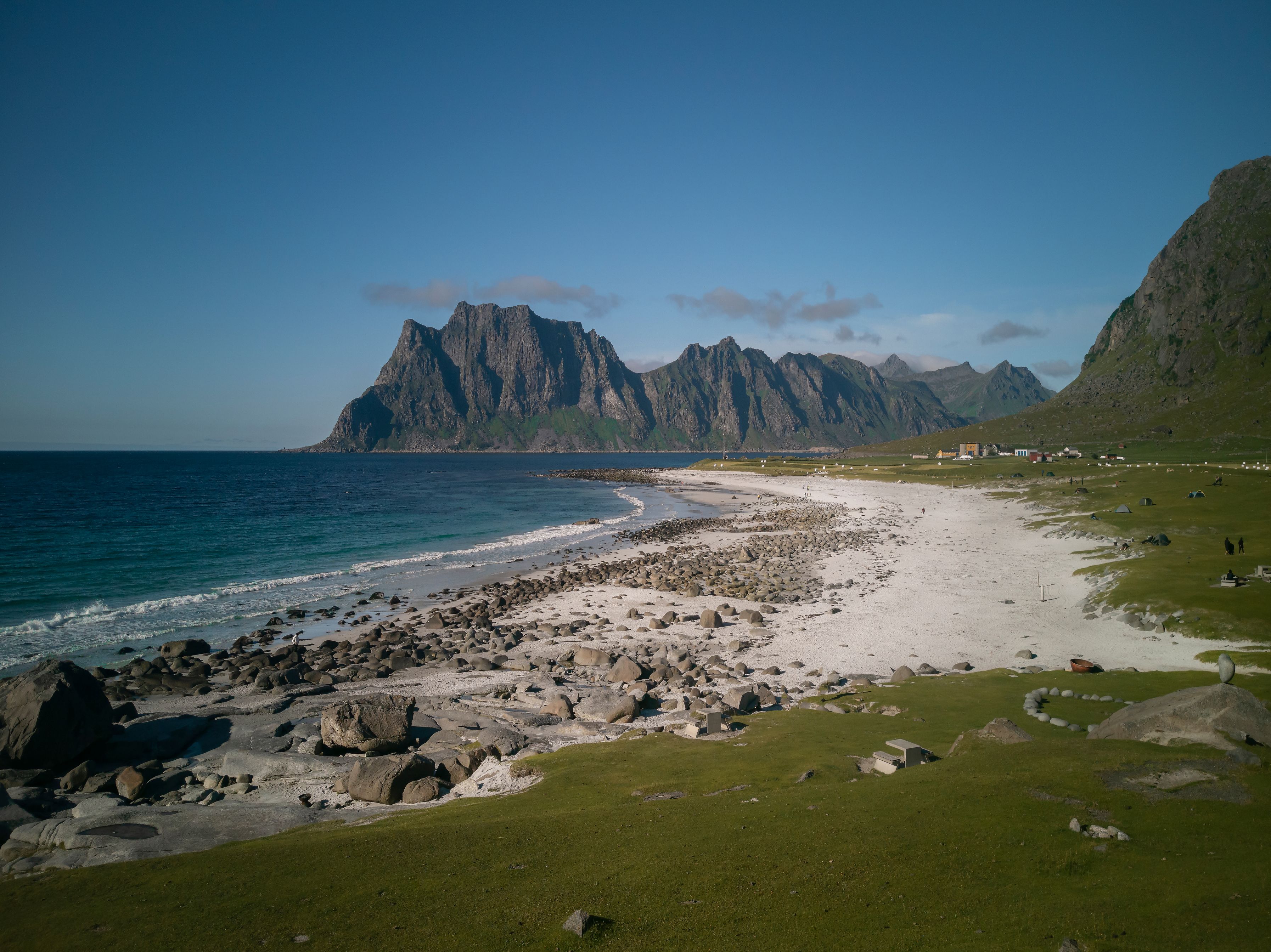
Uttakleiv Beach
Uttakleiv feels different when you earn it—salt air first, sand last, silence in between.
Uttakleiv Beach matters because it’s one of the few places in Lofoten where the ocean and the mountains meet without a buffer—no harbor, no town noise, just a broad arc of sand pressed against dark rock and Arctic weather.
Most people arrive by car, step out, take the same wide shot, and leave. What they miss is the headland approach—the way the beach reveals itself slowly, with the soundscape changing before the view does.
When you come on foot, Uttakleiv isn’t just a postcard backdrop. It becomes a small rite of arrival… and you feel your body downshift into the place, not simply observe it.
The beach is louder from the trail—and that’s the point
Arriving by car gives you Uttakleiv all at once: an open sweep of sand, a quick scan for the best frame, a straight line to the shoreline. It’s efficient—and it flattens the place. The headland trail does the opposite. It builds the beach in layers, and the first layer is sound. Up on the rocks, before you see the bay, the Atlantic is a presence you feel in your chest. The wind catches in the grass and turns it into a soft, continuous hiss; the waves land with a deeper, slower rhythm than they seem to have from the sand. That mismatch is the giveaway: distance changes scale. You begin to understand how exposed this coastline is, and why the mountains look like they’re bracing. Then there’s the choreography of light. On Lofoten, clouds move like stage curtains. From the trail you watch shadows slide across the water and then across the beach—making the sand look silver one minute and beige the next, the sea steel-gray then suddenly green. By the time you step onto the shore, you’ve already witnessed the beach’s moods, not just its appearance. The payoff is subtle but lasting. You arrive with your attention already sharpened. Uttakleiv stops being “a stop” and becomes a threshold—an earned quiet that stays with you long after your shoes are sandy.
You start on the headland trail with your breath already tasting of salt and wet stone, boots working over a narrow ribbon of earth where heather grips the slope and the wind keeps testing your balance. The sea is there but not yet visible—only its low, steady percussion, like someone turning pages in a heavy book. As you crest a shoulder of rock, the light changes first: a cooler wash that seems to lift off the water and slide under your eyes. Then the beach appears in sections—sand, then surf, then the black ribs of mountains behind it—until the whole curve is suddenly complete. You follow the path down with gulls carving the air above you, their calls sharp and clean. At the bottom, the sand feels unexpectedly fine for the Arctic, pale and compacted near the waterline, softer higher up where seaweed dries in tangles that smell like iodine. You step closer to the tide and the water runs clear over stones, cold enough to make you instinctively laugh, then go quiet.
The Water
The water shifts with the sky—often slate and ink at distance, but glass-clear at the edge where it reveals amber-brown kelp and pale stones. On brighter spells it turns a restrained Arctic turquoise, more mineral than tropical, with white foam sketching the shallows.
The Cliffs
Uttakleiv sits in a wide, open bowl of coastline where sand collects between blunt granite forms and sea-smoothed rock shelves. Behind you, the Lofoten mountains rise abruptly—dark, angular, and close enough to make the beach feel like a stage set built at full scale.
The Light
Late afternoon into evening is when the bay starts to glow—especially when low sun slips under cloud layers and ignites the wet sand. In winter, the blue hour can feel endless, turning the entire shoreline into a gradient of pewter, lavender, and charcoal.
Best Angles
Headland approach lookout (trail crest)
You get the full curve of the bay with the mountains stacked behind—best for understanding scale before you descend.
Rock shelves at the eastern end
Closer texture—seaweed ribbons, tide pools, and the water’s clarity against dark stone.
Mid-beach waterline
The cleanest horizon and the most dramatic reflections when the sand is wet and the wind drops.
Upper beach dunes/grass edge
A higher, calmer vantage that compresses the mountains and makes the beach feel more expansive—great for long lenses.
Between boulders near the trail descent
A more intimate frame—rock in the foreground, surf threaded through, with the beach opening beyond.
Wear windproof layers even in summer—the headland catches gusts that feel one season colder than the beach.
Choose grippy footwear; rock sections can be slick with moisture and lichen, especially after rain.
Bring a small towel or dry socks—if you wade even briefly, the cold is immediate and surprisingly energizing.
Check tide and swell if you plan to explore rock shelves; waves can surge higher than they look from a distance.
Respect parking rules and private property boundaries around access points—Lofoten is welcoming, but it’s also lived-in.
Handpicked Stays & Tables
Places chosen for beauty and intention, not algorithms. Each one is worth your time.

Lofoten Beach Camp
Uttakleiv
Cabins and apartments right by the shore, where you fall asleep to surf and wake into shifting weather. It’s simple, well-positioned luxury—the kind measured in proximity, not marble.

Nusfjord Village & Resort
Nusfjord
A restored fishing village stay with a strong sense of place—tarred wood, sea air, and thoughtful Nordic design. It’s an elegant base for beach-and-hike days with a warmer return at night.

Restaurant Karoline
Nusfjord
Seasonal cooking with a Lofoten backbone—seafood when the sea allows it, comforting dishes when the weather turns. Come for a slow dinner after the wind has had its say.

Huset Restaurant
Henningsvær
A polished, ambitious kitchen with one of the region’s more serious wine programs. It’s where you go when you want the day’s wild coastline translated into craft and calm.
When you arrive over the headland, Uttakleiv doesn’t greet you with a view—it meets you with a cadence, and you step into it.