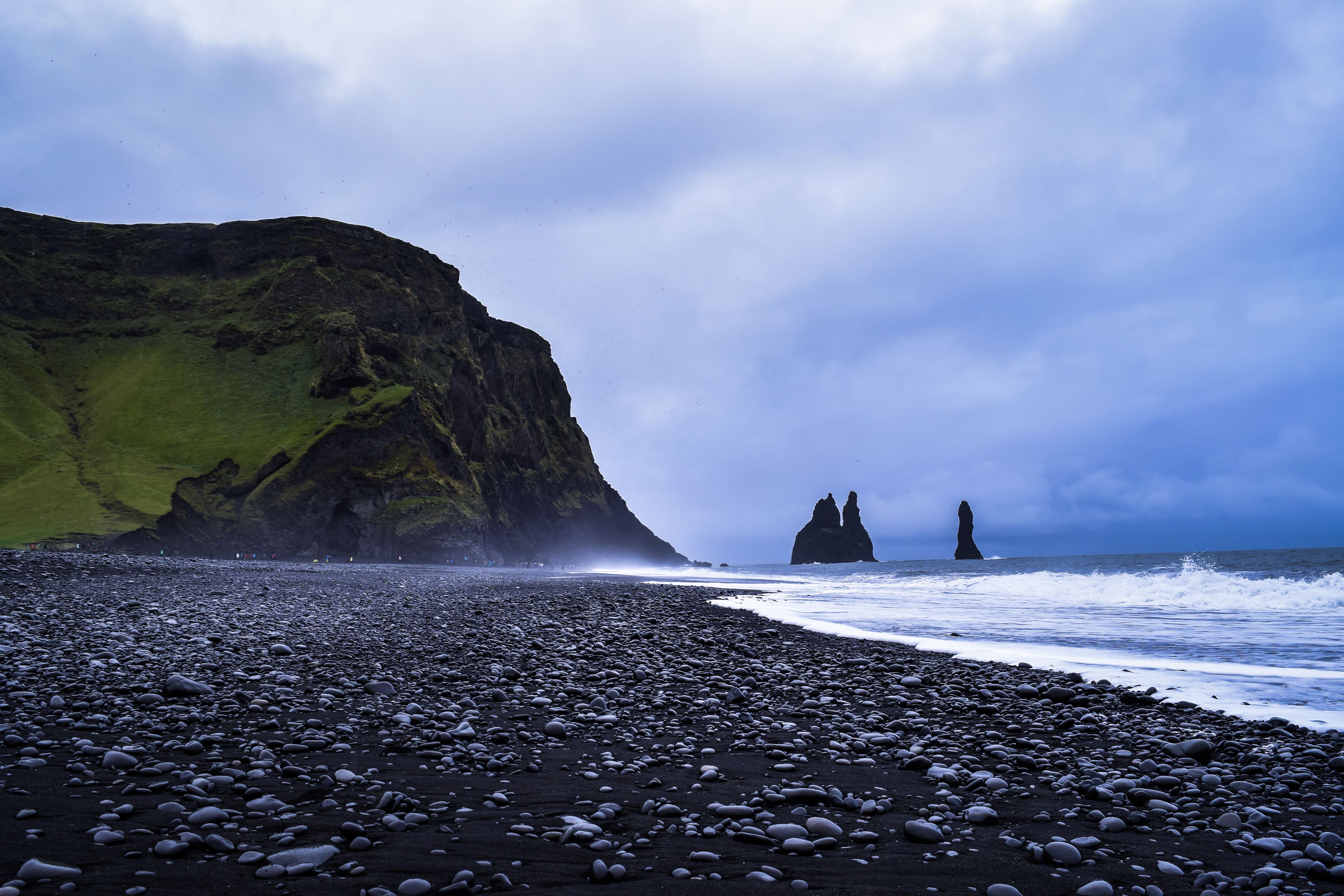
Reynisfjara
On Iceland’s black-sand edge, beauty is inseparable from risk—and the ocean is never background.
Reynisfjara matters because it corrects your expectations. You arrive for the basalt columns and the black sand, and you leave thinking about sound—how the Atlantic doesn’t crash so much as breathe, then suddenly take.
Most people watch the waves; they don’t watch the waterline. The beach teaches you to read intervals, not moments: the way foam thins, the way the next set stacks higher, the way the sand turns from matte to lacquered right before it moves.
The payoff is a rare kind of calm—earned, not gifted. When you stop treating Reynisfjara as a backdrop and start treating it as a living edge, you feel present in a way photos can’t capture.
The Beach Has a Rhythm—Learn the Count
Reynisfjara is famous for being dramatic. What’s less discussed is how methodical it is. The ocean here doesn’t behave like a single wave rolling in for your camera; it arrives in sets, and each set has a personality. If you give it five minutes—standing well above the wet line—you start to notice patterns: a sequence of smaller waves that seem manageable, followed by one that runs farther up the sand, as if the beach tilts toward it. That last wave is often the one people underestimate. The black sand makes this easier to read than you think. Dry sand is a deep, velvety charcoal. Wet sand turns reflective, like polished obsidian. When you see that glossy band creep up the slope and linger, it’s telling you the water is reaching higher than it has in the last few minutes. The undertow is the second message. After the surge, the retreat pulls hard and low—less splash, more suction—dragging stones and anything loose with a sound like rattled beads. Once you learn to “count” the sets, Reynisfjara changes. You stop rushing the shoreline and start pacing the beach like a lookout. The columns, the cave, the distant Reynisdrangar sea stacks… they all become part of a moving system, not a static scene. That awareness is the real luxury here: not access, but attention.
You step off the path and the temperature drops as if someone opens a door. The sand is not sand so much as ground volcanic glass—fine, dark, and slightly squeaking under your boots. Wind combs across the beach in low sheets, carrying salt and a mineral tang that feels almost metallic. Ahead, the basalt columns rise like an organ in a cathedral, their facets catching a cold sheen whenever a pale sun breaks through the cloud deck. The sea is slate-green at its thickest and silver at its thinnest, flashing white where it worries at the shore. You hear the cave before you reach it: a hollow, tidal thrum that makes your chest feel lightly tuned. People drift toward the water for a picture, then drift back, laughing too loudly into the wind. You stand a little higher on the slope, watching sets arrive in groups—one, two, three… then a longer pause. In that pause, the beach feels almost gentle. Then the next wave comes in faster than it looks, and the undertow whispers its warning in reverse.
The Water
The water reads as steel and slate from a distance, then turns bottle-green where it thickens over deeper channels. Near shore it flashes silver-white—foam skimming over black sand like torn silk.
The Cliffs
This is a volcanic shoreline built from fire and edited by surf: hexagonal basalt columns, a wave-cut cave, and a wide strand of dark tephra. Offshore, the Reynisdrangar stacks stand like punctuation marks against the horizon—sharp, vertical, and constantly re-framed by mist.
The Light
Reynisfjara looks most dimensional under broken cloud, when sunbeams isolate sections of sand and column like spotlights. In low winter light, the black beach turns bluer, and every wet surface becomes a mirror.
Best Angles
Basalt Column Amphitheater (Hálsanefshellir side)
The geometry becomes architectural here—repeat patterns, strong leading lines, and scale when you include a person at the base.
Cave Mouth Looking Out
You frame the sea and Reynisdrangar through a dark arch; the contrast makes the water look brighter and more dangerous.
Upper Beach Slope (well above the wet line)
The unexpected angle is safety plus storytelling—you capture the run-up of waves and the shine line that reveals the ocean’s reach.
Eastward View Toward Dyrhólaey
For photographers, this compresses the coastline into layers—black sand foreground, surf texture midground, headland silhouette behind.
Basalt Steps at the Column Edge
The intimate angle: close-ups of wet basalt facets, salt spray beading on stone, and the tactile contrast between matte rock and reflective sand.
Keep a wide buffer from the waterline; sneaker waves can surge far beyond the last wet band and retreat with force.
Wear waterproof boots with grip—wet basalt and compacted sand can be slick, and wind-driven spray is constant.
Check conditions (wind, swell) before you arrive; if signs advise staying off certain areas, take them literally.
Bring a lens cloth and a rain cover; salt mist films glass quickly and makes photos look hazy.
If you’re visiting in winter, budget extra time for icy roads and sudden closures—this stretch of the South Coast changes fast.
Handpicked Stays & Tables
Places chosen for beauty and intention, not algorithms. Each one is worth your time.

Black Sand Suites
Vík í Mýrdal
Modern, design-forward suites with a quiet, residential feel—ideal after a wind-heavy day on the beach. You’re close enough to Reynisfjara for early starts without the rush of tour timing.

Hótel Kría
Vík í Mýrdal
Sleek, comfortable, and reliably well-run, with clean Nordic lines and a good breakfast for road-trip mornings. The location makes it easy to pair Reynisfjara with Dyrhólaey and the South Coast waterfalls.

Smiðjan Brugghús
Vík í Mýrdal
A relaxed brewpub with big windows and satisfying post-coast food—think burgers and fish with local beer. It’s the kind of place where the wind finally leaves your shoulders.

Suður-Vík
Vík í Mýrdal
A more refined dining room than you expect in a small South Coast town, with thoughtful plating and Icelandic ingredients treated simply. Good for slowing down and letting the day’s weather feel like part of the meal.
Stand back, watch the sets, and you’ll feel Reynisfjara shift from a photograph into a lesson the ocean repeats until you listen.