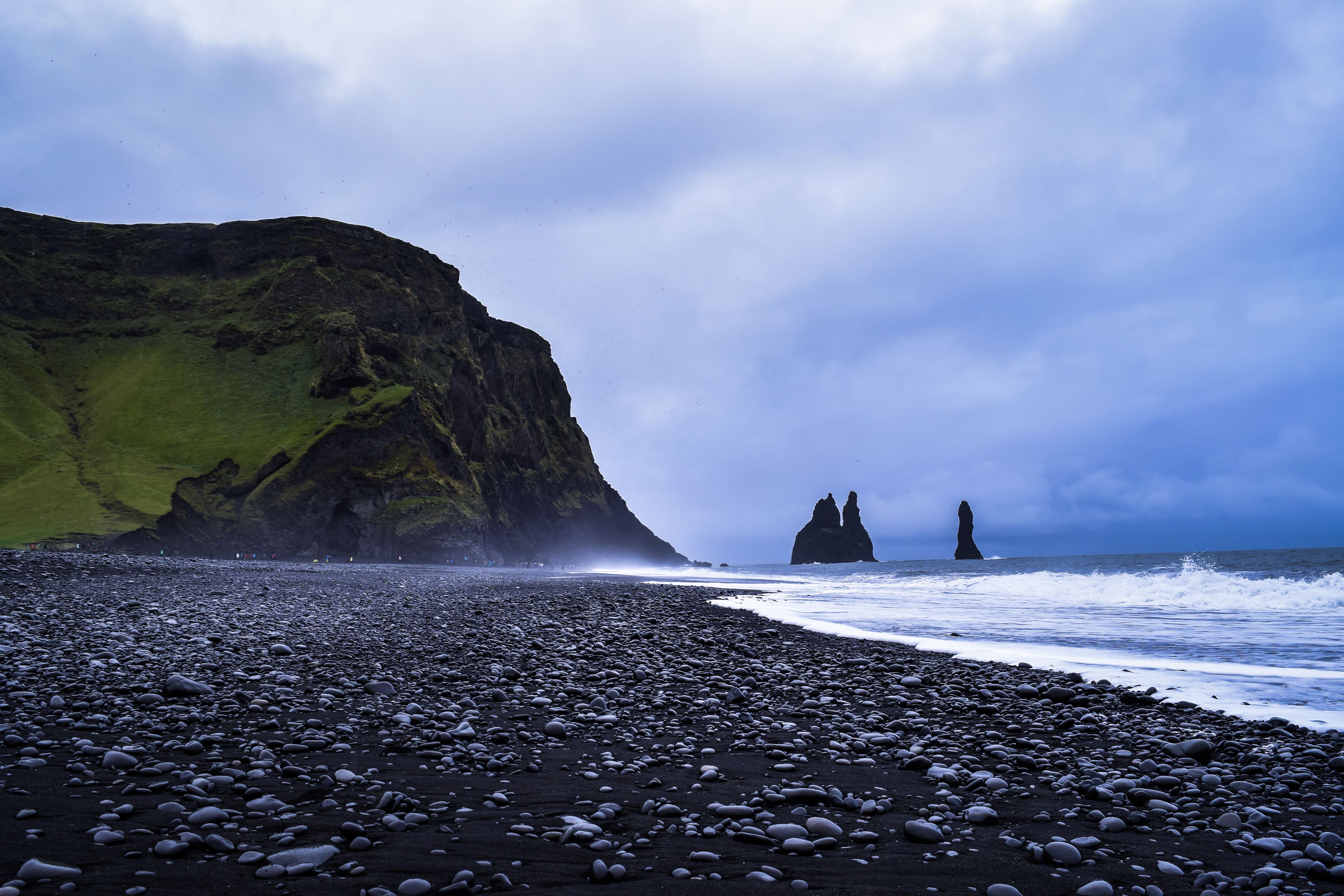
Reynisfjara
From Dyrhólaey, you watch Reynisfjara turn from postcard to pulse—black sand, white water, and real scale.
You arrive at Dyrhólaey’s clifftop and the South Coast opens like a slow, deliberate reveal—Reynisfjara laid out below in ink-black bands, the Atlantic whitening itself as it collides with shore. From up here, the beach feels almost orderly. That illusion is the point.
Most people miss how the beach changes as you descend. Perspective collapses. The basalt stacks stop being “features” and start being walls. The surf stops being scenic and becomes physical—wind-sheared spray, a low thunder you feel in your sternum before you hear it.
The payoff is a rare kind of awe: not the pretty kind, but the honest kind. You leave with salt on your lips and a sharper sense of respect—Reynisfjara doesn’t ask to be conquered. It asks to be watched well.
The beach isn’t the danger. The rhythm is.
From the clifftop, Reynisfjara reads like geometry: a clean crescent of black, a bright fringe of surf, a few dramatic rocks set out for effect. Down on the sand, you realize the design is alive. The ocean here doesn’t arrive in tidy, repeatable waves—it breathes in uneven sentences. What most visitors miss is that the “sneaker wave” story isn’t a freak occurrence so much as a pattern you can learn to read. Sets come with longer intervals, then a sudden, higher push that runs farther than the last few waves…exactly when you’ve relaxed. The pullback is just as important: water draining fast over steep sand, tugging at your footing, making you take one extra step toward the sea without noticing. Stand still for two full minutes before you commit to a spot. Watch the farthest line the water reaches and then add a buffer you can feel smug about. If you want the cathedral-like basalt without the risk, stay close to the cliff base but away from the cave’s dripline and any falling pebbles—this is a living coastline, not a stage. When you move with the rhythm instead of against it, the beach gives you something rarer than a photo: the sensation of being small in a way that clarifies rather than diminishes you.
You park on the headland at Dyrhólaey and step out into a wind that smells of kelp and cold stone. The light keeps moving—cloud-shadow sliding across the sea—so the beach below seems to grow and shrink with each passing minute. When you start the descent toward Reynisfjara, the scale recalibrates: the black sand turns from a smooth swatch into a granular, glassy grit under your boots. Ahead, Reynisdrangar rise out of the surf like dark teeth, their bases disappearing and reappearing as waves fold in. The sound is layered—wind in your hood, gulls above, and beneath it a steady, percussive boom as sets arrive. Near the basalt columns, the air cools; the cliff face sweats with mist. You keep a wide distance from the waterline, watching the ocean’s body language—longer pauses, then a sudden surge. When the sun breaks through, the wet sand turns mirror-black and the foam glows briefly, almost blue-white, before it’s pulled back into the Atlantic.
The Water
The water is steel-gray with green undertones, whipped into white and blue-white foam that flashes brighter when the sun breaks through. In calm moments between sets, you catch a thin, oily sheen of slate and jade before the surface roughens again.
The Cliffs
Reynisfjara is a collision of volcanic logic and ocean insistence—black basalt, hexagonal columns, and a sand field made from pulverized lava. Offshore, Reynisdrangar puncture the horizon, while Dyrhólaey frames the scene above like a lookout built by geology.
The Light
Late afternoon into golden hour turns the wet sand into a dark mirror and gives the basalt columns soft edge-lighting that reveals their ribbed texture. On overcast days, the palette goes monochrome and cinematic—fewer colors, more drama, with the foam doing most of the bright work.
Best Angles
Dyrhólaey Upper Viewpoint (Háey)
You get the full composition—Reynisfjara’s curve, the stacks, and the surf lines that show scale and motion.
Dyrhólaey Lighthouse area
A slightly different elevation that lets you layer foreground cliff with the beach below, especially strong in shifting cloud light.
Reynisfjara Basalt Columns (Hálsanefshellir edge)
The vertical rhythm of the columns contrasts with the horizontal surf—stand back to show human scale without stepping near the waterline.
Reynisfjara viewpoint near the parking area (beach approach)
Clean, wide frames of the black sand and incoming sets—ideal for shutter-speed play and wave timing from a safer distance.
Cliff-base perspective looking east along the beach
An intimate angle where you feel the beach ‘shrink’ behind you—texture of sand, mist on rock, and the stacks pulled into the distance.
Treat the sneaker-wave signage as instruction, not decoration—stay well back and never turn your back on the ocean.
Wear waterproof footwear with grip; the sand is steep, wet, and can shift under you when the water drains fast.
Bring a windproof layer even in summer—the beach funnels gusts that can turn a mild day into a cold one in minutes.
If you’re photographing, use a lens cloth and keep your camera out of the spray zone; salt mist arrives farther than you expect.
Check road and weather conditions on vedur.is and road.is—closures and high winds can change your plan quickly.
Handpicked Stays & Tables
Places chosen for beauty and intention, not algorithms. Each one is worth your time.

Black Sand Suites
Vík í Mýrdal
Sleek, apartment-style suites with ocean-facing balconies—made for lingering with a coffee while the weather performs. You’re close enough to Reynisfjara for dawn runs, but removed from the parking-lot bustle.

Hótel Kría
Vík í Mýrdal
Modern, comfortable rooms with a calm, Nordic palette that feels restorative after wind and salt. It’s a practical base with a premium finish—easy access to the South Coast without sacrificing sleep.

Smiðjan Brugghús
Vík í Mýrdal
A relaxed brewpub with well-made burgers and local beer—exactly what you want when you come back windburned and hungry. Go early if you’re aiming to miss the dinner rush.

Sudur-Vik
Vík í Mýrdal
A more refined room with thoughtful plating and a welcome warmth after the beach’s rawness. It suits travelers who want a proper sit-down meal without losing the casual rhythm of the South Coast.
From the cliff you think you understand Reynisfjara—on the sand, with the ocean rewriting the edges, you realize you’ve only just begun to look.