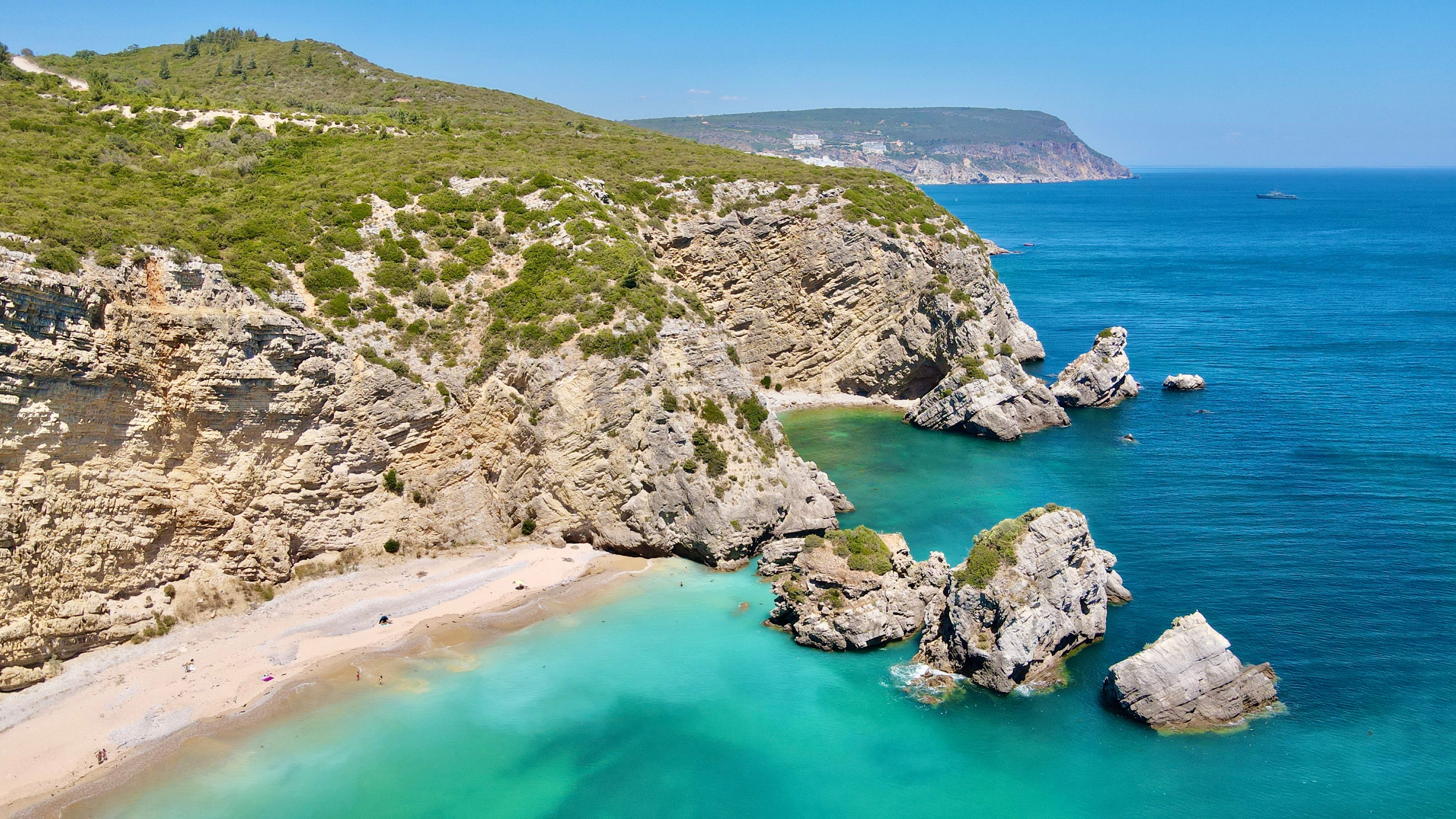
Praia do Amado
A 6-minute boardwalk detour changes Praia do Amado from surf arena to Atlantic theatre.
Praia do Amado matters because it shows the Costa Vicentina at full volume—wind-scrubbed dunes, black rock ribs, and an Atlantic that never sits still. You feel it in the salt on your lips and the constant percussion of sets folding onto sand.
Most people stop at the car park and read the beach as a single wide stage: surf schools, wetsuits, a line of boards, a snack bar. They miss the dune path that rises behind the beach and quietly rearranges the whole coastline in your mind.
Take that path and the place shifts from a busy shoreline to something slower and more intimate. You leave the noise behind, watch the wind comb the grasses, and realize the real luxury here is space—space to see, to breathe, to be unhurried.
The Dune Corridor That Reframes the Entire Beach
Praia do Amado is famous for its surf, and the beach layout encourages you to treat it like an arena: you arrive, you pick a patch of sand, you watch the lineup. The skipped detail is a simple one—an elevated dune corridor that starts almost apologetically behind the main access and runs just far enough to lift you above the day’s clutter. It’s not a “hike” in the heroic sense. It’s a change in altitude and attention. From the boardwalk you begin to notice what the beach level hides. The sand isn’t uniform; it’s patterned by wind into fine, repeating ripples, like corduroy. The dune plants are doing real work—marram grass stitched into the slope, low succulents hugging the ground where the wind would otherwise strip it bare. Look seaward and you can read the water like a map: darker, smoother lanes show deeper channels; pale, aerated patches mark where waves break over shallower bars. It’s a lesson in how this coast functions, not just how it photographs. The payoff is emotional, not informational. Up here, you’re not part of the beach’s busy narrative—you’re the observer. It’s a quieter kind of exhilaration: the feeling of standing in the wind and understanding the place as a whole, then returning to the sand with a calm that doesn’t depend on finding an empty spot.
You step off the gravel of the car park and the beach presents itself immediately—umbrellas, neoprene, the bright rectangles of surf school flags snapping in the wind. Then you turn away on purpose. A narrow boardwalk begins behind the dunes, sun-bleached wood underfoot, the scent of hot sand and wild fennel rising as you climb. The sound changes first: the crowd drops to a murmur, and the ocean becomes the only voice, deep and steady. At the top, the view opens like a cut in a film—Amado’s crescent below, the water streaked with darker bands where swell meets current, and the headlands to either side layered in ochre and charcoal. You pause because the wind insists you do, tugging at your sleeves, carrying spray that tastes metallic and clean. Down on the shore, surfers look like moving punctuation. Up here, you watch the whole grammar of the coast—dunes, cliffs, and wave lines—work together.
The Water
The water reads as Atlantic ink at first—deep blue-green with slate undertones, especially when the wind flattens sections into dark panels. Closer to shore it turns bottle-glass and then milky, whipped beige where the sand gets pulled into the break.
The Cliffs
Amado sits inside the Costa Vicentina Natural Park, where dunes press up against rugged, stratified cliffs. The headlands show bands of ochre, rust, and charcoal rock, with low vegetation clinging in wind-shaped silhouettes.
The Light
Late afternoon is when the cliffs start to glow and the dune grasses turn from straw to gold, each blade edged in light. After a passing cloud, the contrast snaps into place—dark sea, bright sand, luminous cliff faces.
Best Angles
Main dune boardwalk crest
You get the classic overview without the foreground clutter—clean lines of shore, surf, and headlands.
North headland viewpoint (trail toward the cliffs)
The coastline becomes layered; you see the beach curve and the wave sets arriving in diagonal ribbons.
South dune edge above the surf schools
An unexpected angle on the human choreography—tiny surfers against a wide, graphic seascape.
Mid-beach at low tide facing north
For photographers: wet sand becomes a mirror, reflecting cliffs and sky with crisp leading lines.
Dune hollow beside the boardwalk
The intimate angle—close textures of rippled sand, seed heads, and wind-bent grass with the ocean as sound design.
Bring a wind layer even in summer—the dune crest can feel 5–10°C cooler than the car park when the nortada picks up.
Wear shoes with grip; the boardwalk is easy, but sand can be soft and the cliffside trails can be slick after mist or rain.
Pack water and something small to eat; options near the beach are limited and lines can be long at peak hours.
If you’re photographing, a lens cloth matters—salt spray rides the wind and fogs glass faster than you expect.
Respect dune fencing and planted areas; the vegetation is fragile and it’s the only reason the sand stays put.
Handpicked Stays & Tables
Places chosen for beauty and intention, not algorithms. Each one is worth your time.

Azenha do Mar Valley House
Rogil / Azenha do Mar
A quiet, design-forward base between the cliffs and the countryside, with a calm, curated feel that suits early starts. Expect clean lines, natural materials, and an atmosphere that encourages you to slow down between coastal drives.

Memmo Baleeira
Sagres
A polished, contemporary stay with ocean-facing views and an easy connection to the wilder beaches of the southwest. It’s ideal if you want comfort, a good breakfast, and a spa to return to after wind and salt.

O Sítio do Rio
Carrapateira
A straightforward, locally loved spot where the food feels like it belongs to the landscape—honest portions and the kind of warmth you appreciate after a windy beach session. Go early in peak season to avoid waiting.

Restaurante do Pescador
Aljezur
A dependable choice for fish and seafood when you want something more settled than beach snacks. The mood is relaxed but focused on product—simple preparations that let the Atlantic do the talking.
When you take the dune path, you don’t just arrive at Praia do Amado—you learn how the wind, sand, and sea are staging it.