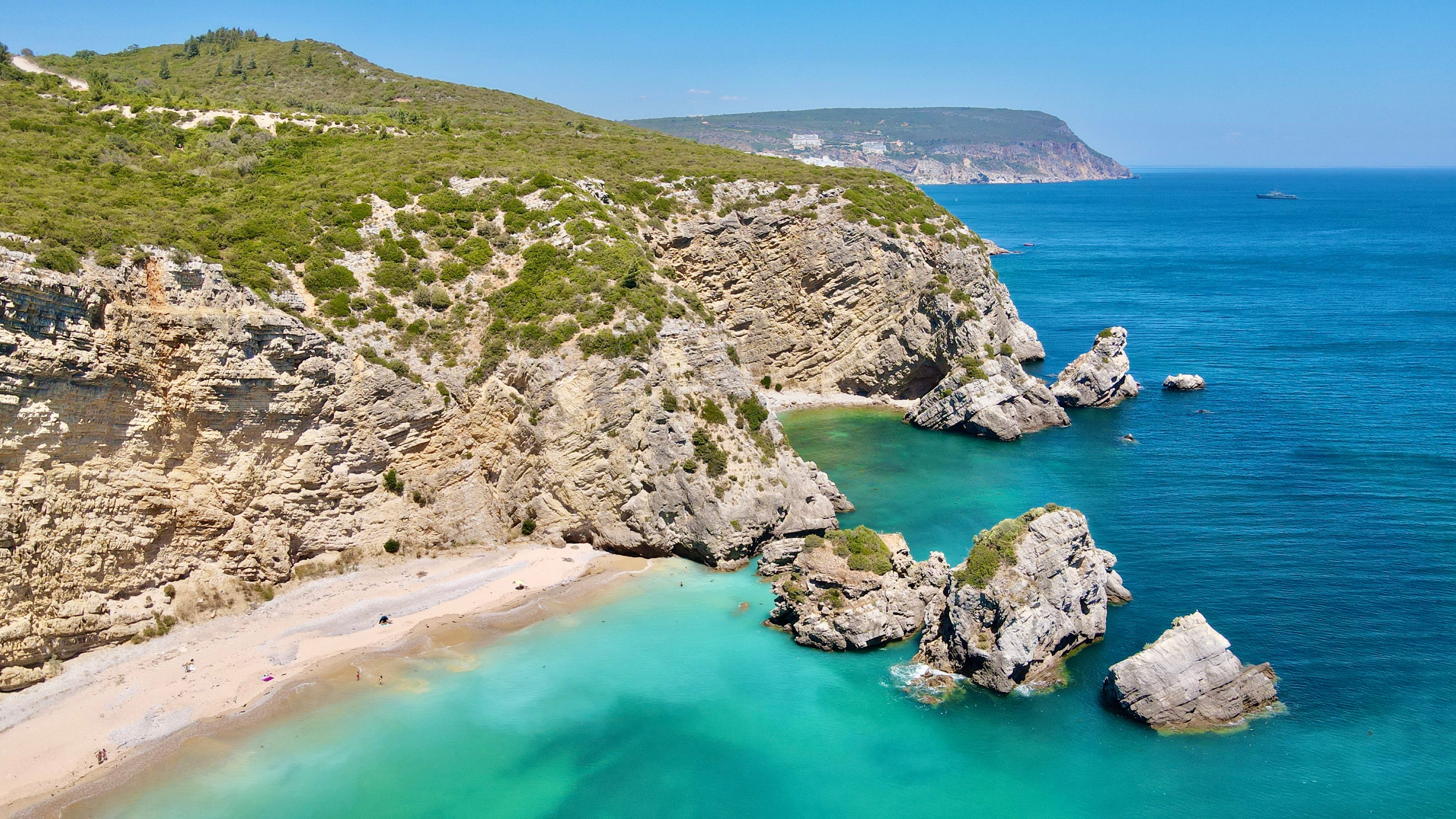
Praia do Amado
Walk past the lesson flags and you find the Algarve’s quieter pulse—wind, shale, and room to breathe.
Praia do Amado matters because it shows the Algarve in a more elemental register—Atlantic, not postcard. You arrive to a broad bay where wind writes on the sand and the cliffs hold their ground in dark layers, like a book left open to weather.
Most people stop at the surf schools and read the beach as a single scene. The south end changes everything: the noise thins, the sand firms, and the shoreline begins to feel like a corridor between rock and tide—more coastline than “beach day.”
The payoff is space—physical and mental. You feel your breathing slow to the pace of sets arriving, your thoughts rinsed clean by salt air and the steady percussion of whitewater against stone.
The South-End Shift: Where Amado Stops Performing
Amado is famous for being busy—and it earns it. The bay is wide, forgiving, and built for learning, which means the center of the beach often feels like a stage: instructors calling out, tourists timing photos to foam, the steady choreography of beginners paddling and standing and falling. If you only experience that, you leave with the idea that Amado is “a surf beach,” full stop. Walk beyond the last cluster of boards toward the south end and the beach quietly edits itself. The sand darkens with moisture, the wind feels cleaner, and the human noise drops away until you can separate sounds again—whitewater fizzing, pebbles clicking in the wash, the hush that follows a set. The cliffs here are the detail most people don’t read. They’re not just a backdrop; they’re texture and scale, layered and angular, catching light in thin slices so the coastline looks drawn rather than built. This is where you notice how the Atlantic behaves at Amado: not tropical transparency, but muscle—cold, moving, sometimes unruly. You stop trying to “do” the beach and start letting it happen to you. The south end gives you a different kind of luxury… the rare feeling that you are not consuming a destination, just being present inside it.
You park above the bay and the first thing you hear is instruction—boards thumping, whistles, a chorus of wetsuit zips. The air smells of neoprene and sun-warmed wax. You step onto the sand and the Atlantic wind meets you head-on, tugging at your collar, pushing a veil of fine grains across your shoes. Ahead, the lesson flags stitch bright rectangles into the beach, but you keep walking—south, where the crowd loosens and the soundtrack simplifies. The sand turns darker and slightly firmer underfoot, damp with the last retreating wave. Cliffs rise in banded slate and ochre, their edges crisp in the light, their faces rough enough to catch shadow like velvet. A gull hangs motionless in the wind. Sets arrive in clean lines, then fold with a blunt, satisfying boom. You sit near the rocks where the spray cools your skin and everything becomes tactile—the salt on your lips, the sting of wind on your cheeks, the faint vibration in the ground when a larger wave meets the shore.
The Water
The water is Atlantic steel with sudden flashes of jade—green that appears only where a wave thins before breaking. In brighter moments, the foam turns almost luminous against the darker sea, like chalk dragged across slate.
The Cliffs
Amado sits inside the Costa Vicentina Natural Park, where cliffs show hard, stratified rock and sharp erosion lines. The bay feels exposed and honest—wide sand, assertive wind, and headlands that frame the horizon without softening it.
The Light
Late afternoon is when the cliffs become three-dimensional—shadows deepen into the rock bands and the sand warms to a muted gold. After a passing cloud, the contrast snaps into place and the whole bay looks freshly washed.
Best Angles
North clifftop viewpoint above the main parking
You get the full sweep of the bay—surf lines, lesson flags, and the cliff geometry that explains Amado’s scale.
South-end shoreline near the rock base
The beach turns quieter here, and the cliffs feel taller; you can frame waves against dark stone for a more dramatic look.
Mid-beach, facing south with the dunes at your back
This angle compresses the shoreline into a clean leading line—sand, foam, cliff—without the visual noise of the surf schools.
Clifftop path toward Ponta da Atalaia (upper trail section)
For photographers: a higher, oblique view that catches parallel wave sets and the layered rock faces, especially in side light.
Tide-edge close-up at the south end
The intimate angle: wet sand reflections, lacey foam patterns, and the subtle green in the face of a forming wave.
Bring a wind layer even in summer—the clifftop parking and the open bay can feel surprisingly cold.
Check the tide if you want maximum south-end walking room; higher tide narrows the shoreline near the rocks.
Wear sandals or shoes you can shake out—Amado’s sand is fine and wind-driven, and it gets everywhere.
If you’re sensitive to crowds, avoid mid-day in July and August; arrive early and walk south immediately.
Pack water and a snack; services are seasonal and the wind makes you thirstier than you expect.
Handpicked Stays & Tables
Places chosen for beauty and intention, not algorithms. Each one is worth your time.

Aldeia da Pedralva
Pedralva (near Vila do Bispo)
A restored village stay that feels deliberately quiet—whitewashed lines, stone textures, and a sense of distance from the coastline’s busier rhythms. It’s a strong base for Amado if you want design-minded comfort without losing the rawness of the region.

Memmo Baleeira Hotel
Sagres
Modern, ocean-facing calm with a spa and a mood that suits wind-swept days. You’re well placed for Costa Vicentina beaches, and the hotel’s clean lines mirror the coastline’s stripped-back beauty.

Restaurante do Pescador
Carrapateira
A grounded, local room where seafood tastes like it came from nearby water, not a concept. Go for grilled fish and simple sides, and let the salt air follow you inside.

Sitio do Forno
Bordeira (near Carrapateira)
A reliable stop for Portuguese comfort—hearty plates, friendly pacing, and a countryside feel that pairs well with an Atlantic day. It’s the kind of place where you linger because the wind has finally left your skin.
At Amado’s south end, the Algarve stops posing for you—and starts breathing with you.