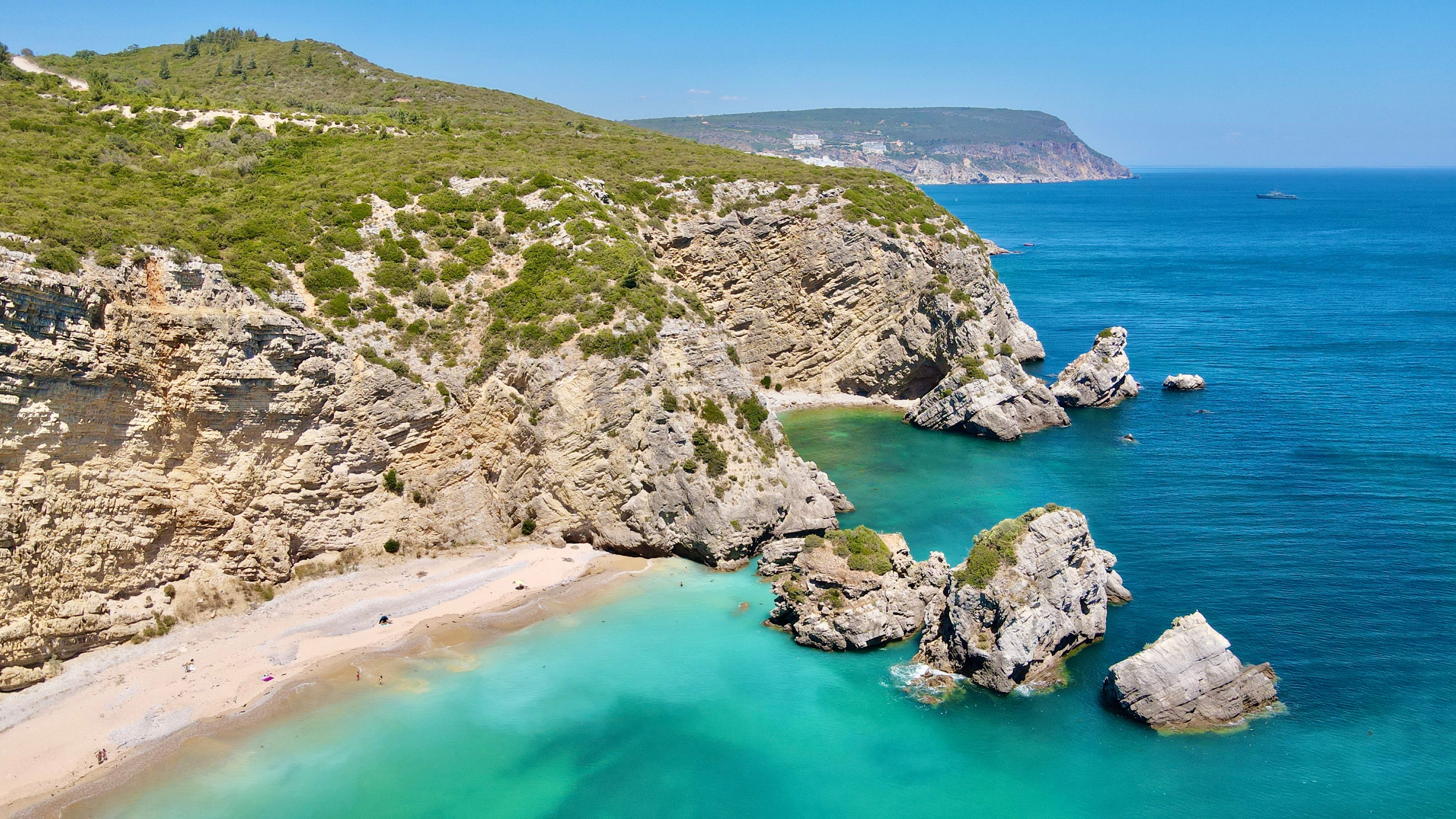
Praia do Amado
Walk in from Carrapateira and watch Praia do Amado widen below you—wind, surf, and raw Atlantic scale.
Arriving at Praia do Amado from Carrapateira on the clifftop track changes the beach before you even see the sand. You earn the first full view step by step—Atlantic wind in your ears, salt on your lips, the coastline opening like a long sentence you can read with your body.
Most people drive straight to the car parks and meet Amado as a surf spot with amenities. What they miss is the way the headlands choreograph the approach: the beach doesn’t appear all at once, it reveals itself in panels—dark rock, pale sand, then the moving gloss of water.
The payoff is a rare kind of calm. Not the calm of stillness, but the calm of scale—your thoughts get smaller, your breathing gets easier, and the day starts to feel properly coastal rather than merely sunny.
The Beach Is Two Beaches, Separated by Wind
Praia do Amado gets described as a single sweep of sand, but from the clifftop track you understand it as a set of rooms shaped by wind and headland. The western end, closer to the main surf access, is louder—more boards under arms, more shouted timing, more flags and lessons. The waves feel performative there because everyone is looking for the same thing: a clean takeoff, a photo, a moment that proves the day delivered. Keep walking along the clifftop a little longer and you notice the change. The beach subtly shifts in tone where the cliffs pinch the wind and redirect it. Spindrift starts to lift off the wave faces in silver threads, and the water takes on a darker, glassier look. Down on the sand, the footprint patterns tighten—fewer wandering lines, more straight purposeful tracks toward the water. This is the detail most people miss: Amado is a place where the weather is the architecture. The same shoreline can feel communal or private depending on which fold of cliff you stand under and which direction the wind is pressing. If you arrive on foot from Carrapateira, you instinctively read these signals before you commit to the beach. You choose your own version of Amado—and it feels like it chose you back.
You leave Carrapateira with the last white houses behind you, then the land turns to scrub and low thyme, bruised green against the ochre soil. The clifftop track is firm underfoot, sandy in patches, and the wind is a constant hand at your shoulder. Ahead, the Atlantic keeps flashing through gaps in the vegetation—slate one second, bottle-green the next—while gulls hang almost motionless, working the updrafts. As you round a bend, Praia do Amado begins to assemble itself: a long, clean sweep of sand, backed by tawny dunes and framed by dark, folded rock. You hear the surf before it looks close—deep, rhythmic impacts that travel up through the cliff. Nearer the viewpoint, the smell sharpens: iodine, warm sand, wet neoprene. Below, surfers are small as punctuation marks, waiting in lines that form and dissolve. You pause without meaning to, because the beach doesn’t ask for haste. It asks for attention.
The Water
The water is Atlantic-clear but rarely turquoise—more a layered mix of steel-blue, deep green, and tea-colored swirls where sand suspends in the shorebreak. On windy days, the surface flashes with white spindrift that makes the darker sets look even heavier.
The Cliffs
Amado sits within the Costa Vicentina’s blunt geology—dark schist and sandstone cut into sharp profiles, with dune grasses gripping the edges. The cliffs are not decorative; they feel structural, like a stage set built to hold back the ocean.
The Light
Late afternoon gives the cliffs warmth—rust, honey, and copper—and turns the beach into a wide reflector of pale gold. After a passing cloud, the light snaps back with cinematic contrast: bright sand, ink-dark rock, and silvered wave tops.
Best Angles
Clifftop bend on the Carrapateira track (north approach)
You get the first ‘assembled’ view—beach, headlands, and wave lines in one frame, with real sense of scale.
Miradouro above Praia do Amado (main viewpoint)
Best for reading the surf and the geometry of the bay; you can watch sets stack and break in clean sequence.
Eastern headland overlook
The unexpected angle—more dramatic rock foreground and a longer perspective down the sand, especially in side light.
High point near the dune edge (stay behind fences)
For photographers: leading lines of dune fencing and footpaths pull the eye toward the water without clutter.
Lower cliff base near the beach access path
The intimate angle—close enough to feel the spray and hear boards slap water, while the cliffs loom above you.
Bring a wind layer even in summer—the clifftop track can feel cold the moment the breeze turns.
Wear shoes with grip; sand over hardpack can be slippery on descents, and the path edges can crumble near the cliffs.
Stay behind dune fencing and marked paths—the vegetation is fragile, and the wind accelerates erosion fast.
If you’re swimming, treat it like the Atlantic: strong currents, cold water, and sudden shorebreak. Watch locals and the flags.
Carry water and a small snack if you’re walking in from Carrapateira; services are concentrated near the main beach access, not along the track.
Handpicked Stays & Tables
Places chosen for beauty and intention, not algorithms. Each one is worth your time.

Casa Mãe
Lagos (about 35–40 minutes by car)
A polished, design-forward base with calm rooms, a strong breakfast, and an easy glide into old-town evenings. It’s a good counterpoint to Amado’s elemental mood—soft linens after salt and wind.

Memmo Baleeira
Sagres (about 25–30 minutes by car)
Modern, sea-facing and tuned to the surf-and-hike rhythm of the southwest. The spa and pool make the post-clifftop recovery feel intentional rather than incidental.

O Sitio do Rio
Carrapateira
Casual, local and comforting after a windy walk—grilled fish, straightforward plates, and that small-town warmth you feel more than you’re told. Go early on busy nights.

A Sagres
Sagres
Classic seafood with a sense of occasion—think grilled catch, shellfish, and a view-adjacent coastal appetite. Ideal when you want the day to end with a proper table rather than another snack in the car.
You arrive with the wind in your clothes, and the beach below feels less like a destination than the natural ending of a very good walk.