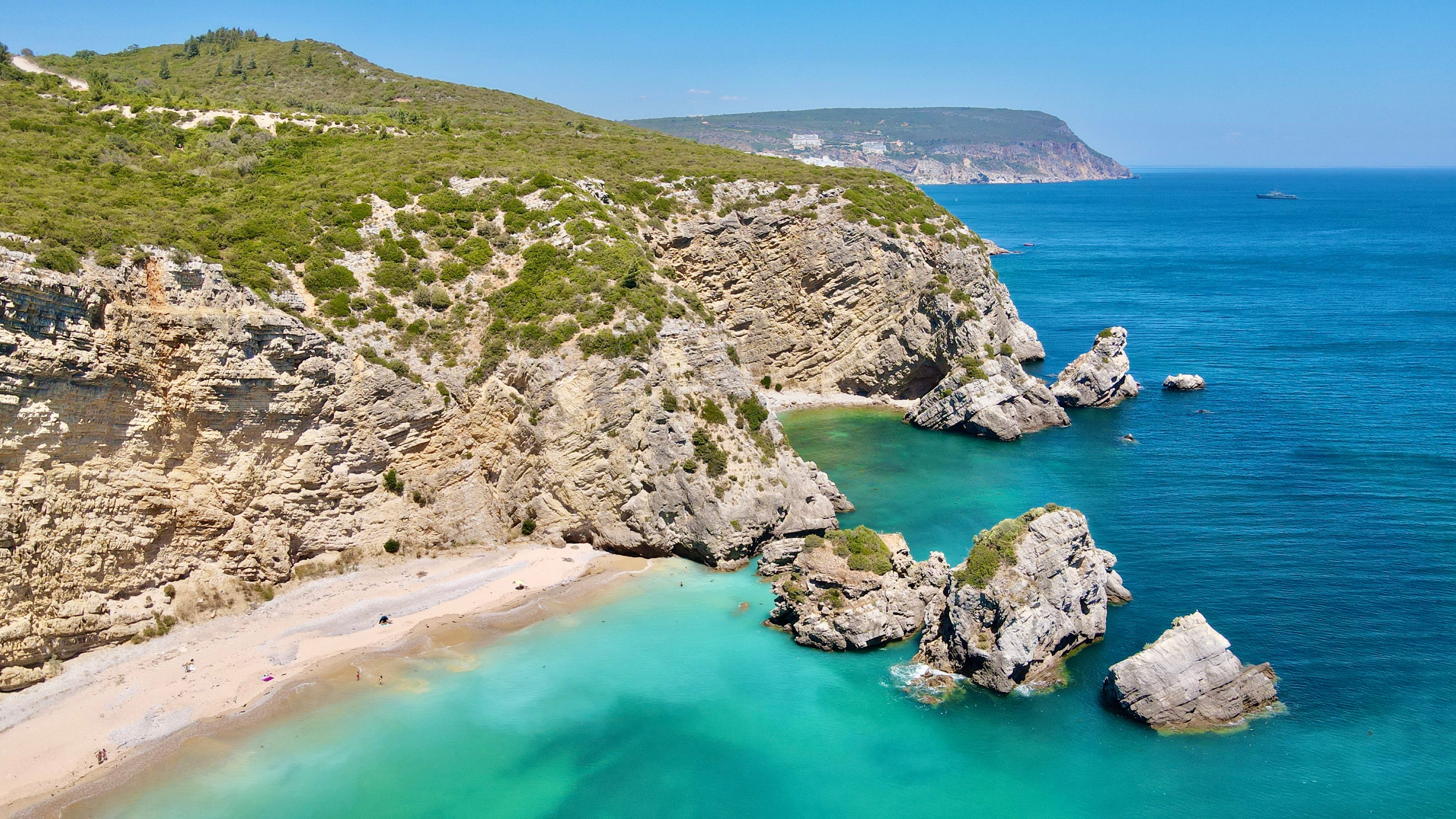
Praia do Amado
In winter nortada, Praia do Amado trades turquoise for steel—and you feel the Atlantic thinking.
Praia do Amado matters because it shows you the Algarve before the postcard—raw, wind-cut, and honest. In winter, the nortada turns the bay into a working seascape: surfers read it like a map, and the cliffs hold the sound like an amphitheater.
Most people come for summer sand and a quick lookout photo. They miss what happens when the wind shifts north and the light flattens—the water loses color and gains texture, like metal being brushed.
You leave with that rare coastal feeling of being recalibrated. Not entertained, not merely impressed—made quieter by scale, weather, and the steady discipline of the Atlantic.
The Metallic Moment: When the Atlantic Stops Performing and Starts Working
Amado is often described as a surfer’s beach, but in winter it becomes something more interesting—an instrument that makes the nortada visible. The wind arrives from the north and skims the bay at an angle, shaving the tops off waves and pulling them into streaks of vapor. That’s when the water turns metallic. It isn’t a color so much as a finish: brushed steel under a cold sun, with darker bands where the current and sandbar shape the energy. You start noticing structure. Sets don’t just “come in”—they queue, stack, and then release, the way weather systems do on a radar screen. Most visitors stand at the main access, take in the panorama, and leave. Walk a few minutes toward the edges—especially toward the cliffs—and the sound changes. The bay becomes a bowl, and the surf’s impact deepens into a drum you feel in your chest. Look down at the tideline: the sand is patterned with scallops and ripples, and the foam outlines them like ink. This is the Algarve without softness. The payoff is emotional, not scenic. You feel the coast’s seriousness—how it resists being reduced to a backdrop—and your own pace adjusts to match it.
You arrive with the car rocking slightly in the gusts, salt already on your lips before you’ve stepped onto sand. The path drops through low scrub and wind-bent grasses, and then the bay opens—wide, slanted, and loud. In a winter nortada the ocean is not blue; it’s pewter, scored with darker seams where sets gather and stand up. Spray lifts off the lip and rakes sideways, needling your cheeks. The sand is firm and cool, stippled with tiny shells and the occasional ribbon of kelp that smells sharp and clean. Surfers in black neoprene move like punctuation marks against the glare—patient, spaced out, looking beyond what you’re watching. Between sets, the surface goes briefly smooth, a sheet of hammered silver, and you can hear the beach breathe: the thud of impact, the hiss of retreat, the faint clatter of pebbles rolling under foam. You keep walking until voices thin out and only wind and water are talking.
The Water
In a winter nortada, the water reads as pewter and graphite, with sudden flashes of chrome where the sun hits a flattened face. On calmer intervals between sets, it becomes a slick, mirror-like sheet that reflects the cliffs in broken fragments.
The Cliffs
Amado sits inside the Costa Vicentina Natural Park, where dark schist and sandstone cliffs fold and fracture into ledges and shallow coves. The dunes behind the beach are low but textured—wind-combed and stitched with hardy coastal plants that smell resinous when warmed by sun.
The Light
Late afternoon in winter gives you the most dimensional scene—the cliffs take on rust and umber tones while the sea stays silver. After a squall, the air clears fast, and the contrast between storm-dark water and bright sand becomes almost graphic.
Best Angles
Miradouro da Praia do Amado (main lookout above the beach)
You get the full geometry of the bay—sandbar lines, wave direction, and the wind’s diagonal sweep across the surface.
Northern cliff path (toward Arrifana/Amado Norte side)
From here, the sets look steeper and the spray reads like smoke—great for understanding the nortada’s force.
Southern edge near the rockier end of the beach
The shoreline curves tighter and feels more intimate; you can frame surfers against cliff strata instead of open sky.
Mid-beach at low tide, facing west
Low tide exposes reflective wet sand that doubles the sky—perfect for minimalist, high-contrast compositions.
Dune line behind the main beach (slightly elevated, sheltered)
You’re out of the harshest wind and can watch the bay in quieter detail—foam patterns, footprints, and shifting light.
Bring a windproof outer layer even if the forecast looks mild—the nortada cuts through fleece quickly.
Wear shoes with grip if you plan to use cliff paths; the sand over hardpack can be slick, and edges can crumble after rain.
If you’re photographing, pack a microfiber cloth and keep your lens sheltered—salt spray arrives sideways and fast.
Check the tide chart: low tide gives reflective sand and more walking space; high tide tightens the beach and amplifies the sound.
Respect surf conditions and currents—this is an exposed Atlantic bay; swim only when it’s clearly safe and monitored.
Handpicked Stays & Tables
Places chosen for beauty and intention, not algorithms. Each one is worth your time.

Memmo Baleeira
Sagres
A calm, design-forward base with sea-facing views and a spa that makes winter feel intentional rather than inconvenient. It’s well placed for day trips along the Costa Vicentina, including Amado.

Casa Mãe
Lagos
Polished but relaxed, with warm interiors that suit a wind-heavy itinerary. You come back from the coast to good light, strong coffee, and a sense of quiet luxury.

Restaurante O Pescador
Carrapateira
A straightforward local room where seafood tastes like it came in that morning. Order grilled fish or shellfish and let the simplicity match the coastline.

Sitio do Rio
Bordeira (near Praia da Bordeira)
A dependable stop after a windy beach walk—warming plates, honest flavors, and the kind of atmosphere where you keep your jacket on and don’t mind. Good for lingering when the weather turns.
When the nortada holds steady, Amado isn’t asking you to look—it’s asking you to listen, and to stay long enough for the sea to change color.