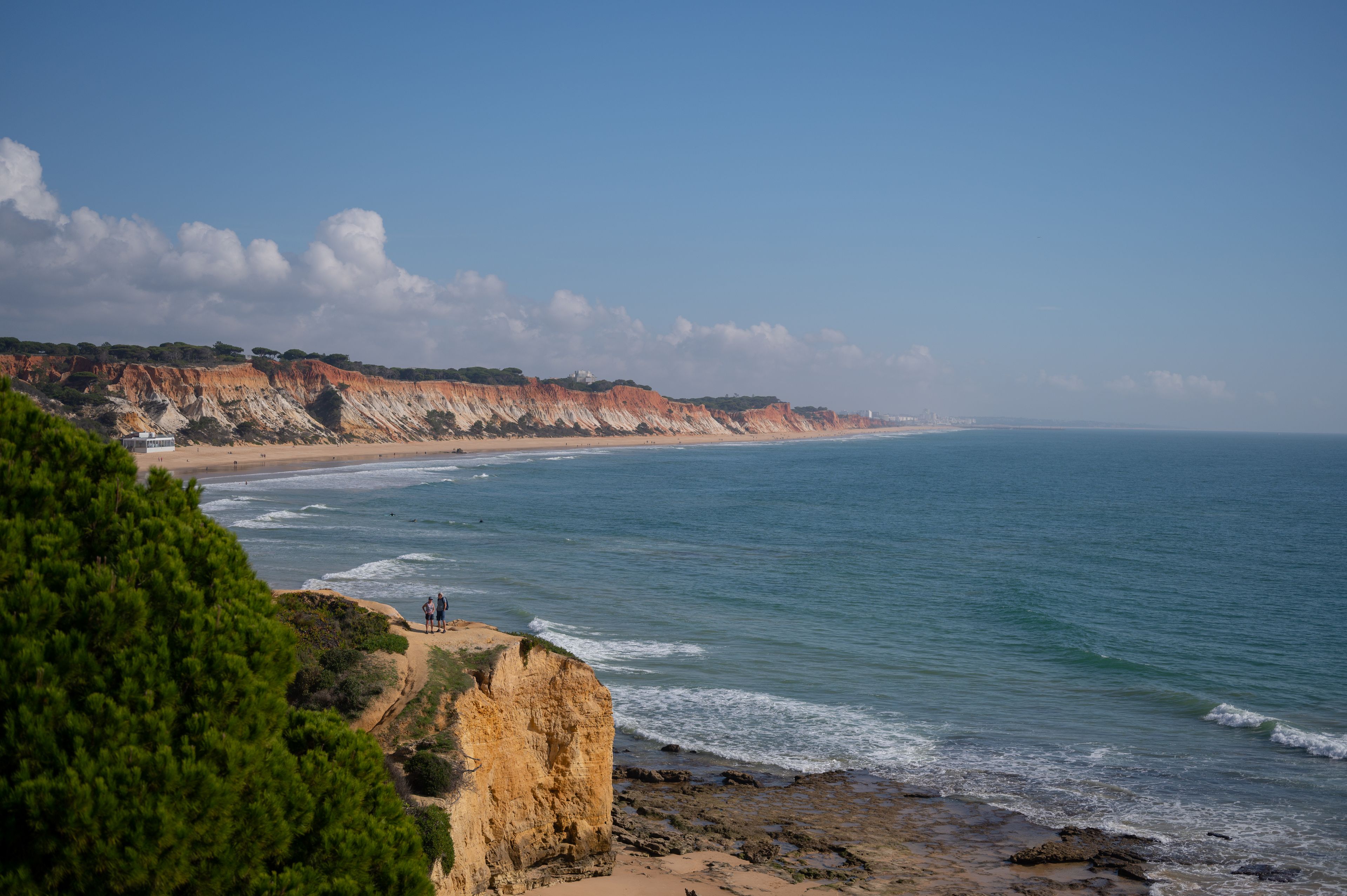
Praia da Falesia
At Praia da Falésia, the real spectacle begins on the staircase most people treat like a fast-forward button.
Praia da Falésia isn’t just a long, beautiful Algarve beach—it’s a living cross-section of time, where rust-red cliffs meet Atlantic blues with almost surgical clarity. You feel it before you photograph it: warmer air rising off iron-rich rock, cooler wind coming in clean from the sea, the soft give of sand that stretches for kilometers.
Most people race down the main cliff staircase as if it’s a corridor to the “real” beach. They miss how the steps choreograph your first encounter—the way the color temperature changes, how the horizon appears in slices, how the cliff face reads like layered pigment when you’re close enough to see its grain.
If you slow down, the beach stops being a backdrop and becomes a sensory place you can locate yourself inside. You arrive not with the bluntness of a day trip, but with a quiet, cinematic sense of having crossed a threshold.
The Staircase Is a Color Lab, Not a Shortcut
Falésia’s famous cliffs photograph well from the shoreline, but the staircase is where you actually understand them. Up top, the landscape is all Algarve familiarity—pine, scrub, holiday roads. Then you step into a vertical gallery of sediment. The reds aren’t one red. They range from paprika to brick to dried-blood umber, interrupted by thin, pale bands that look like sand poured between chapters. In the shade, the cliff reads cooler and more violet; in sun, it turns almost incandescent. Your phone tries to average it out. Your eye doesn’t. Most visitors rush down because the beach is the reward. But if you pause on the landings, the view arrives in deliberate stages: first the sound of surf without the image, then the first flash of blue, then the full breadth of shoreline curving away toward Vilamoura one direction and Olhos de Água the other. It’s a built-in pacing mechanism—an editorial sequence. There’s also a subtle intimacy here. The staircase puts you close enough to see texture: granular crumble, compacted faces, tiny hollows where last winter’s rain cut through. You’re watching erosion in slow motion, and it makes the place feel less like a postcard and more like a moment you’re allowed to witness.
You park above the cliffs and the first thing you notice is sound—pine needles ticking in the breeze, a distant hush of surf you can’t yet see. The staircase begins in scrubby green and pale dust, then tips you into color: burnt sienna walls, sand-colored seams, the occasional stubborn plant gripping the edge. Each landing frames a different cut of the Atlantic…first a bright strip, then a wider pane of turquoise, then the full, level horizon that makes your shoulders drop. Halfway down, the air changes. It smells less like sun-warmed resin and more like salt and wet mineral. You run your fingertips along the cliff beside you—powdery in places, cool and compacted in others—and the rock leaves a faint, rusty stain. At the bottom, the sand opens out in a broad, pale sweep. Waves arrive in even sets, folding into white lace. Behind you, the cliff glows like ember under daylight, and you realize the “entrance” was the main event.
The Water
The water shifts from deep cobalt offshore to a clear, green-leaning turquoise near the break, with a milky opal edge where the waves churn sand into the foam. On calmer days, the shallows can look almost glassy—until the next set arrives and redraws everything in white.
The Cliffs
Falésia’s cliffs are iron-rich and layered, a stratified wall that reads like a geological timeline in warm tones. At their base, the beach is wide and pale, and the contrast between cliff pigment and Atlantic blue feels unusually crisp, especially after rain when the rock darkens.
The Light
Late afternoon into golden hour is when the cliffs do their most dramatic work—the reds deepen, shadows carve out the layers, and the sand turns warmer. Midday is harsher but graphic: saturated blues, sharp edges, minimal softness.
Best Angles
Praia da Falésia main cliff staircase (Acesso à Praia da Falésia)
The landings give you a natural storyboard—each pause reveals a wider slice of sea and a closer read of the cliff’s texture.
Miradouro da Falésia (clifftop path above the beach)
From above, the shoreline becomes a clean ribbon and the cliff colors read as broad blocks—strong for minimalist compositions.
Waterline walk toward Olhos de Água
You get the cliffs in profile, with repeating buttresses and little collapses that show the coastline as something actively changing.
Base of the cliffs at low tide
Low tide gives you space to shoot upward—towering red walls against blue sky, with people for scale.
Dune edge near the beach entrance
From here, you can frame grasses in the foreground, cliffs mid-frame, and the sea beyond—an intimate, layered perspective.
Wear grippy sandals or trainers for the staircase—sand on steps can be slick, especially in flip-flops.
Bring water even for a short visit; the clifftop access points feel exposed and the heat reflects off the rock.
Check tides if you plan to walk far along the base of the cliffs—some sections feel tighter at high tide.
Avoid sitting directly under crumbly cliff sections; minor rockfall can happen, especially after rain or wind.
Pack a light layer for later in the day—the breeze can turn cool fast once the sun drops behind the cliff line.
Handpicked Stays & Tables
Places chosen for beauty and intention, not algorithms. Each one is worth your time.

Pine Cliffs, a Luxury Collection Resort
Açoteias (above Praia da Falésia)
A polished clifftop base with direct access to Falésia’s sands and a sense of calm that holds even in high season. Expect manicured paths, serious service, and Atlantic views that make you linger longer than planned.

Vila Galé Collection Praia
Galé (west of Albufeira)
An adults-focused, smaller-scale option with a quieter rhythm and easy reach to multiple beaches. It’s a good counterpoint to Falésia’s scale—simple, restful, and designed for slow mornings.

Maré at Pine Cliffs
Açoteias (clifftop)
Come for seafood with a front-row Atlantic view, especially at sunset when the cliffs start to burn orange. The setting does a lot of the talking, so you can keep the meal elegantly straightforward.

Restaurante O Pescador
Olhos de Água
A classic place to reset after salt and sun—grilled fish, shellfish, and that unmistakable seaside appetite. Go early or book ahead in summer; it’s popular for a reason.
If you let the staircase take its time with you, Falésia stops being somewhere you arrive—and becomes somewhere you enter.