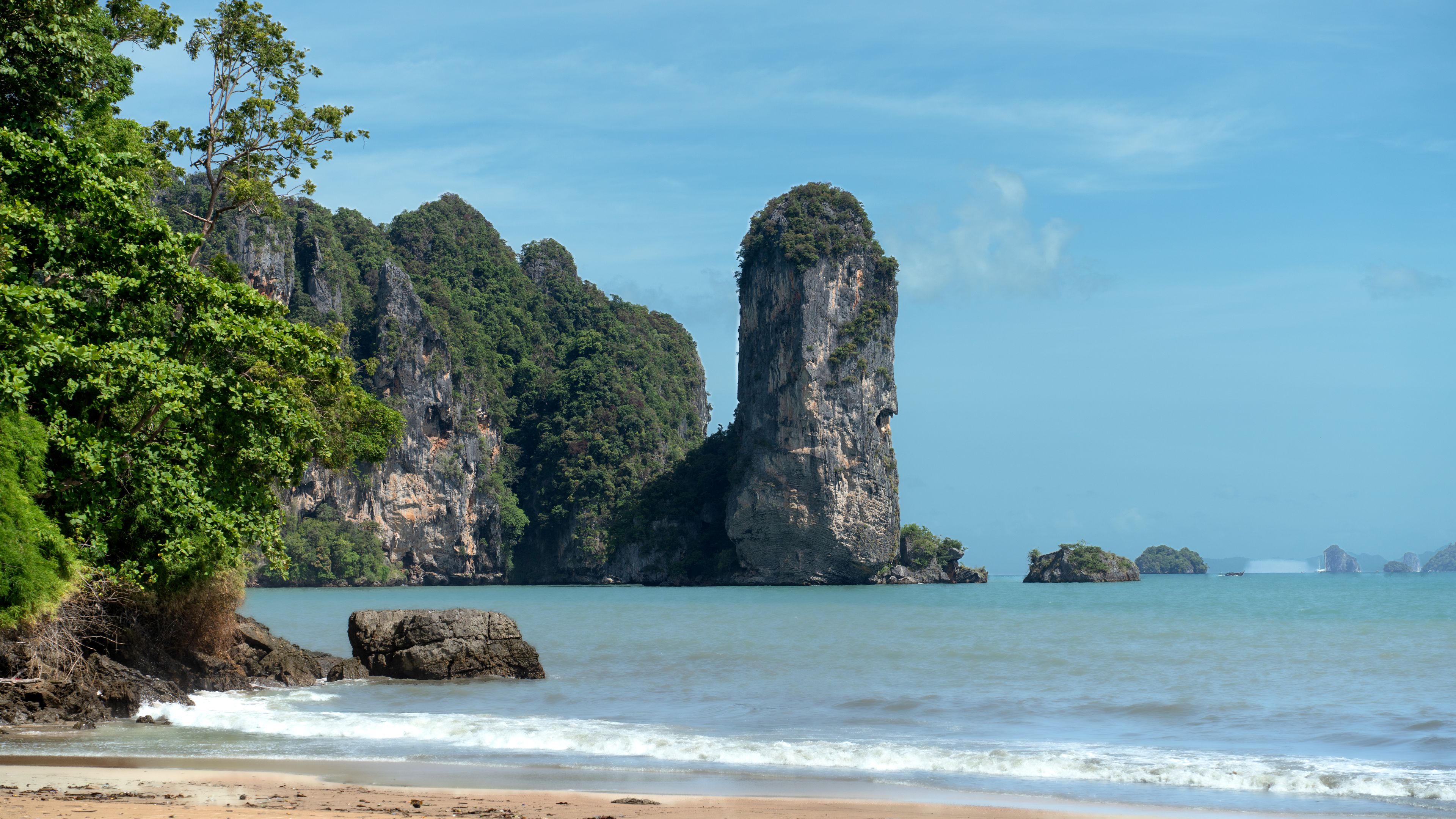
Phra Nang Beach
In rain season, Phra Nang’s cliffs darken like wet ink—turning a famous beach into something almost solemn.
Phra Nang matters because it shows you Thailand’s beach mythology with the lights turned down—cathedral limestone, shallow turquoise, and longtail boats that arrive like punctuation marks across the bay.
Most people come for the white sand and the cave, then leave before the weather changes. In monsoon, the limestone doesn’t just get wet… it turns black, streaked and glossy, as if the cliffs are freshly varnished.
That shift recalibrates the whole mood. You stop chasing the postcard and start listening—to dripping rock, to low thunder behind Railay, to your own pace returning.
The black limestone isn’t dirt—it’s the beach revealing its chemistry
In the dry season, Phra Nang’s cliffs look sun-bleached and friendly, a pale limestone amphitheater designed for day trips. In monsoon, the same rock becomes graphic. Water films over the surface, and suddenly every groove, pocket, and vertical runnel is legible. The darkness isn’t grime. It’s saturation—rain filling microscopic pores, deepening the stone’s tone and sharpening contrast against the sand. If you linger, you start noticing the cliff behaving like a living system. Freshwater seeps from hairline fractures and traces paths downward, leaving temporary calligraphy. Where it meets salt spray, the surface dries unevenly, creating patchwork panels of matte gray and glossy black. In places the rock looks lacquered; in others it looks powdered, as if rubbed with ash. This is why the monsoon version of Phra Nang photographs so differently: the cliff stops being background and becomes subject. The deeper payoff is psychological. Crowds thin, the soundscape widens, and the beach feels less like an attraction and more like a threshold—between seasons, between moods. You walk slower. You’re more careful with your footing on wet sand. You pay attention to the sky’s temperature. Phra Nang doesn’t lose beauty in the rain; it gains depth, and you leave with a memory that feels personal rather than collected.
You step off the boat and the sand feels cooler than you expect, packed tight by recent rain. The sea is still that Krabi blue-green, but it moves with more intention—small, muscular waves that push up the beach and retreat with a soft, sucking sound. Ahead, the limestone wall rises in a single, abrupt gesture, and the monsoon has changed its color completely: the cliffs read as charcoal and obsidian, with pale seams where water has rinsed the mineral veins clean. You walk toward Phra Nang Cave as the air thickens with salt and wet stone. Longtails idle and click against their ropes, their ribbons damp and darker, no longer festive so much as ceremonial. Under the overhang, the light shifts to a cool, reflected silver. Drops fall in irregular rhythms. A gust brings the scent of frangipani from somewhere inland, then the metallic smell of coming rain. You watch swimmers hesitate at the edge, then commit—skin against warm water, eyes drawn to the blackened rock like it’s a stage set waiting for the next scene.
The Water
The water stays translucent even in rain season—jade near shore, shifting to milky aquamarine where sand is stirred by boat wakes. After a downpour, it can take on a faint tea tint at the edges where freshwater runoff meets the sea, like watercolor bleeding into a wash.
The Cliffs
You’re standing in a karst basin—ancient limestone lifted and carved into vertical walls, caves, and overhangs. Monsoon moisture makes the geology more dramatic: darker rock, brighter mineral seams, and lush greenery clinging to impossible angles.
The Light
The beach looks most cinematic under high cloud or just after a squall, when the cliff is still black and reflective but the air clears. Late afternoon often brings softer contrast and longer shadows that sculpt the rock face without flattening the water.
Best Angles
Phra Nang Cave mouth (under the overhang)
You get a natural frame—dark ceiling above, silver light bouncing off wet sand, and the bay opening like a screen.
Far-left end of the beach near the limestone wall
The cliff feels tallest here, and the monsoon-black streaking reads as bold texture rather than distant scenery.
Shallow-water wade line facing Railay West
A few steps into the sea compresses the scene—boats, ribbons, and black rock stacked in layers with the water as a reflective foreground.
Longtail boat approach (arrive by sea, camera ready)
The reveal works in your favor: you glide in with the cliff expanding, and the wet rock catches highlights like polished stone.
Cave-side dripline (look down, not out)
For an intimate detail shot—ripples from falling drops, dark sand, and small shells that look newly rinsed.
Bring a light rain jacket or poncho you can actually walk in—umbrellas are awkward on boats and in wind.
Wear sandals with grip; wet sand and slick rock near the cave can surprise you.
Carry a dry bag for phone/camera on longtails, especially in monsoon chop and spray.
Plan flexibility: sea conditions can delay or cancel boats, and that’s part of the monsoon rhythm.
Pack reef-safe sunscreen and mosquito repellent; humid, overcast days can still burn and bite.
Handpicked Stays & Tables
Places chosen for beauty and intention, not algorithms. Each one is worth your time.

Rayavadee
Railay (Cape between Railay and Phra Nang)
You’re staying inside the limestone landscape—pavilions tucked into tropical gardens with direct access to Phra Nang’s edge. In monsoon, the setting feels especially hushed, and the short walk to the beach lets you time visits between showers.

Bhu Nga Thani Resort & Villas Railay
Railay East
A polished, practical base with comfortable rooms and an easy walk across the peninsula to Phra Nang. It’s a good choice when you want Railay’s calm, boat-only atmosphere without committing to the highest-end splurge.

Raya Dining (Rayavadee)
Railay / near Phra Nang
A refined room for Southern Thai flavors and seafood with service that matches the setting. Come after a rain shower—hair still damp, sandals sandy—and let the slower monsoon evening do its work.

Krua Phranang (Railay boat-side stalls area)
Railay / near the walking route to Phra Nang
A straightforward, well-liked local-style stop for curries and stir-fries when you want something satisfying between beach walks. It’s not about staging a dinner; it’s about eating well, quickly, and getting back to the weather.
When the rain turns the cliffs black, Phra Nang stops performing for the crowd—and starts speaking directly to you.