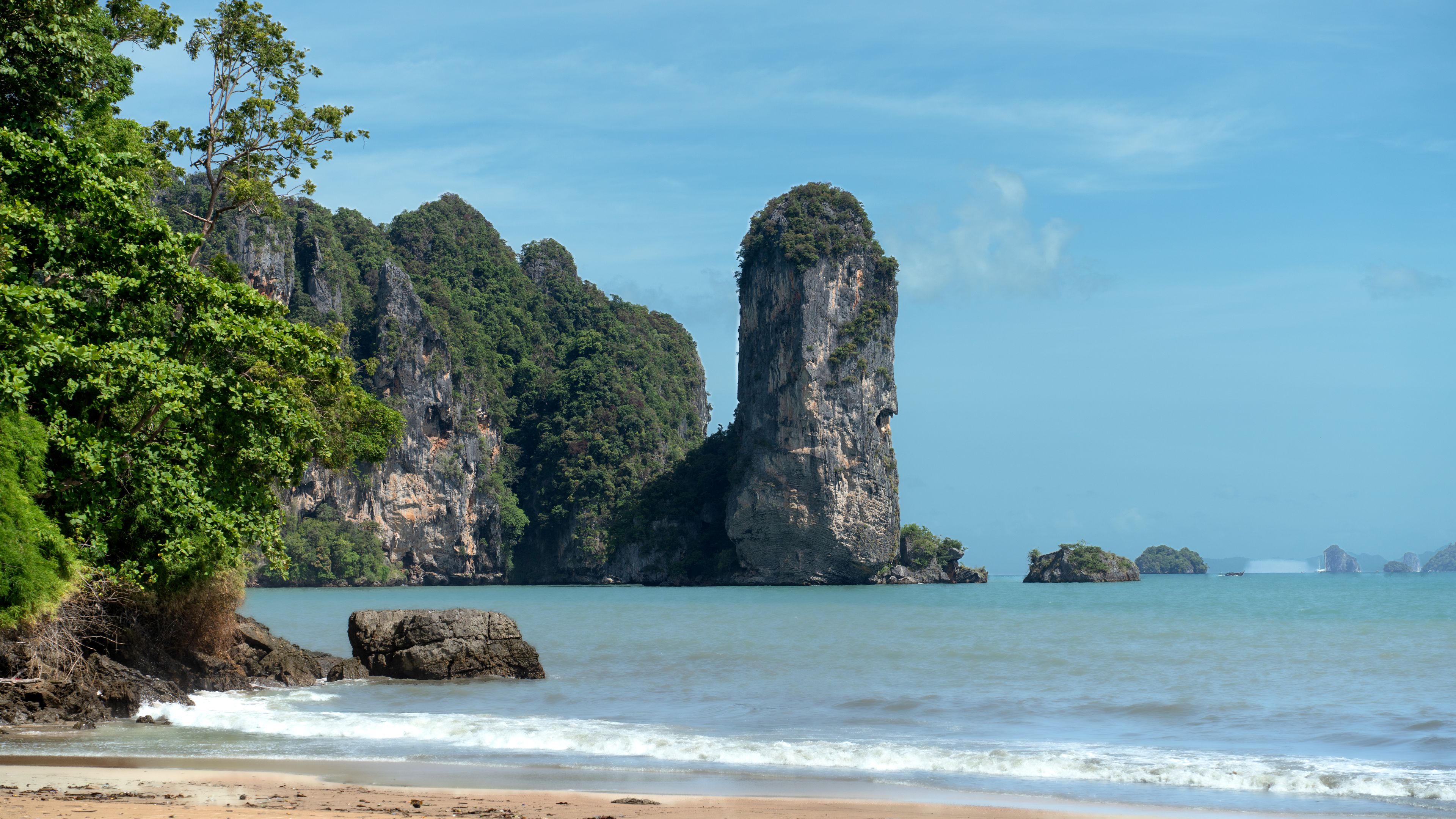
Phra Nang Beach
Walk past the crowd and the last longtail… and Phra Nang turns quiet, tidal, and almost private.
Phra Nang is famous for its postcard limestone and the flotilla of longtails nosing up to shore—but its real story is written at the far-right edge, where the beach stops performing and starts breathing with the tide.
Most people never keep walking beyond the last boat and the last cluster of towels. They miss the moment the sand thins into a pale ribbon, the water shifts color, and the crowds dissolve into sea-sound and cliff-shadow.
Out there, you feel the place recalibrate you. The heat softens, your pace slows, and you’re suddenly traveling the way you meant to—by noticing.
The beach’s quiet seam—where the tide edits the crowd
Phra Nang’s far-right sandbar isn’t a “separate” place so much as a different version of the same beach—one that only appears when the tide gives you permission. Most visitors anchor themselves to the central crescent, where the longtails line up like punctuation marks and the day feels scheduled: arrive, swim, photograph, leave. Walk beyond the final longtail and the beach changes its posture. The sandbar forms as an elegant taper, and with it comes a subtle shift in acoustics: the slap of wake and the clink of anchors fade, replaced by the steady, breathable rhythm of small waves meeting shallow sand. What you notice first is not emptiness, but texture. The sand is firmer, cooler, and faintly rippled—tidal handwriting. The water clarifies in bands: a skim of warm, tea-pale shallows over sand; then a cooler, clearer strip where the seabed drops; then the deeper jade that holds the horizon. This is where you can feel the geography working—the cliff throwing shade earlier than the main beach, the outcrop interrupting currents, the tide drawing a temporary walkway that makes you slow down and look. The payoff is restraint. You don’t need to “do” anything here. You stand in ankle-deep water, watch the light slide across limestone, and let the day become less about arrival and more about attention.
You arrive with everyone else—salt in the air, engines idling, the soft thud of longtails settling onto sand. The limestone wall behind the beach rises like a theater backdrop, streaked with dark mineral seams, jungle-green at the edges. You keep moving right, past the photo-stops, past the snacks and the easy chatter… until the sound changes. The voices drop away and the water takes over—small, precise waves that click and hush as they comb the shore. The sand underfoot becomes finer, cooler, almost sifted, and the beach narrows into a tidal corridor between cliff and sea. At low tide, the far-right end unspools into a sandbar—pale as raw sugar—curling toward a rocky outcrop where the water turns glassy in the lee. You wade shin-deep and the temperature shifts; a cooler seam slides around your ankles. Behind you, the longtails look suddenly far away, like you’ve stepped out of the scene without leaving the set.
The Water
The shallows read as milky aquamarine over pale sand, then sharpen into clear jade as the depth increases. In calm weather, the surface takes on a glassy sheen that reflects the limestone in broken, wavering lines.
The Cliffs
Sheer karst limestone frames the beach—pocked, striated, and darkened where moisture clings. At the far-right end, a rocky outcrop and shallow shelf shape the sandbar and calm the water, creating a more intimate, enclosed feeling.
The Light
Late afternoon is when the cliff throws longer shade and the heat eases, giving the sandbar a softer, silkier look. In the last hour before sunset, the limestone warms to honey and the water turns from green to a more translucent, luminous blue.
Best Angles
Past the last longtail (far-right shoreline)
You isolate the sandbar’s taper and remove the “busy beach” context—your frame becomes water, sand, and cliff.
Edge of the sandbar at low tide
This gives you leading lines—ripples and the sandbar’s curve pulling the eye toward the outcrop and open sea.
Cliff-shadow boundary line
Photograph where shade meets sun for a natural gradient—cool blues in shadow, warmer tones on lit sand.
Knee-deep in the lee of the outcrop
From the water looking back, the beach feels wider and cleaner, and the limestone reads taller and more dramatic.
Tidepool-level near the rocks
Get low for textures—wet sand sheen, tiny ripples, and reflected cliff patterns that feel almost abstract.
Check tide times the night before—this spot is defined by low tide, and the sandbar can vanish quickly as water rises.
Wear reef-safe water shoes if you plan to explore near the rocks; there can be sharp limestone and broken shell.
Bring your own water and a small snack if you’re staying late—vendors are concentrated closer to the main landing area.
Pack a dry bag for phone and camera; wading is part of the experience, and spray comes with passing boats near the center.
Be respectful near the cliff and cave areas—this beach has spiritual sites; keep voices low and avoid climbing or touching offerings.
Handpicked Stays & Tables
Places chosen for beauty and intention, not algorithms. Each one is worth your time.

Rayavadee
Railay / Phra Nang area
A true limestone-jungle setting with a level of calm that changes how you experience the peninsula. You’re close enough to time Phra Nang’s quiet moments, and far enough to escape the day-trip tempo.

Bhu Nga Thani Resort & Villas Railay
Railay East
A polished, comfortable base with easy access across Railay to Phra Nang. It’s practical luxury—good rooms, a restful pool, and a location that makes early-morning or late-day beach walks realistic.

Krua Phranang
Railay area
A relaxed Thai kitchen when you want something grounding after salt and sun—think stir-fries, curry, and seafood done simply. Go early evening to avoid the rush and catch the air cooling off.

The Grotto (Rayavadee)
Phra Nang Beach
Dining under a limestone overhang changes the whole meal—shade, rock texture, and the sea just beyond your table. Prices match the setting, but the atmosphere is hard to replicate elsewhere on the beach.
When you let the tide and your own curiosity set the itinerary, Phra Nang stops being a backdrop and becomes a place you actually inhabit.