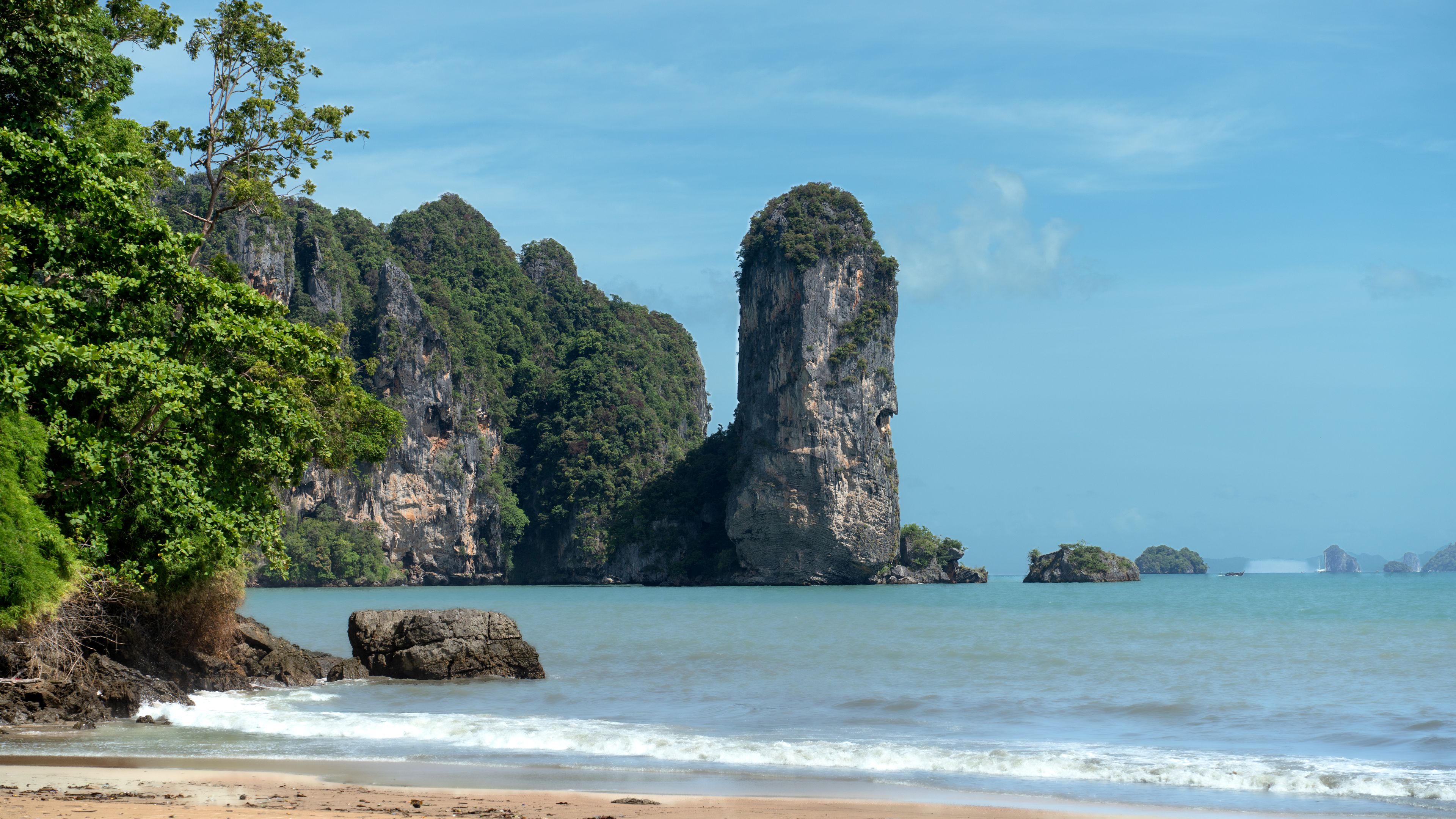
Phra Nang Beach
Skip the longtail boat scrum—walk the headland and let Phra Nang reveal itself in stages.
Phra Nang Beach isn’t just a pretty crescent at the end of Railay—it’s where Krabi’s limestone drama meets the most intimate, swimmable water on the peninsula. Arriving on foot recalibrates your pace. You feel the temperature drop in the shade, hear the surf before you see it, and step into a scene that earns its reputation rather than shouting it.
Most people miss that the beach is as much about its edges as its center. The headland footpath delivers you through pockets of jungle and rock where the soundtrack changes—boat engines fade, cicadas take over—and the first glimpse of pale sand comes framed like a cinema screen between cliffs.
The payoff is quiet authority. You arrive without adrenaline or negotiation, your eyes already adjusted to the textures—wet stone, bright sand, green-black foliage. Instead of chasing a photo, you feel present enough to notice what the place is actually doing to you: slowing your breathing, widening your attention, softening your day.
The Beach Changes Completely Once You Stop Entering Through the Engine Noise
Arriving by boat is efficient, but it forces Phra Nang into a single mood: a busy shoreline with prows nudging sand and a constant soundtrack of arrival. The headland footpath does something subtler—it edits. As you walk, the beach becomes a conclusion rather than a starting line, and your senses catch up before the scenery does. There’s a specific moment near the end of the path when the wind shifts. You feel salt on your lips and the temperature lifts a degree, and you realize you’ve been moving through shade for long enough that the sun on your forearms feels like a spotlight. That contrast is part of Phra Nang’s power: the cliffs don’t just look dramatic, they control the light. You can watch the water change color in real time as cloud edges pass and the limestone throws long, cool bands across the shallows. People also rush straight to the center of the sand. Don’t. The most memorable Phra Nang is at the margins—where the cliff base weeps mineral water into dark streaks, where the sand turns firmer near the rock, where the cave’s cool breath carries a faint smoke-and-flowers scent from offerings. When you arrive on foot, you’re already tuned to those edges… and the beach stops being a checklist and becomes a place with tempo.
You leave Railay’s main strip behind and the air changes almost immediately—less sunscreen-sweet, more damp leaf and warm limestone. The headland footpath narrows to packed earth, then turns to stone steps worn smooth by flip-flops and monsoon runoff. On your left, the sea flashes through gaps in pandanus and palms, turquoise in hard sunlight, then suddenly slate-blue where the cliff throws shade. You pass climbers’ chalk marks on the rock, a stray ribbon of rope, the small hush of a cove below. The path rises just enough to make you aware of your lungs, then drops you toward the sound of water folding onto sand. When Phra Nang finally opens, it doesn’t arrive as one grand reveal—it arrives in layers: first the curve, then the anchored longtails like punctuation marks, then the massive cliff face with its mineral streaks, then the cave mouth at the far end, cool and incense-scented. You step onto sand that feels almost flour-fine underfoot, and your shoulders unclench without you noticing.
The Water
In sun, the shallows read as pale jade with a milky, opaline softness from fine sand suspended in the water. In the cliff’s shadow, the same water deepens to teal and then a clean, glassy cobalt further out, especially on calm days when longtails barely ripple the surface.
The Cliffs
Phra Nang sits in a limestone amphitheater—vertical walls scored with orange mineral stains and patches of green that cling wherever roots can find purchase. The beach is short enough to feel enclosed, but the horizon stays open, with karst silhouettes floating offshore like dark cutouts against the brightness.
The Light
Early morning gives you the most forgiving light—soft on skin, gentle on the sand, and clear enough to read the water’s gradient without glare. Late afternoon can be spectacular when the sun drops low and the cliffs begin to shade the bay, creating alternating bands of gold and cool blue that make the scene feel dimensional.
Best Angles
Headland footpath final bend
You get the first framed reveal—sand and water boxed by rock—before the boats and people dominate the foreground.
Left-side cliff edge (near the path exit)
Shoot diagonally across the bay for scale; the limestone wall reads as a true vertical, making swimmers look tiny and cinematic.
Phra Nang Cave entrance area
The contrast between cool shadow and bright water gives depth; you can capture offerings, rock texture, and the luminous sea beyond.
Shallow-water wade, mid-bay
From knee-deep water, the beach cleans up visually—fewer footprints, fewer umbrellas—and the cliffs become a full backdrop.
Far-right end at low tide (away from the main landing area)
This is the intimate frame: quieter sand, softer soundscape, and close-up textures—shell grit, wet rock sheen, and gentle shore break.
Wear shoes with grip for the headland path—smooth rock steps can be slippery, especially after rain.
Bring a small dry bag; even if you walk in, spray and sudden showers are common, and you’ll want your phone protected near the cave and waterline.
Carry cash for drinks or snacks sold along the beach, and for potential return-boat arrangements if you decide not to walk back.
If you plan to swim, consider goggles or a mask—Phra Nang’s best detail is the water clarity close to the rocks when the sea is calm.
Be respectful around the cave offerings—photograph quietly, don’t touch, and give people space if they’re making a prayer.
Handpicked Stays & Tables
Places chosen for beauty and intention, not algorithms. Each one is worth your time.

Rayavadee
Railay / Phra Nang headland
You stay inside the limestone theater, where paths run through gardens and the sea feels like a private courtyard at certain hours. It’s the rare address here that matches the landscape’s grandeur with real quiet and polish.

Bhu Nga Thani Resort & Villas Railay
Railay East
A comfortable, well-situated base with easy access to the walking routes and enough calm to reset between beach sessions. Choose it when you want Railay’s proximity without the sense of being on display.

Krua Phranang (by the beach stalls)
Phra Nang Beach
Simple Thai plates and cold drinks with your feet in sand and boats as a moving backdrop. You come for the immediacy—lime, chili, salt, and the feeling that lunch is part of the shoreline.

The Grotto
Railay (near Phra Nang)
A dramatic setting tucked beneath limestone with a view that makes even a quiet drink feel ceremonial. Come in late afternoon when the light softens and the rock overhead turns warm and textured.
When you arrive by the headland, Phra Nang isn’t a stop on the map—it’s a slow-opening scene you step into already changed.