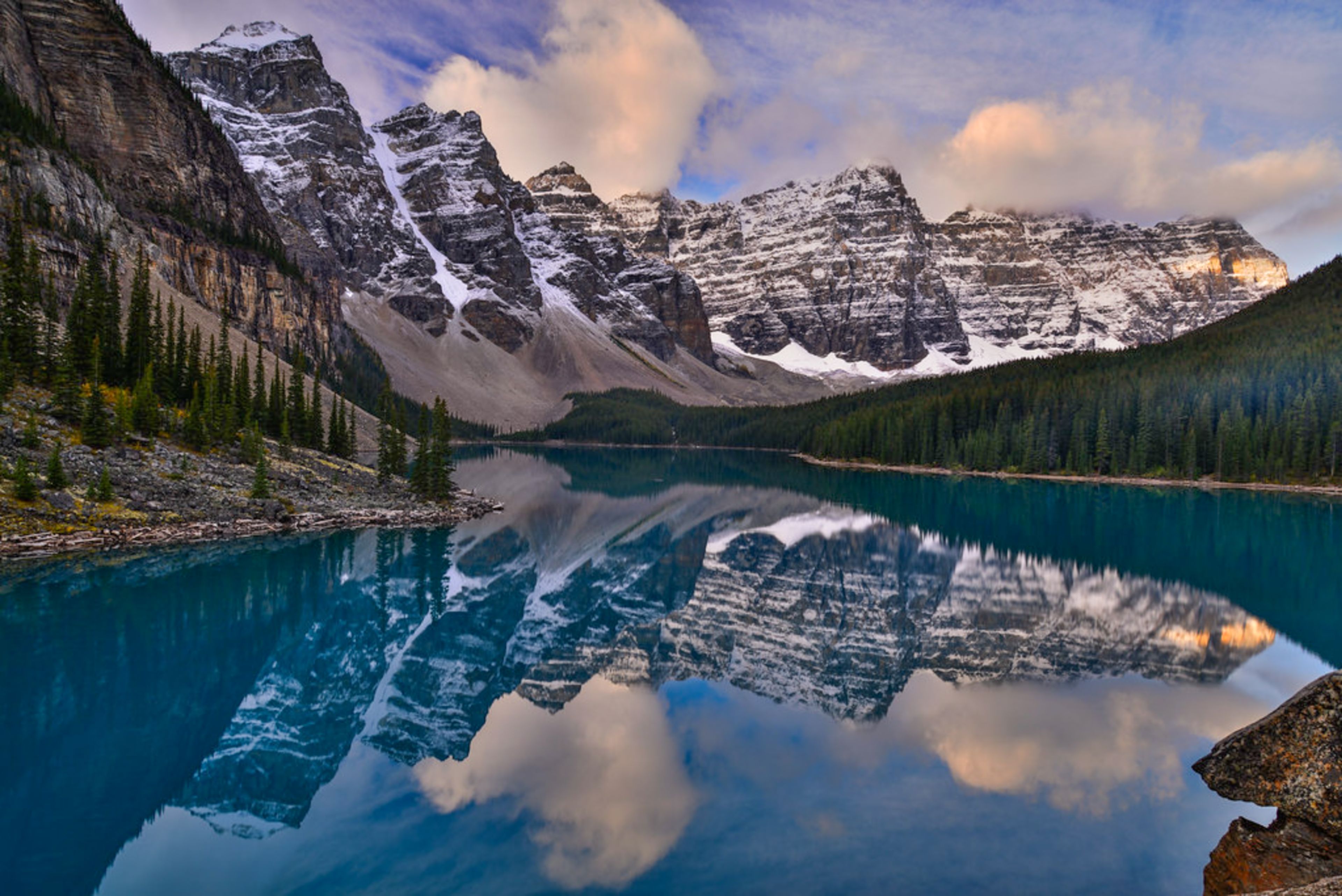
Moraine Lake
In the blue hour, the valley holds its breath.
Moraine Lake is a bowl of cold light set beneath the Ten Peaks.
Its color isn’t romantic; it’s geological—glacial silt turning water into pigment.
Before the day arrives, it feels less like a destination and more like a held silence.
The Shoreline Sound Before the Color Shows
Most visitors arrive for the postcard: that first clean turquoise, the peaks stacked behind it, the quick proof that you were here. But the lake’s most honest minutes are earlier, when the water is still dark enough to look bottomless and the scene hasn’t decided what it will be. Stand near the canoe dock and listen. The shoreline isn’t quiet in the way people expect—there’s a soft, granular sound where tiny stones shift under thin wavelets, a small, deliberate scraping that comes and goes as the lake exhales. In the half-light, the rock flour hasn’t “lit up” yet, so the surface reads like slate, and the peaks feel closer, heavier, less theatrical. Even the famous Valley of the Ten Peaks looks different here: not sharp, but layered, like paper cutouts. If you come only when the color arrives, you miss the lake’s deeper register—the minutes when it’s more shadow than scenery.
The First Ten Minutes After the Rim Light Hits the Ten Peaks
Watch the skyline rather than the water. The change starts high—an edge of pale gold on the ridges, a thin line that makes the Ten Peaks separate from the sky. For a few minutes the lake stays dark, holding the blue hour while the mountains begin to warm. Then, almost abruptly, the basin brightens and the water turns from graphite to a muted milk-glow, as if someone has stirred a spoon through it. This is the pivot: the moment when Moraine stops being a quiet hollow and becomes an image people recognize. If the air is windless, the reflections sharpen at the same time the color wakes up, and you get a brief overlap—night-smooth surface with morning’s first pigment. After that, the world starts to arrive: distant footsteps, a zipper, a camera strap tapping a jacket. The transformation is not just visual; it’s the feeling of being the last person inside the lake’s private hours.
The Reflections
In true calm, the Ten Peaks sit on the surface as a slightly darker twin, with the snowfields reading like faint chalk marks. The reflection is cleanest before the first breeze slides down the valley and wrinkles the water into small, broken scales.
The Water
At sunrise it shifts from deep blue-gray to an opaque turquoise, caused by glacial rock flour suspended in the water. The color intensifies as the sun climbs and the lake begins to act like a bowl of light rather than a shadowed basin.
The Landscape
The lake is tightly framed: steep forested slopes, a pale scree fan, and the serrated wall of the Ten Peaks closing the far end. Morning often brings a thin, low haze that sits in the trees, making the shoreline feel softer than the mountains behind it.
Best Angles
Rockpile Trail lookout (upper rocks)
Climb to the top of the rockpile and face southwest into the valley; frame the full lake with the Ten Peaks while the water is still dark and reflective.
Canoe dock shoreline (east side)
Stand low near the dock and aim toward the peaks; early pre-dawn gives a quieter palette, and the dock lines add a thin structure without stealing the scene.
Larch-edged path near the far end (toward Consolation Lakes trail start area)
Most creators stop at the lookout; walk a little farther along the shore and look back for a less familiar angle where the mountains feel taller and the lake narrows into a calmer corridor.
Bench-level stillness on the near shore
Sit facing the water without framing anything; let your eyes adjust until the first color appears—this is the angle for being there, not proving it.
Crowd pattern — before sunrise is the quietest, but the shift is fast; after early morning, the shoreline and rockpile fill steadily as the first shuttle waves arrive.
Effort level — short walking and a brief climb up the rockpile; the main effort is the early start and staying warm while you wait for light.
Access note — Moraine Lake Road is seasonal and may require shuttle reservations; check Parks Canada for current access rules, operating dates, and any closures.
What to bring — a warm layer for the lakeside cold, a headlamp for pre-dawn paths, gloves for waiting still, and something warm to drink that won’t make you rush the moment.
Handpicked Stays & Tables
Places chosen for beauty and intention, not algorithms. Each one is worth your time.

Moraine Lake Lodge
At Moraine Lake

Fairmont Chateau Lake Louise
Lake Louise

Trailhead Cafe
Lake Louise Village

The Post Hotel Dining Room
Lake Louise
If you arrive while the water is still dark, Moraine Lake feels like it belongs to the night a little longer.