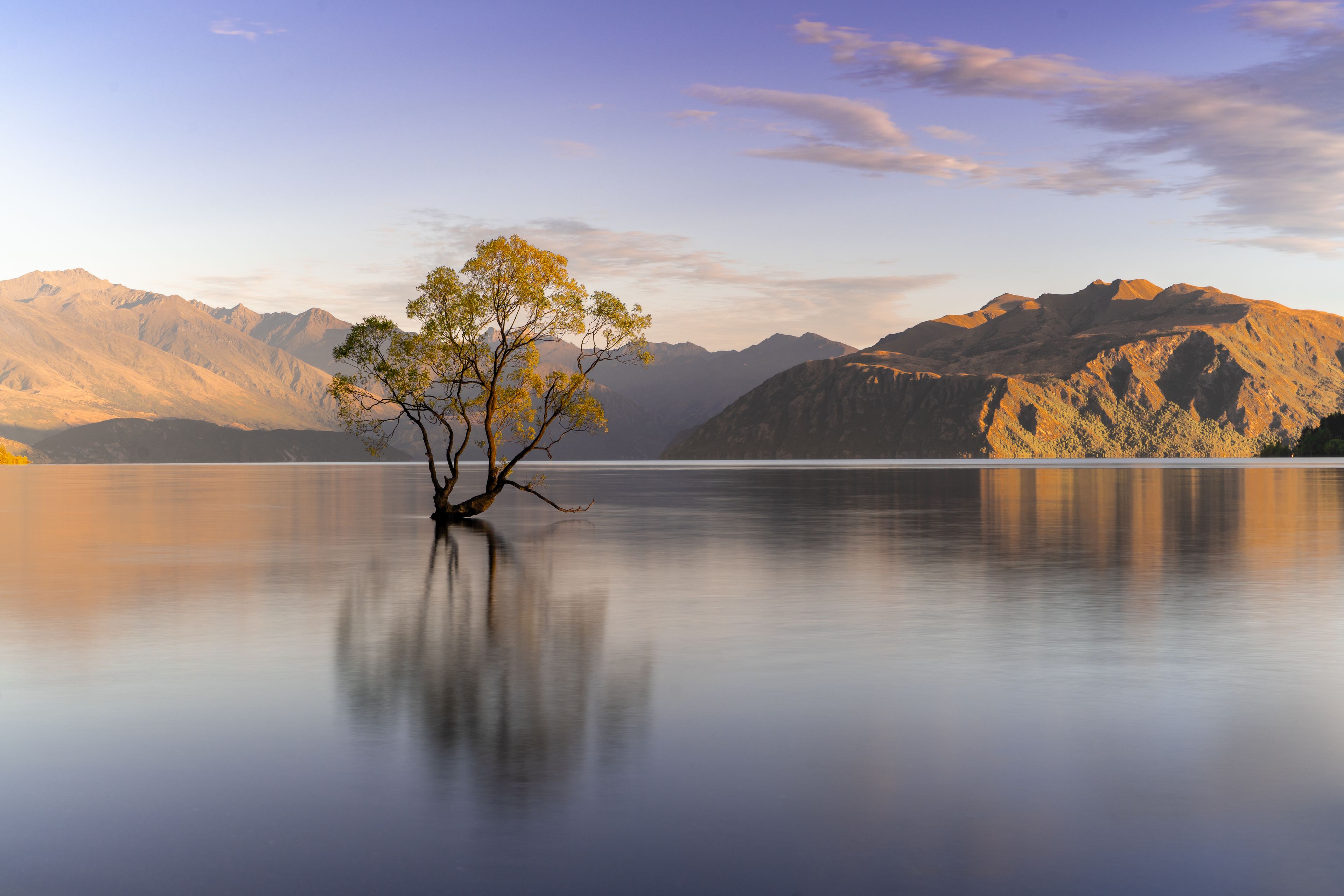
Lake Wanaka
When the lone willow holds its breath before the lake wakes.
Lake Wānaka is a wide, clear bowl of water that keeps the morning quiet for longer than expected.
Unlike many alpine lakes, its shoreline is lived-in and accessible, yet the light can still feel private.
People come for a single tree, then stay because the lake teaches patience in small increments.
The Tree Isn’t the Subject — The Waterline Is
Most visitors aim straight at the willow and forget to watch what Lake Wānaka is doing around it. In the dark-to-grey stretch before sunrise, the lake draws a thin, shifting border along the stones — not quite tide, not quite stillness. When the wind is low, that edge becomes a quiet metronome: a soft push forward, a pause, a retreat that changes the tree’s posture by millimetres. The willow looks different when its trunk is dry versus when the lower bark is darkened by a fresh lap of water. Stand back and listen for the first small sounds: a distant truck on Ardmore Street, a dog collar, the faint scrape of a paddleboard being pulled over gravel. Those sounds arrive before the lake visibly moves. If you’re only photographing the silhouette, you miss the real story: the shoreline making and unmaking the same line, over and over, as day begins.
The Twelve Minutes When the Willow Stops Being a Silhouette
The transformation happens in a narrow window: after the last of blue hour, before the sun clears the ridgeline behind town. For roughly twelve minutes, the willow shifts from a flat cut-out to something with weight. The branches separate into individual strokes. The trunk shows texture. The lake stops reading as black and begins to show its depth. If the morning is calm, the water becomes a sheet with barely a wrinkle, and the reflected tree is almost as legible as the real one — not a perfect mirror, but a soft double. If there’s a light breeze, the reflection breaks into short, horizontal dashes, like handwriting that can’t decide what it wants to say. This is also the moment when the mountains across the water — Treble Cone and the low shoulders beside it — pick up the first pale warmth, while the lake remains cool-toned. Two temperatures of light in the same frame. It feels like the day is arriving carefully, not all at once.
The Reflections
On windless mornings, the willow and the skyline sit on the surface as a faint duplicate, slightly darker than the real thing. When a breeze arrives, the reflection fractures into fine bands, and the tree becomes a suggestion rather than a mirror.
The Water
In early dawn the water reads as slate-blue with a hint of green, shaped by glacial clarity and the shadow of the surrounding ranges. As the sun lifts, the color turns more turquoise near the shallows, where pale stones brighten the lake from below.
The Landscape
The lake is framed by low alpine forms: Roys Peak to the west, Treble Cone across the water, and the town’s shoreline sitting quietly behind the scene. In colder months, a thin mist can cling close to the surface, staying low and horizontal, like someone exhaled and didn’t move.
Best Angles
That Wanaka Tree (Eely Point shoreline)
Stand a few steps back from the waterline and frame with the tree slightly off-center; face east-southeast to hold the pre-sun glow behind the branches.
Eely Point, looking back toward town lights
Turn around and use the lake as negative space; the small line of town lights can sit low on the horizon during early dawn, adding a quiet human trace.
Low angle at the stones (near the tree, not at it)
Crouch near the shoreline to catch the thin band of water sliding over pebbles; let the tree be secondary and make the waterline the real subject.
Bench line along Wanaka Lakeside (away from the cluster)
Walk a few minutes south or north until you can hear less conversation; sit and watch the lake brighten without composing anything.
Crowd pattern — It can be busy even early, but the quietest stretch is typically weekdays in winter, 40 minutes before sunrise through first light; mid-morning often brings walkers and tour groups.
Effort level — Flat, short walking on paved paths and compacted shoreline; expect cold fingers and damp shoes if you step close to the waterline.
Access note — No permits; keep to public paths and respect the lakeside homes nearby. Conditions can be slippery on frosty mornings.
What to bring — A warm layer, gloves, and something to sit on if you plan to wait; a small towel for condensation, and footwear you don’t mind getting wet at the edge.
Handpicked Stays & Tables
Places chosen for beauty and intention, not algorithms. Each one is worth your time.

Edgewater Hotel
Lakeside, Wānaka

Haka House Wanaka
Central Wānaka

Federal Diner
Central Wānaka

Big Fig
Wānaka town centre
Leave before the wind arrives, while the willow still belongs to the water.