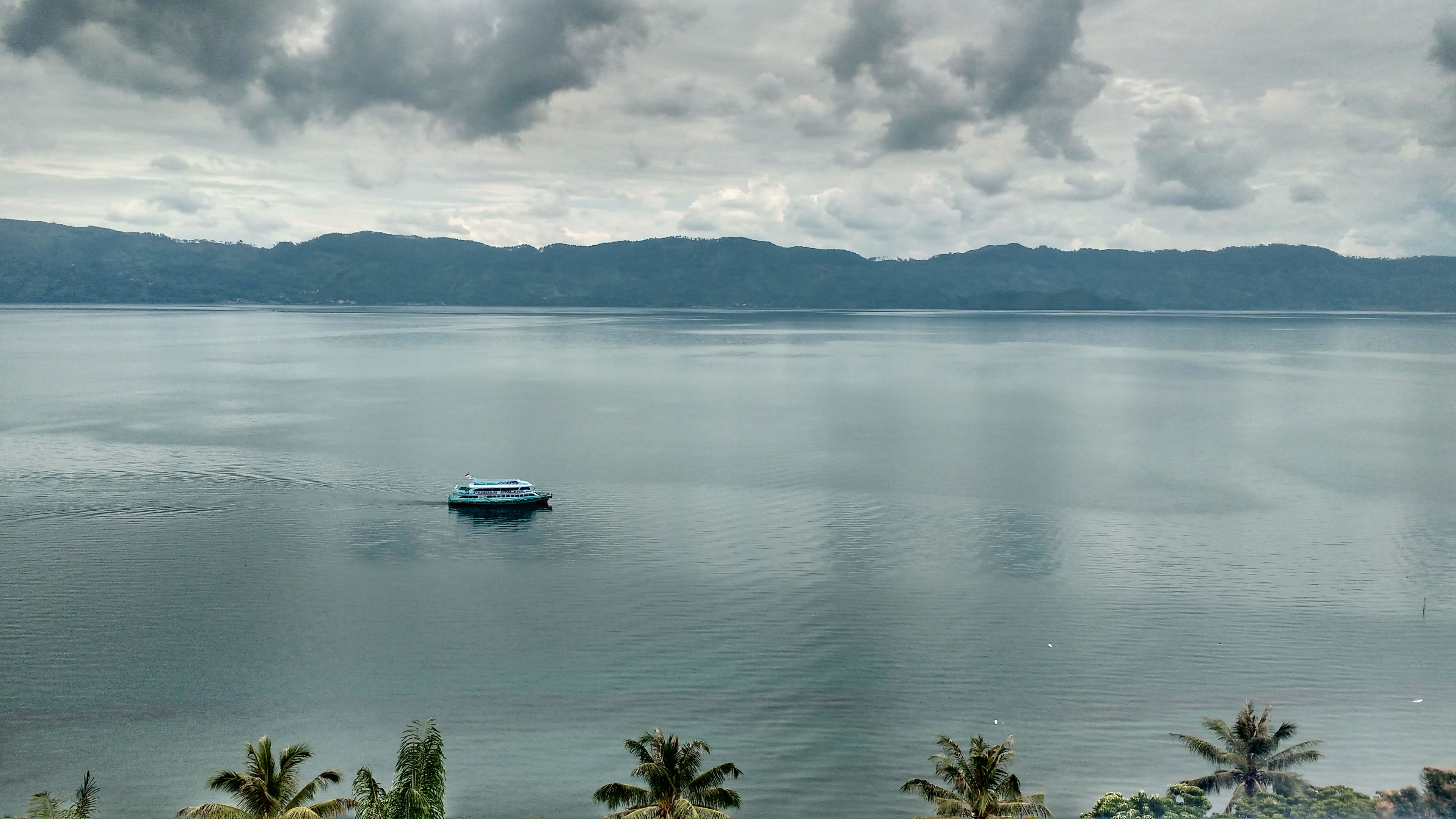
Lake Toba
When the rain lets go, the caldera holds its breath.
Lake Toba is a vast, highland stillness where weather arrives like a curtain.
It isn’t a lake you “see” once; it keeps changing as the caldera light shifts and settles.
Its pull is quiet and physical—the sense that something enormous happened here, and is still happening.
The Shoreline Quiet at Tuk Tuk After the Rain
Most visitors meet Lake Toba in bright, mid-day clarity—boats idling, scooters passing, the water simply blue. What they miss is the half-hour after an afternoon storm when Tuk Tuk’s small bays go almost soundless. The air smells of wet pine and warm earth, and the shoreline stones darken to near-black, as if someone has turned the contrast up. Small drains along the road release thin streams that ribbon into the lake, carrying a faint tea tint that fans out and disappears. Look away from the obvious wide view and watch the near water: ripples cancel each other, then flatten, then return in a new direction as wind reorganizes itself across the caldera. Egrets step out onto the newly rinsed grass. The waterline climbs a few centimeters and leaves a clean, temporary edge on the rocks. It’s not dramatic. It’s Lake Toba becoming intimate—close enough to notice the lake breathing back into stillness.
The First 20 Minutes After the Storm Clears the Ridge
The transformation happens when the last heavy rain slides off the surrounding slopes and the cloud base begins to lift from the rim—often late afternoon, around 4:30–5:30 pm. One minute the lake is a moving sheet of chopped gray, the next it starts to smooth in patches, like fabric being pulled taut. The caldera walls stop looking green and start looking mineral: deep charcoal, softened by steam-like mist rising from warmed land. As the sun reappears low and sideways, it doesn’t brighten the whole lake. It selects. A single corridor of light opens across the surface, and everything outside it turns slate—dense, flat, absorbing. Boats leave thin silver wounds behind them that close almost immediately. The air cools fast after the rain, and you feel the scale of the basin in your chest: a contained weather system, a huge bowl of water deciding what kind of evening it will be. This is the hour when Lake Toba feels most alive, precisely because it is becoming still again.
The Reflections
After rain, reflections appear in fragments first: a dark ridge here, a pale cloud edge there. When the wind drops, the caldera wall becomes a single, clean band on the surface, broken only by a passing boat’s wake.
The Water
The lake turns slate-gray with a faint green cast when clouds thin but the sun stays low, and the surface is still dampened by wind. Near small runoff points it briefly warms into a diluted tea tone, then clears back to cold gray-blue as the inflow disperses.
The Landscape
The scale is all bowl and rim—steep, layered slopes enclosing a wide, inward-looking horizon. Mist hangs mid-height after storms, and the lake feels like it sits under a ceiling that is slowly being raised.
Best Angles
Tuk Tuk peninsula roadside bays (Samosir Island)
Stand low near the stones and face outward toward the caldera wall; frame the dark band of ridge with a narrow strip of near-water texture.
Tele Viewpoint (near Tele, overlooking Toba and Samosir)
Go late afternoon after rainfall; shoot into the clearing sky so the lake reads as slate and the island becomes a quiet silhouette.
Parapat harbor edge at dusk
Most people photograph boats; instead, frame the wake-lines crossing each other as the lake calms—look for the moment the surface starts to seal.
A small jetty in Ambarita or Tomok (Samosir)
Sit at the end and watch the light move across the lake’s skin; the best angle is simply straight down at the water when it turns dark and glassy.
Crowd pattern — Tuk Tuk is calm early mornings and after dinner; midday brings day-trippers and more boat movement, especially around Parapat and Tomok.
Effort level — mostly gentle walking and short rides; viewpoints like Tele involve some driving on winding roads but little hiking.
Access note — ferries run frequently but can slow in rough weather; allow buffer time after storms and near dusk.
What to bring — a light rain layer, something warm for the post-storm cool-down, footwear that handles wet roadside stones, and a cloth for lens/phone humidity.
Handpicked Stays & Tables
Places chosen for beauty and intention, not algorithms. Each one is worth your time.

Toba Village Inn
Tuk Tuk, Samosir Island

Reggae Guest House
Tuk Tuk, Samosir Island

Jenny's Restaurant
Tuk Tuk, Samosir Island

Bagot's (local Batak food)
Tuk Tuk, Samosir Island
When the storm passes, Lake Toba doesn’t brighten—it deepens, and you notice how large quiet can be.