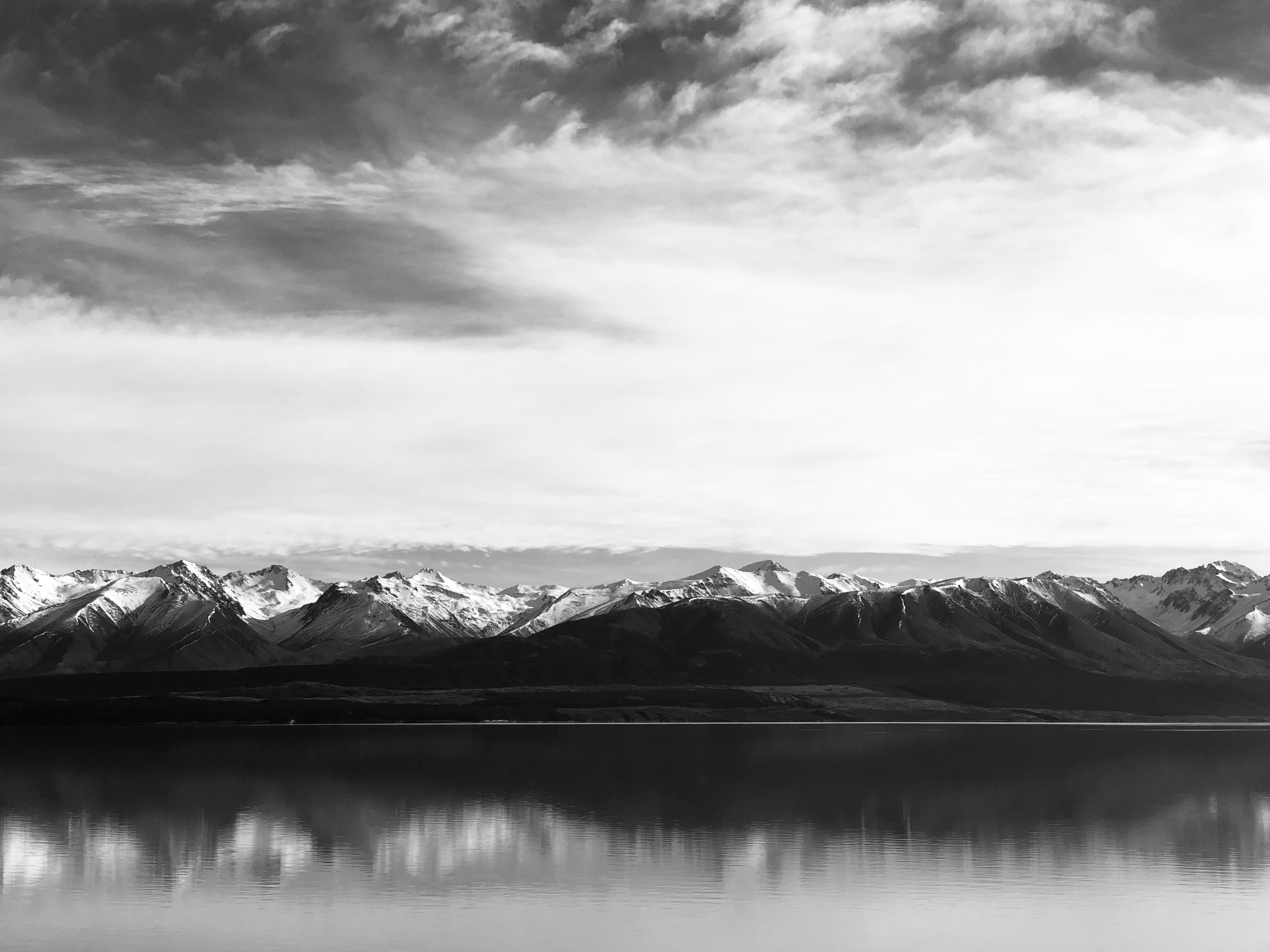
Lake Pukaki
When the turquoise holds its breath and the mountains appear twice.
Lake Pukaki sits wide and patient beneath the Mackenzie sky, always watching the weather arrive.
Its glacial water turns light into color—milk-turquoise by day, then silvered and mirror-clean at dawn.
People come for Aoraki/Mount Cook, but they remember the quiet moment when the lake starts to look back.
The Minutes Before the Lookout Wakes Up
Most visitors meet Lake Pukaki from the roadside lookout on State Highway 8, step out, take the obvious frame, then leave as quickly as they arrived. What they miss is how the lake behaves just before that place becomes a stop. In the half-dark, the shoreline stones lose their detail and the water becomes a single surface rather than a color. The turquoise everyone expects is still there, but it’s muted—more chalk than jewel—because the sun hasn’t yet found the suspended glacial silt. If you stay, you begin to notice smaller movements: a faint line of wind starting mid-lake and traveling toward you, the way the islands and the far shore seem to slide in and out of focus as the air warms, the sudden clarity when a passing car stops and then silence returns. Lake Pukaki isn’t only a viewpoint. It’s a slow reveal, and it asks for five extra minutes most people don’t give it.
The First Ten Minutes of Sun on Aoraki
Lake Pukaki changes fastest at the edge of sunrise—when the sky has color but the land is still undecided. The transformation begins not on the water, but on the peaks: the first direct light catches Aoraki/Mount Cook and the nearby ridgelines, turning them pale gold while the foreground stays cool and blue. For a brief stretch, the lake holds two temperatures at once: cold shadow near your feet, warm light far away. If the night has been calm, the surface becomes a near-perfect mirror and the mountains appear twice, separated by a thin seam of horizon. Then, almost imperceptibly, the wind arrives—often as a soft brush from the valley—and the reflection breaks into long, horizontal textures. This is the moment to watch rather than rush: the lake doesn’t “switch on” like a scene; it loosens, and the day begins to move through it.
The Reflections
On windless mornings, the reflection is clean enough to read the ridge shapes, with only slight rippling that turns peaks into watercolor. When a breeze arrives, it doesn’t shatter the image—it stretches it into layered bands of light and dark.
The Water
The water sits in a glacial turquoise, made opaque by fine rock flour carried from the Tasman Glacier system. At first light it can look subdued and chalky; as the sun lifts, the color brightens and the milky tone becomes more luminous than blue.
The Landscape
The lake is framed by the Mackenzie Basin’s open, tawny land and the distant, white-edged Southern Alps. Aoraki/Mount Cook anchors the far end, and in cold months a low haze can hover near the surface, softening the horizon line.
Best Angles
Lake Pukaki Viewpoint (SH8)
Stand slightly away from the main rail where the ground dips; face south toward Aoraki and keep the horizon low to give the sky room at dawn.
Peter’s Lookout (SH8, north end)
Arrive before sunrise and frame the road as a quiet leading line; the mood here is more solitary, with big sky and less shoreline clutter.
Pukaki Jetty / shoreline near Twizel side access points
Most creators stay high at lookouts; come down to water level to catch small ripples and the color shift close to the stones.
A still cove on the eastern shore (choose a pull-off and walk a few minutes)
Turn away from the mountain postcard and watch the surface itself—light skimming across silted water, the quiet sound of tiny waves arriving one by one.
Crowd pattern — roadside lookouts are busiest mid-morning to late afternoon, and can be briefly busy around tour-bus stops; dawn is usually quiet.
Effort level — minimal walking for classic views; a short, uneven shore walk gives more intimacy and fewer people.
Access note — no standard permit for viewpoints; check NZTA updates for any highway works or winter conditions, and park only in safe, designated areas.
What to bring — a wind layer even in summer, something warm for waiting still, and a cloth for lens/screen (fine spray and dust can arrive with the first breeze).
Handpicked Stays & Tables
Places chosen for beauty and intention, not algorithms. Each one is worth your time.

Peppers Bluewater Resort
Lake Tekapo (about 40–45 minutes away)

Mt Cook Lakeside Retreat
Pukaki / near Lake Pukaki

Poppies Cafe
Twizel

Kohan Restaurant
Lake Tekapo
If you arrive before the day has a voice, Lake Pukaki shows you what silence looks like.