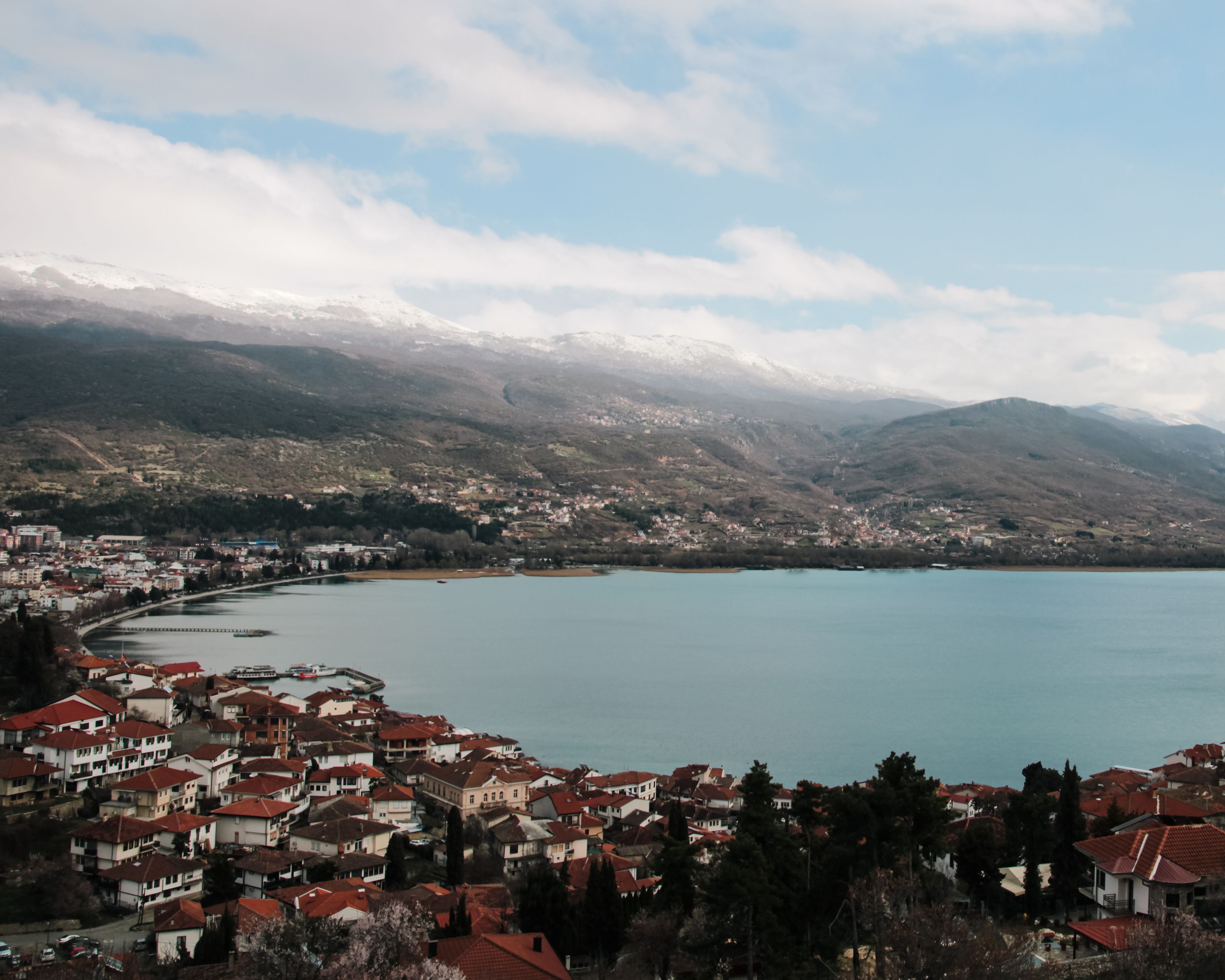
Lake Ohrid
Where the lake breathes through reeds and returns as springs.
Lake Ohrid holds its calm like an old habit, clear and unhurried at the edge of town.
It is not only a lake but a living system—ancient, deep, and quietly fed by unseen water.
You come for the color, and stay for the feeling that something patient is working beneath you.
The Springs Don’t Arrive Like a River
Most visitors treat Saint Naum as a stop: the monastery, the peacocks, a quick boat loop, then back to the road. What they miss is that the place is less a sight than a process. The water doesn’t “enter” the lake in a dramatic line. It seeps, lifts, and gathers in pockets—cold, clean upwellings that make the surface behave differently. Near the reeds the lake goes quiet in a way that isn’t just less noise; it’s less motion. If you stand still, you can feel how the channels decide their own direction, how a thin current slides past your ankles while the wider water looks flat. The reeds do most of the visible work: combing the surface, catching small ripples before they spread, turning wind into a faint shiver. Watch the color where spring water meets lake water—it shifts by degrees, like fabric in shade. This is Ohrid at its most honest: not scenery, but steady exchange.
The Half-Hour After the Last Boat Turns Back
Saint Naum changes when the day’s movement withdraws. Not at sunset exactly, but in the half-hour after the final rental boats stop circling and the engines cut. The air is still warm, yet the water begins to read as cooler—more mineral, more precise. The springs seem to show themselves then, because there’s nothing else writing on the surface. Reeds stop rattling. The channels lose their theatrical wake and return to small, deliberate lines. If you sit low near the wooden edges of the springs, you can hear the place reassemble: insects close to the water, a distant bell, the soft friction of reeds against one another. Across the lake, the mountains darken without drama, and the shoreline lights come on one by one, modest and far apart. The transformation is subtle but complete: the site stops being visited and returns to being a source. You leave with the sense that the lake is being maintained, quietly, all night.
The Reflections
When the wind eases, the springs hold reflections in fragments—reeds, low branches, and the underside of small bridges. Out on the open lake the reflection becomes broader and calmer, turning the opposite shore into a soft mirror line.
The Water
Near Saint Naum, the water reads as pale turquoise over sand and spring-fed shallows, then deepens quickly to blue-green where depth takes over. The clarity comes from cold spring inputs and the lake’s low sediment—light travels farther here before it breaks.
The Landscape
Galicica’s slopes frame the eastern side with a dry, stony presence, while the southern edge feels greener and more sheltered. In the morning, thin mist sometimes sits low over the springs, not as fog, but as a faint whitening of distance.
Best Angles
Wooden footbridges at Saint Naum springs
Stand mid-bridge and frame down the reed channels; keep the horizon out and let the water’s lines lead the image.
Lakeside path just west of the monastery complex
Face east in late afternoon; use the low sun to skim the surface and pick up small texture changes where spring water meets lake water.
The quiet edge behind the main spring area (near the denser reeds)
Most creators stay on the obvious platforms; step back and frame reed silhouettes against the brighter open water for a more private mood.
A bench or low stone by the shoreline at dusk
Sit rather than search; watch the color drain from the shallows first, then notice how the remaining light holds on the deeper water.
Crowd pattern — Midday at Saint Naum is busiest (late morning to afternoon); early morning and the last hour before closing feel noticeably emptier.
Effort level — Mostly flat walking on paths and wooden walkways; expect short stands and slow wandering rather than hiking.
Access note — Parking and small local fees can apply near the Saint Naum area; some walkways may feel narrow when groups pass.
What to bring — A light layer for the cooler spring air near the water, polarizing sunglasses for glare, and shoes with grip for damp boards and edges.
Handpicked Stays & Tables
Places chosen for beauty and intention, not algorithms. Each one is worth your time.

Hotel Tino Saint Naum
Near Saint Naum, on the lake

Villa & Wine House Cebalo
Ohrid old town area

Ostrovo Restaurant
By the springs at Saint Naum

Kaneo Restaurant
Ohrid, near St. John at Kaneo
At Saint Naum, you don’t watch the lake— you watch it being quietly renewed.