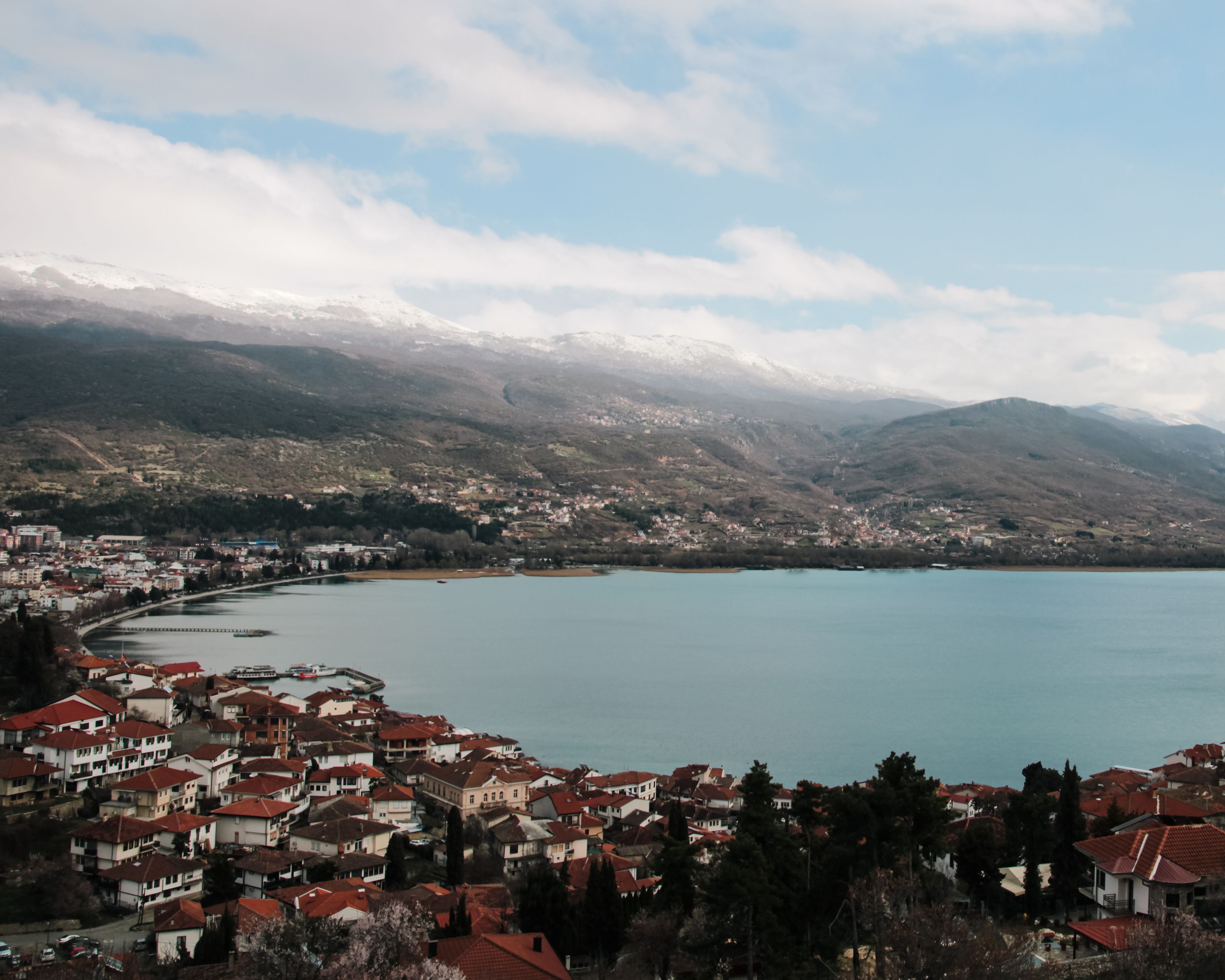
Lake Ohrid
Where the lake exhales, and a river begins without haste.
Lake Ohrid holds its stillness like a habit—deep, clear, and unhurried.
It feels less like a basin and more like a living surface, fed by springs and time.
You come for water and stone, and stay for the quiet certainty of it.
The Outflow Is Not a Sight—It’s a Change of Temperature
Most visitors treat Struga as a crossing point: a place to pass through on the way around the lake. They take a quick look at the Black Drin, photograph the river as proof, then drift back toward cafés and traffic. What gets missed is how the lake’s character shifts in the last few hundred meters before it leaves. Walk the low banks where reeds and grass soften the edge, and pay attention to your skin. Near the outflow, the air cools slightly—even in summer—because the water starts to move with purpose. The lake is no longer only reflecting; it’s choosing a direction. You can hear it too, not as a rush, but as a low, steady murmur under the city sounds, like a sentence spoken in another room. If you stand still long enough, you notice the seam: the lake’s broad, patient breath tightening into a river’s narrow insistence. It’s a small transformation, but it changes how you remember the whole shoreline.
The First Thirty Minutes After Sunset, When the River Becomes Audible
In Struga, the lake doesn’t end with drama—it changes state. The moment arrives just after the sun drops behind the mountains and the waterfront lights begin to appear one by one. Daytime noise thins, and the surface stops glittering. The water turns from a bright object into a dark material. This is when the Black Drin feels most present. In the half-light, the outflow is easier to sense than to see: the lake’s surface seems to tighten, lines of faint current drawing toward the river mouth. The air holds the smell of wet stone and cooling plants. A few last birds pass low, and the small sounds—oars, footsteps on the bridge, a distant clink of cups—sit on top of a deeper, continuous murmur. Stay on the bank without moving the camera for a minute. The transformation is subtle: Lake Ohrid stops performing as scenery and becomes a body of water doing work, leaving calmly, without apology.
The Reflections
In calm weather, the lake near Struga reflects in long, unbroken bands—buildings and trees become soft vertical strokes. At dusk, the reflections shift from crisp to ink-like, and the first streetlights lay thin, trembling lines across the surface.
The Water
Lake Ohrid reads as pale turquoise to cold blue-green in clear light, shaped by its depth and spring-fed clarity. Near the outflow, the color often darkens a shade, not from dirt, but from movement and shadow—water that’s starting to leave doesn’t hold light as long.
The Landscape
The lake is framed by broad, distant mountains, but in Struga the foreground is quieter: low banks, bridges, reeds, and flat stones at the edge. When evening cools arrives, a thin veil of haze can sit above the water, softening the far shore into a gray-blue line.
Best Angles
Bridge over the Black Drin in central Struga
Stand on the upstream side and look back toward the lake; frame the narrowing water with the banks as leading lines. Best at dusk when the river reads as a darker ribbon leaving a wider, quieter surface.
Lakeside path just east of the outflow (reed-lined bank)
Walk 5–10 minutes away from the cafés, then turn back toward the river mouth; keep the reeds in the lower frame and let the horizon sit high. This angle holds the feeling of the lake tightening into motion.
Low stone edge near the outflow where the current first becomes visible
Crouch close to the water and photograph along the surface; the slight diagonal pull of current is what creators usually miss. Use a slower shutter near blue hour to show the lake’s smoothness against the river’s faint texture.
A quiet bench or step down by the bank, away from the main promenade
Sit facing the direction the water leaves. Don’t frame anything—listen for the steady murmur under the city. This is the intimate angle: the lake becoming a river in real time.
Crowd pattern — busiest on summer evenings along the promenade; noticeably quieter early morning year-round and in autumn weekdays.
Effort level — flat, urban walking with short distances; the best experience comes from lingering rather than covering ground.
Access note — no permits needed for the river bridges and public banks; occasional waterfront works or seasonal events can change the easiest path along the promenade.
What to bring — a light layer for dusk near the water, especially outside midsummer; polarizing sunglasses for midday glare; a small towel if you plan to sit on stone edges.
Handpicked Stays & Tables
Places chosen for beauty and intention, not algorithms. Each one is worth your time.

Hotel Drim
Struga, near the Black Drin and lakeside

Villa Chingo
Ohrid, lakeside

Restaurant Drim
Struga, near the river

Kaj Kanevche
Ohrid, by the lake
In Struga, Lake Ohrid doesn’t end—it simply lowers its voice and keeps going.